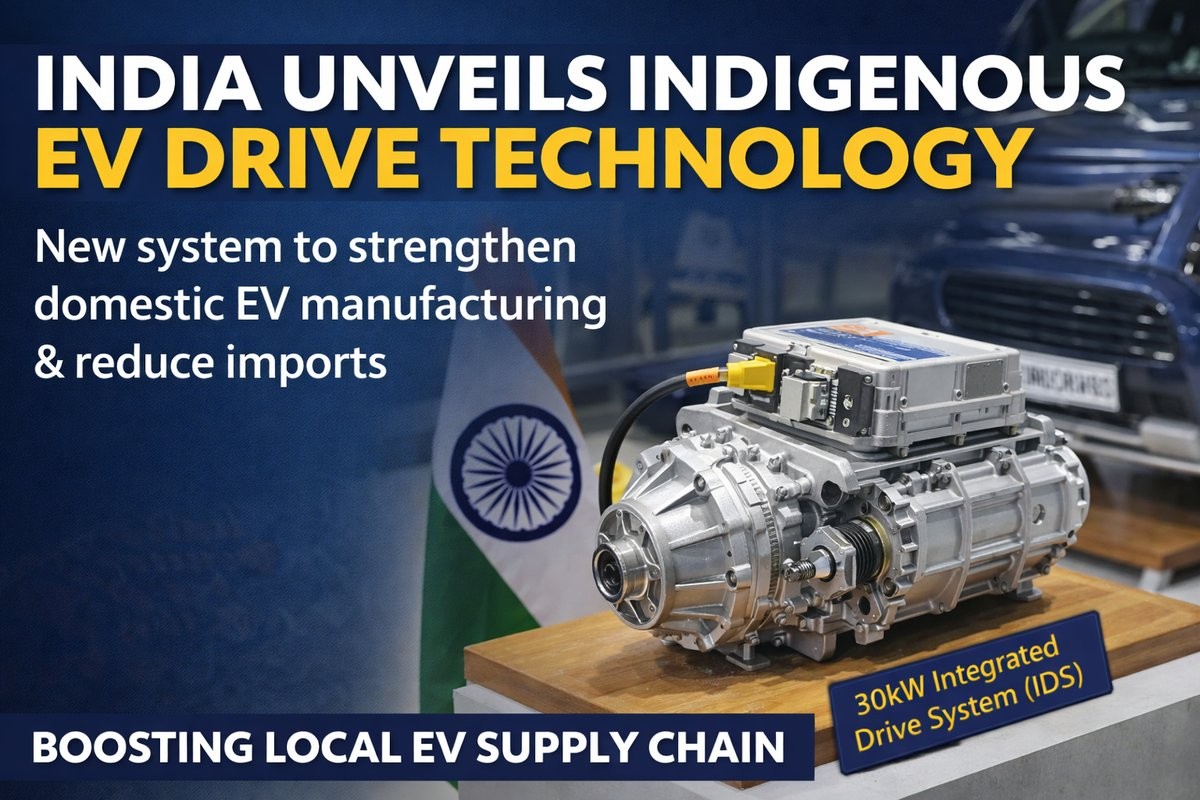
India’s push toward becoming a global hub for electric mobility received a significant boost with the unveiling of a new indigenous electric vehicle drive technology. The government introduced a 30 kW Wide Band Gap (WBG)-based Integrated Drive System (IDS) at the Indian Institute of Technology Madras, marking a crucial milestone in the country’s efforts to strengthen domestic manufacturing capabilities in the EV sector.nnThe advanced drive system has been developed by the Centre for Development of Advanced Computing, Thiruvananthapuram, in collaboration with IIT Madras and automotive component manufacturer Lucas TVS. The project has been carried out under the National Mission on Power Electronics Technology, an initiative supported by the Ministry of Electronics and Information Technology to accelerate innovation in advanced power electronics and semiconductor technologies.nnThe newly developed system is designed specifically for electric passenger vehicles in the 30 kW power category, a segment that represents a large and rapidly expanding portion of India’s EV market. This category includes compact electric cars, urban mobility vehicles, and shared mobility fleets that dominate city transportation across the country.nnOne of the most significant aspects of the technology is its integrated architecture. Traditional electric vehicle powertrains typically use separate units for the motor and inverter. However, the new Integrated Drive System combines these components into a single compact module, improving overall efficiency and power density while reducing space requirements within the vehicle. This design approach enables automakers to build lighter, more efficient EV platforms and simplifies vehicle assembly.nnThe system also utilizes Wide Band Gap semiconductor technology, a modern power electronics solution known for higher efficiency, improved thermal performance, and better energy management compared with conventional silicon-based systems. These advantages can translate into improved vehicle performance, longer driving range, and reduced energy losses in electric vehicles.nnGovernment officials believe that the development of such indigenous technologies will play a critical role in strengthening India’s electric mobility supply chain. Currently, a significant portion of high-performance EV powertrain components and semiconductor devices used in electric vehicles are imported from global suppliers. This dependency not only increases manufacturing costs but also exposes the industry to global supply chain disruptions.nnBy developing domestic solutions like the WBG-based Integrated Drive System, India aims to reduce import dependence and build a self-reliant EV technology ecosystem. The initiative is also aligned with broader national strategies promoting local manufacturing through policy measures such as production-linked incentive schemes for advanced automotive technologies.nnAnother important outcome of the project is its potential to stimulate innovation and entrepreneurship across the EV supply chain. Local manufacturing of drive systems and power electronics components could create new opportunities for startups, small and medium enterprises, and specialized hardware manufacturers involved in semiconductor design, thermal systems, and automotive electronics.nnIndustry experts suggest that such initiatives could significantly enhance India’s competitiveness in the global EV market. As electric mobility continues to grow worldwide, countries that develop strong domestic capabilities in battery technology, semiconductor devices, and power electronics are likely to emerge as major leaders in the sector.nnThe government’s latest announcement signals a clear commitment to accelerating EV adoption while simultaneously building a robust domestic manufacturing ecosystem. With continued collaboration between research institutions, technology organizations, and automotive manufacturers, India is steadily moving toward becoming a major center for electric vehicle innovation and production in the coming decade.