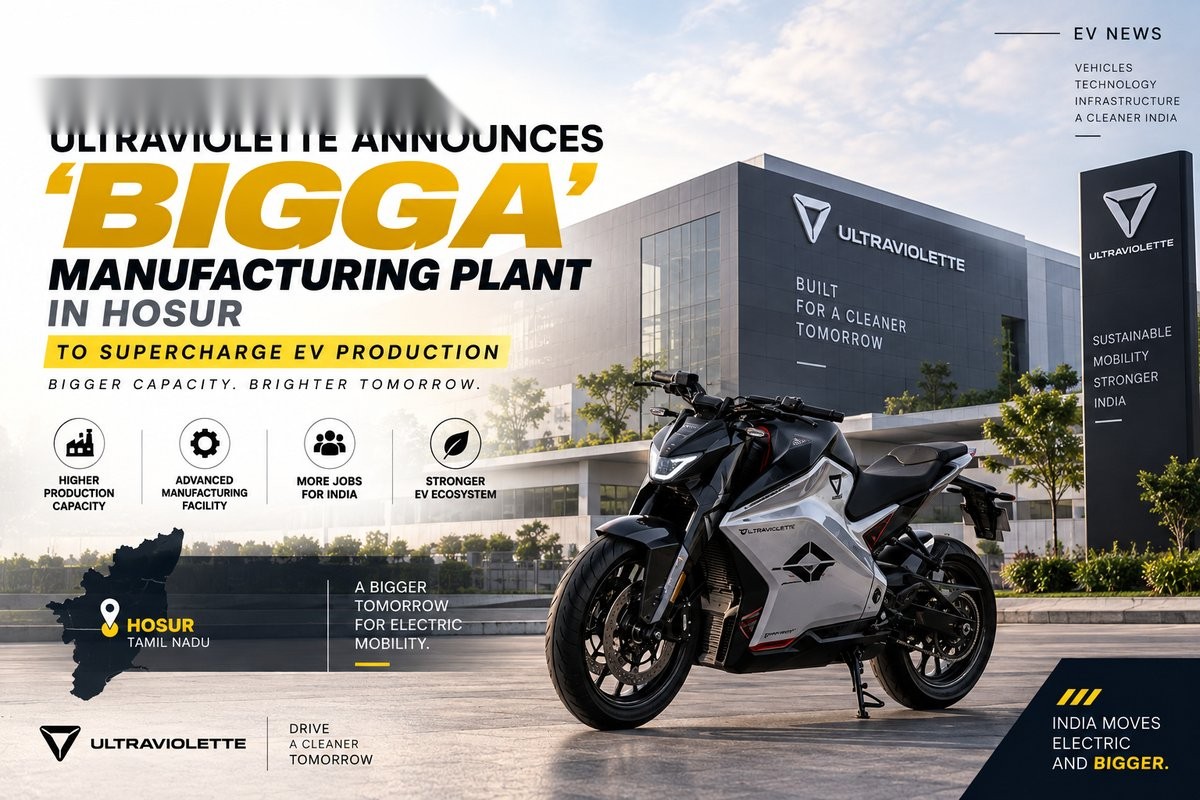
Ultraviolette Automotive has announced plans to build a new manufacturing facility in Hosur, Tamil Nadu, named the BIGGA Factory — short for Big Global Ambition. It’s a genuinely significant move for a company that’s built its reputation almost entirely on premium, performance-focused electric motorcycles sold in relatively modest volumes so far. The new plant is designed for something categorically different: real mass-market scale, built specifically around the company’s upcoming Tesseract electric scooter and a much broader product portfolio still to come.
What’s Actually Been Announced
With that context in mind, here’s what’s concretely been laid out: the BIGGA Factory will come up at the SIPCOT Industrial Park in Shoolagiri, with the Tamil Nadu government facilitating the land allotment. Ultraviolette has said cumulative investment in the facility will total approximately ₹779 crore over the next four to five years, funded through the company’s internal resources and future cash flow.
The Scale: From Boutique to Genuinely Mass-Market
The capacity numbers here are the real story. Phase one of the BIGGA Factory is planned to support production of 250,000 vehicles annually, with the underlying infrastructure designed to scale further to as much as 500,000 vehicles per year, depending on how demand actually develops. According to reporting on the plan, that second phase — the jump toward the full 500,000-unit capacity — isn’t expected until after 2029, giving a rough sense of the timeline Ultraviolette itself is working against.
What Will Actually Be Built There
The BIGGA Factory’s most immediate job will be manufacturing the Tesseract, Ultraviolette’s upcoming electric scooter — itself a genuinely significant departure for a company that’s built its identity almost entirely around performance motorcycles until now. But the facility is being built with a considerably wider brief than just one model. According to the company’s 2027 product roadmap, Ultraviolette plans to expand well beyond its existing F-Series, X-Series, and Shockwave motorcycle lineup, with two entirely new electric scooters scheduled to launch starting Q1 2027. Beyond that, the plant is expected to support the company’s future portfolio across Sports, Crossover, Cruiser, Street, and Scooter segments — a genuinely broad spread for a brand that’s, until now, been fairly narrowly focused on performance bikes.
Why Hosur, Specifically
The choice of location isn’t incidental. Hosur has, over the years, emerged as a genuinely significant automotive manufacturing hub in India, and Ultraviolette is leaning directly into that existing ecosystem rather than building somewhere entirely fresh. Niraj Rajmohan, Ultraviolette’s Co-founder and CTO, specifically pointed to Hosur’s automotive ecosystem and established vendor access as a distinct tactical advantage for the company. The site sits close to Ultraviolette’s existing supplier network and its R&D operations, and its proximity to Bengaluru — where the company’s existing manufacturing facility will continue to operate alongside the new plant — keeps the two sites within reasonable reach of each other rather than fragmenting operations across the country.
What the Company’s Leadership Said
— Narayan Subramaniam, Co-founder & CEO, Ultraviolette
— Niraj Rajmohan, Co-founder & CTO, Ultraviolette
That “inflection point” framing from Subramaniam is a fairly candid admission of what this announcement really represents: an acknowledgment that the company’s early identity — built around technology and performance credibility rather than volume — has essentially done its job, and the next phase requires a genuinely different kind of operational scale to match.
The Manufacturing Approach
The BIGGA Factory is being designed around Industry 4.0 principles rather than a more conventional manufacturing setup. That includes a Manufacturing Execution System (MES) for real-time production tracking and traceability, alongside digital lean manufacturing and digital quality systems. On the automation side, the plant will use collaborative robots for sorting, welding, and assembly work, automated error-proofing systems built into the assembly process, and vision-based inspection systems for quality control. A dedicated test track is also planned for vehicle testing before dispatch — a detail that suggests Ultraviolette is building end-to-end quality control directly into the facility rather than treating it as a separate downstream step.
Jobs and Local Impact
The project is expected to create approximately 2,000 jobs in its initial phase, with the workforce expected to grow further as production scales up over time. For the Hosur-Shoolagiri region, this adds another significant manufacturing project to an area that’s already become an important node in Ultraviolette’s supplier network — though, as with the plant itself, the actual scale and timeline of that local employment impact will depend on how smoothly construction, hiring, and production ramp-up actually proceed.
Who’s Backing This
Ultraviolette’s expansion is being underpinned by a genuinely notable roster of investors, including Lingotto, TDK Ventures, Qualcomm Ventures, Zoho Corporation, TVS Motors, and Speciale Invest. That mix of global venture capital, strategic corporate investment, and a direct stake from an established two-wheeler manufacturer like TVS Motors lends the announcement a fair amount of credibility beyond just the company’s own stated ambitions — though, as one analysis of the plan pointedly put it, the honest question worth asking is whether this represents genuinely ambitious, well-backed growth, or whether it’s at least partly a byproduct of currently buoyant EV sector valuations. Reasonable observers can differ on that, and the coming years of actual execution will likely settle the question either way.
The Broader Market Context
This announcement doesn’t exist in isolation from what’s happening in India’s EV two-wheeler market more broadly. Electric two-wheeler sales in India crossed 10 lakh units in the first eight months of 2026 alone, and industry commentary has specifically pointed to growing concerns over E20 petrol compatibility as one factor pushing more buyers toward electric alternatives. Set against that backdrop, Ultraviolette’s decision to build genuinely mass-market production capacity — rather than staying confined to its original premium motorcycle niche — reads as a fairly direct response to a market that’s expanding faster than any single manufacturer’s existing capacity can comfortably absorb.
Key Numbers at a Glance
| Detail | Figure |
|---|---|
| Total Investment | ~₹779 crore (over 4-5 years) |
| Phase 1 Capacity | 2,50,000 vehicles/year |
| Scalable Capacity | Up to 5,00,000 vehicles/year (post-2029) |
| Initial Jobs Created | ~2,000 |
| Primary Product | Tesseract electric scooter |
| Future Segments Supported | Sports, Crossover, Cruiser, Street, Scooter |
| Location | SIPCOT Industrial Park, Shoolagiri, near Hosur, Tamil Nadu |
| Existing Facility | Bengaluru (continues operating alongside BIGGA) |
What Happens Next
With the announcement now public, the real developments worth watching over the coming months and years are considerably more concrete than the press release itself: finalised land allocation, the actual start of construction, hiring progress toward that 2,000-job initial target, and — most importantly for anyone tracking Ultraviolette as a company — whether the Tesseract itself, whose deliveries have already slipped from their original early-2026 target, actually reaches production volumes that justify a facility built for a quarter-million units a year. A factory announcement is a statement of intent; the numbers that will actually matter are the ones that show up once vehicles start rolling off the line.
EVreporter · YourStory · The Week · EMobility+ · GaadiKey · Urban Acres · iamabiker.com