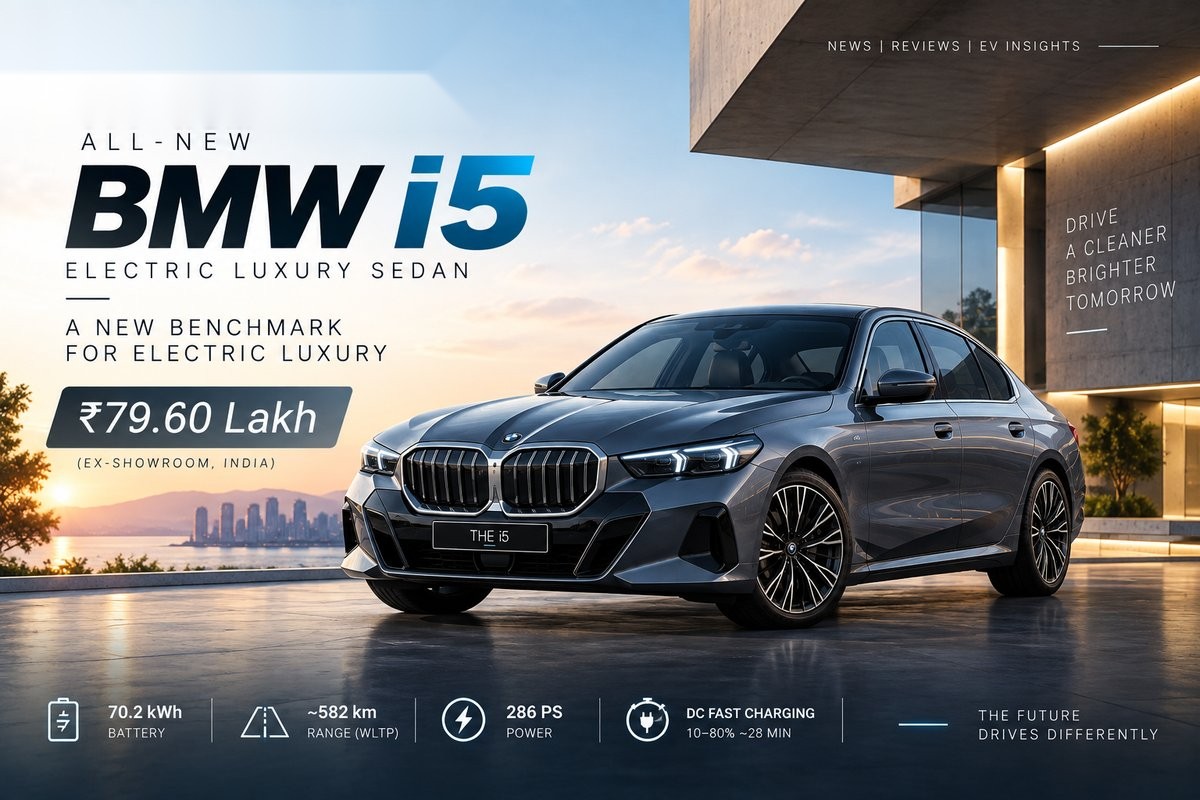
BMW’s i5 Long Wheelbase has been out for barely a week, and it’s already drawn a fair bit of road-test attention — for good reason. It’s the first electric BMW sedan actually built in India, it’s priced to sit almost exactly alongside the petrol-powered 530Li rather than commanding an EV premium, and it promises the kind of rear-seat space Indian luxury buyers have historically demanded from anything wearing a badge like this. Several outlets have now actually spent real time behind the wheel, and their combined impressions give a genuinely useful, warts-and-all picture of what this car is actually like to live with — not just what its spec sheet claims.
Pricing: The Number That’s Doing a Lot of the Talking
At ₹79.60 lakh, ex-showroom, the i5 LWB’s pricing has drawn genuine praise from reviewers, and it’s easy to see why. For comparison, the petrol-powered 530Li — powered by a 2.0-litre turbo engine — starts from ₹76.6 lakh, which means BMW is asking buyers barely ₹3 lakh more to go fully electric, with meaningfully more power and torque thrown in. That’s a genuinely tight gap for a market where EV alternatives have traditionally carried a substantial premium over their combustion counterparts, and reviewers have directly credited local Chennai assembly as the reason BMW’s been able to price it this closely.
It’s also worth knowing where this car sits relative to BMW’s other i5 offering in India. The standard-wheelbase i5 M60 xDrive — a considerably more powerful, dual-motor variant — remains available, but it’s fully imported and currently costs ₹1.20 crore, making the locally-built LWB a full ₹40.40 lakh cheaper. If outright performance is your priority over rear-seat space, the M60 is the one to look at; for most buyers in this segment, though, the LWB’s pricing advantage is difficult to ignore.
Design: Familiar on Purpose
Reviewers have been consistent on this front: there are no real surprises in how the i5 LWB looks, and that’s by design. It carries the classic long-wheelbase 5 Series silhouette, with the only clear giveaways that you’re looking at the electric version being the ‘i’ badge on the grille, larger 20-inch alloy wheels that reviewers note look considerably more proportionate than the smaller wheels initially offered on the 530Li, the i5 and eDrive35L badges at the rear, and — the most obvious tell of all — the green EV number plate.
Interior: Genuinely Impressive Tech, With One Real Trade-Off
Step inside and the general consensus across reviews is overwhelmingly positive on look and feel. The dashboard is dominated by BMW’s twin curved-screen setup, paired with a flat-bottomed steering wheel, generous ambient lighting, and what one reviewer specifically called a tasteful mix of open-pore wood trim and silver inlays. The crystalline drive selector and rotary infotainment controller add what’s been described as a genuine sense of occasion — details that are easy to dismiss on a spec sheet but apparently register clearly once you’re actually sitting in the car.
The 17-speaker Bowers & Wilkins sound system draws specific praise, and reviewers note the four-zone climate control and panoramic glass roof are both present and work well — though at least one reviewer was personally lukewarm on the glass roof itself, even while acknowledging that buyers in this segment tend to like it.
Performance: Quick, Even If the Claimed Numbers Are Slightly Optimistic
The i5 eDrive35L runs a single rear-mounted motor producing 272PS (268-272hp depending on source rounding) and 410Nm — figures reviewers point out make it marginally more potent than the equivalent 530Li M Sport, which manages 258PS and 400Nm. BMW’s official claim for the 0-100km/h sprint is 6.7 seconds, but Autocar India’s own test run came in slightly behind that, at 6.99 seconds — a small but honest gap between the claimed figure and what an actual timed run produced, and a useful reminder that manufacturer-claimed acceleration numbers are usually best-case scenarios rather than guaranteed outcomes.
On the driving character itself, reviewers who’ve spent proper time behind the wheel came away genuinely impressed. One reviewer, testing the car in and around Pune across varied conditions, described the steering as light but capable of weighing up depending on the selected drive mode, with minimal body roll and enough confidence-inspiring directness to genuinely enjoy pointing the car into corners — a notable observation for a car this long and this heavy. Braking performance also drew specific praise as a genuine strength.
Ride Quality: The Air Suspension Does Real Work
This is where the i5 LWB seems to have won reviewers over most convincingly. Despite riding on 20-inch wheels with correspondingly low-profile tyres, ride quality has been described as seriously impressive, with the air suspension doing enough to make reviewers essentially forget they’re on wheels that large. One reviewer summed it up as striking the right balance between composure and comfort — settled and relaxed when you want it to be, but capable of being “unleashed” for a genuinely sporty drive without complaint.
The Honest Downside: Ground Clearance on Indian Roads
Range: A Meaningful Gap Between Claimed and Real-World
BMW’s official MIDC-tested claim for the i5 LWB is up to 669km, but it’s worth being clear about what independent real-world testing actually found. Autocar India’s own range test returned an average efficiency of 5.06km/kWh, translating to an estimated real-world range of around 386km — tested specifically in the car’s most efficiency-focused ‘Efficient’ drive mode, with regenerative braking set to Adaptive. That’s a genuinely large gap from the claimed figure, and worth internalising before assuming you’ll see anything close to 669km in typical daily use, especially if you drive with any enthusiasm rather than purely for efficiency.
On charging, the same test connected the car to a 60kW DC fast charger and recorded a 20-80 percent charge time of 47 minutes — slower than BMW’s own claimed 33-minute figure for a 10-80 percent charge on a full 160kW charger, though the discrepancy is at least partly explained by the lower-power charger used in that particular test rather than necessarily reflecting a shortfall in the car itself. BMW also includes a complimentary AC wallbox charger with installation, a genuinely useful inclusion for home charging.
Space: Where the “Long Wheelbase” Promise Gets Complicated
Given that rear-seat space is really the entire point of choosing the LWB over the standard-wheelbase i5, it’s worth flagging that not every review has been uniformly glowing here. One expert review of the broader i5 range separately noted that rear seat space “isn’t great” on some variants, with the rear seat base sitting too low and a large central tunnel making the middle seat nearly unusable — a criticism that predates this specific LWB launch but is worth keeping in mind given it points to a structural characteristic of the platform rather than something the LWB update necessarily fixes outright. Buyers who specifically prioritise three-across rear seating, in particular, should test that configuration directly rather than assuming the “L” in the name solves every space concern.
The Verdict, By Category
What Reviewers Liked
- Genuinely aggressive, near-parity pricing against the petrol 530Li
- Ride quality that belies its 20-inch wheels
- Confident, composed handling despite the car’s size and weight
- Strong braking performance
- Premium, tech-forward cabin with a genuine sense of occasion
- Complimentary wallbox charger included
What Reviewers Flagged
- Ground clearance still catches out on aggressive speed breakers, even with the extra 18mm
- Real-world range (~386km tested) falls well short of the claimed 669km figure
- Raised floor from the battery pack is noticeable versus the ICE 5 Series
- Rear middle seat and seat-base height remain a compromise on some variants
- 0-100km/h slightly behind BMW’s own claimed time in testing
Full Spec Sheet
| Specification | Detail |
|---|---|
| Motor | Single, rear-mounted |
| Power / Torque | 272PS / 410Nm |
| 0-100 km/h (Claimed / Tested) | 6.7 sec (claimed) / 6.99 sec (Autocar test) |
| Battery | 81.6 kWh |
| Claimed Range (MIDC) | Up to 669 km |
| Tested Real-World Range | ~386 km (5.06 km/kWh, Efficient mode) |
| DC Fast Charging | 160 kW (claimed); 60kW test charger took 47 min for 20-80% |
| Ground Clearance | +18mm over international-spec version |
| Wheels | 20-inch alloys |
| Weight Distribution | 50:50, RWD |
| Price (Ex-Showroom) | ₹79.60 lakh |
The Bottom Line
The i5 LWB is a genuinely accomplished car, and the reviewers who’ve actually driven it seem to agree on the big picture: BMW has built something that’s quick, composed, plush, and — thanks to local assembly — priced close enough to the petrol 530Li that choosing electric no longer feels like a financial sacrifice. But this isn’t a review that glosses over the rough edges either. Ground clearance remains a genuine, repeatedly-flagged concern on Indian roads despite BMW’s efforts to address it, and the real-world range gap between BMW’s 669km claim and the roughly 386km actually achieved in testing is large enough that prospective buyers should plan their expectations around the lower figure, not the marketing one. For buyers who prioritise rear-seat comfort, composed handling, and genuine EV performance over ultimate range or worst-case ground clearance, the i5 LWB makes a strong, honestly-earned case for itself — just go in with clear eyes about where its real-world numbers actually land.
Autocar India · RushLane · Turbocharged · CarWale · V3Cars