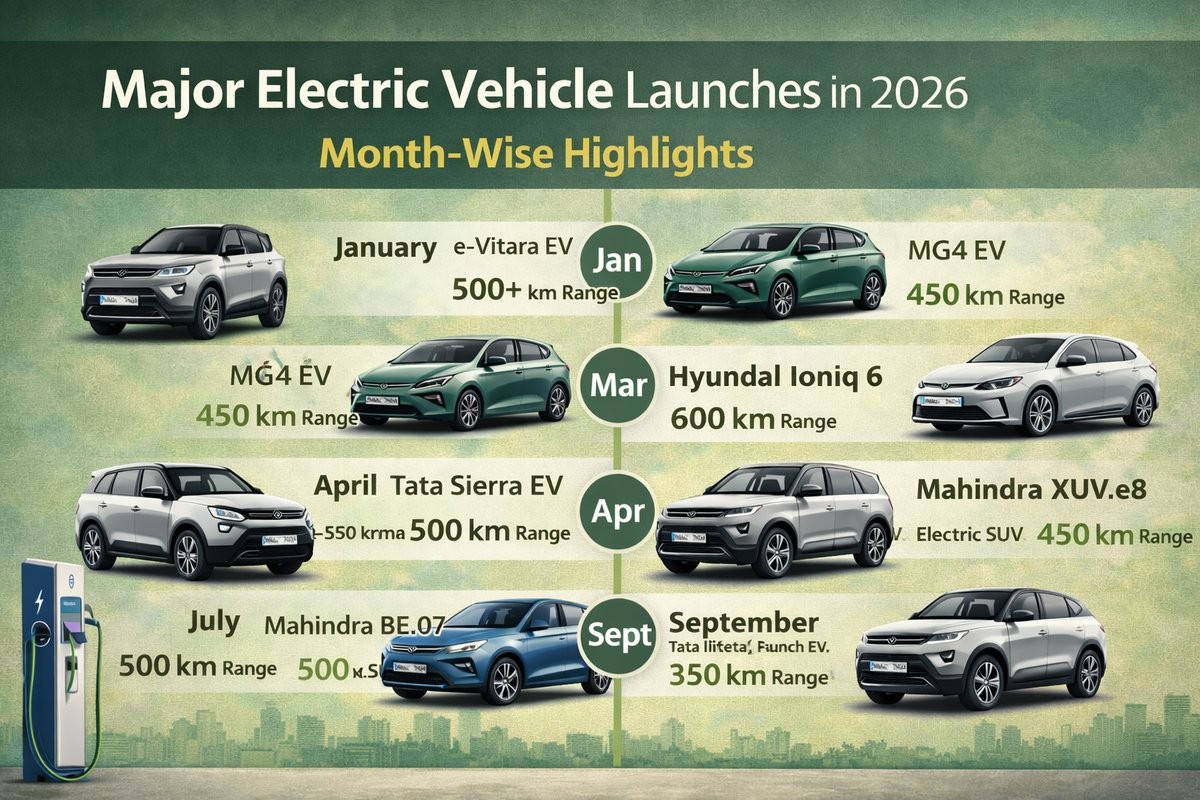
nThe electric vehicle revolution in India is gaining strong momentum in 2026 as major automotive manufacturers prepare to introduce a wide range of electric models across different segments. With advancements in battery technology, improved driving ranges, and the rapid expansion of charging infrastructure, electric vehicles are becoming an increasingly practical option for everyday mobility.n
nn
nAutomakers are now focusing on dedicated EV platforms that are designed specifically for electric vehicles rather than adapting traditional petrol or diesel platforms. These new architectures allow manufacturers to improve battery placement, increase interior space, and deliver better performance and efficiency.n
nn
Month-Wise EV Launch Timeline for 2026
nnn
| Month | EV Model | Manufacturer | Segment | Expected Range |
|---|---|---|---|---|
| January | e-Vitara EV | Maruti Suzuki | Electric SUV | 500+ km |
| February | MG4 EV | MG Motor | Electric Hatchback | 450 km |
| March | Hyundai Ioniq 6 | Hyundai | Electric Sedan | 600 km |
| April | Tata Sierra EV | Tata Motors | Electric SUV | 500 km |
| May | Mahindra XUV.e8 | Mahindra | Electric SUV | 450 km |
| July | Mahindra BE.07 | Mahindra | Electric SUV | 500 km |
| September | Tata Punch EV Facelift | Tata Motors | Compact EV | 350 km |
| October | Tata Avinya EV | Tata Motors | Premium EV | 600 km |
n
nn
Growing Competition in the EV Market
nn
nThe Indian electric vehicle market is becoming increasingly competitive as both domestic and international manufacturers accelerate their EV strategies. Companies like Tata Motors and Mahindra are expanding their electric portfolios rapidly, while global brands such as Hyundai and MG Motor are introducing internationally successful electric models to the Indian market.n
nn
nElectric SUVs are expected to dominate the upcoming EV launches because Indian buyers increasingly prefer SUVs that offer higher seating positions, larger cabin space, and longer driving ranges. Meanwhile, compact EVs and hatchbacks will continue to attract urban consumers who want efficient and affordable electric mobility.n
nn
Technology Advancements in New EVs
nn
nModern electric vehicles launching in 2026 will feature advanced technologies such as Level-2 ADAS safety systems, large touchscreen infotainment systems, connected car technology, and over-the-air software updates. These features enhance convenience, improve safety, and allow vehicles to receive software improvements even after purchase.n
nn
nBattery technology is also improving rapidly, enabling faster charging times and longer battery life. Many upcoming EVs will support ultra-fast DC charging, allowing drivers to charge their vehicles up to 80 percent in under 30 minutes.n
nn
The Future of Electric Mobility in India
nn
nGovernment initiatives including EV subsidies, production-linked incentive (PLI) schemes, and investments in domestic battery manufacturing are helping build a strong foundation for electric mobility in India. Charging networks are expanding quickly along highways and within cities, making long-distance EV travel easier than ever before.n
nn
nAs more manufacturers launch new electric vehicles and technology continues to improve, EV adoption in India is expected to grow significantly over the next decade. By the end of the 2020s, electric vehicles could account for a substantial portion of total vehicle sales, transforming the country’s transportation landscape and reducing dependence on fossil fuels.n