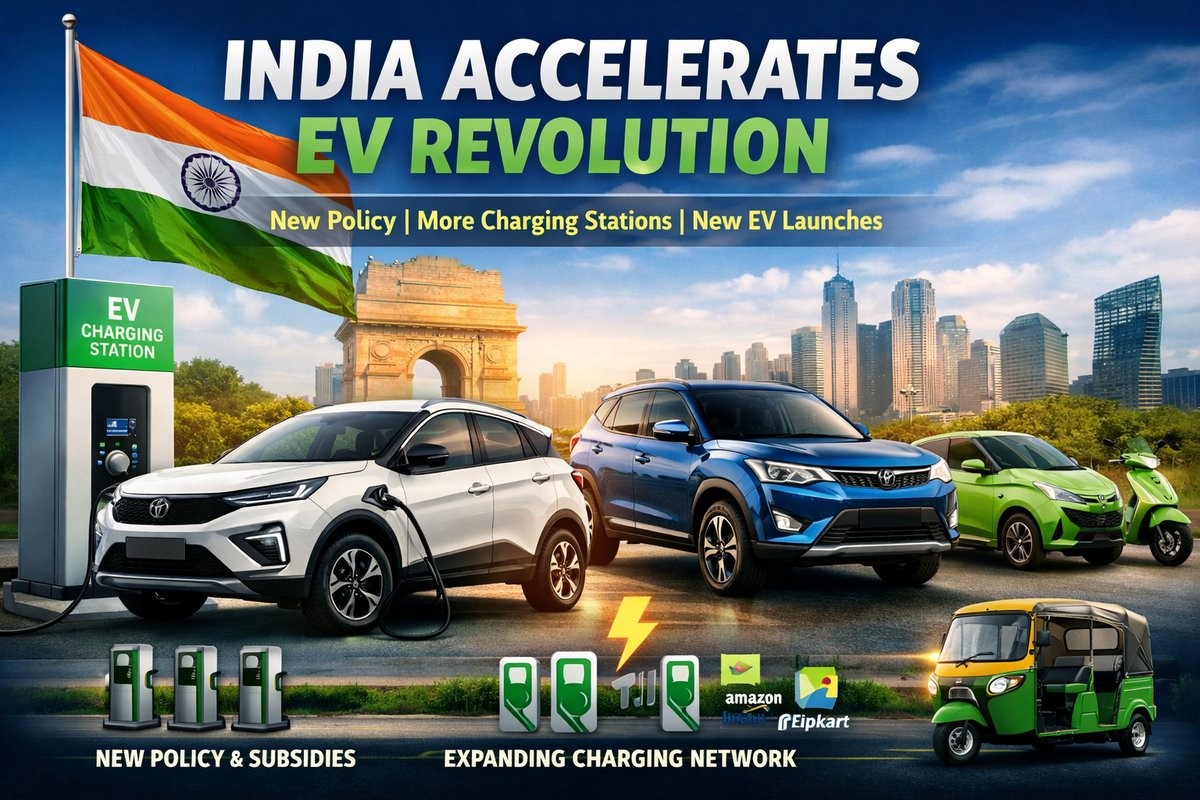
India’s electric vehicle (EV) ecosystem witnessed a major boost today as a combination of government policy announcements, new vehicle launches, and infrastructure expansion signaled a decisive shift toward electrification. Leading automobile manufacturers and policymakers aligned their strategies to strengthen India’s position as one of the fastest-growing EV markets in the world.
nn
Government Announces New Incentives Under Updated EV Policy
nn
The Government of India unveiled an updated framework under its ongoing EV mission, aimed at accelerating adoption across both urban and rural areas. Officials confirmed that the revised policy will include enhanced subsidies for electric two-wheelers and four-wheelers, along with incentives for domestic battery manufacturing.
nn
The policy update builds upon previous initiatives like FAME-II and focuses on long-term sustainability, local manufacturing, and reducing dependence on imported components. According to officials, the new scheme will prioritize affordability and accessibility, especially for middle-income buyers.
nn
Key highlights include:
n
- n
- Increased subsidies for electric two-wheelers
- Tax benefits for EV buyers
- Incentives for battery recycling infrastructure
- Support for indigenous battery production
n
n
n
n
nn
The government also emphasized the importance of building a circular economy for EV batteries, ensuring proper recycling and reuse mechanisms are in place.
nn
Major Automakers Announce New Electric Vehicle Launches
nn
Several major automobile companies made headlines today by unveiling their latest EV models for the Indian market. These launches cater to a wide range of consumers, from budget buyers to premium segment customers.
nn
Tata Motors announced an updated version of its popular electric SUV lineup, featuring improved battery range and enhanced safety features. The company stated that its focus remains on affordability and mass adoption.
nn
Mahindra Electric introduced a new compact electric SUV designed specifically for Indian roads. The vehicle is expected to offer a range of over 400 kilometers on a single charge, making it suitable for both city and highway use.
nn
Hyundai and Kia also showcased their upcoming EV models, highlighting advanced features such as fast charging, connected car technology, and AI-based driving assistance systems.
nn
Industry experts believe that the increasing competition among automakers will lead to better pricing and more choices for consumers.
nn
Charging Infrastructure Expansion Gains Momentum
nn
One of the biggest challenges in EV adoption has been charging infrastructure. However, today’s developments indicate significant progress in this area. Several energy companies and startups announced plans to expand charging networks across major highways and urban centers.
nn
The Ministry of Power confirmed that over 10,000 new charging stations will be installed across the country in the next 12 months. This includes:
nn
- n
- Fast-charging stations on national highways
- Charging hubs in metro cities
- Public-private partnerships for rural deployment
n
n
n
nn
Private players are also entering the market aggressively, offering innovative solutions such as battery swapping and mobile charging units.
nn
Experts suggest that improved infrastructure will address “range anxiety,” one of the primary concerns among potential EV buyers.
nn
Battery Technology Sees Breakthrough Advancements
nn
Battery technology remains at the core of EV innovation, and today’s news included significant developments in this area. Several companies announced advancements in lithium-ion and solid-state battery technologies.
nn
Indian startups are also making strides in developing cost-effective and high-performance batteries. These innovations are expected to:
nn
- n
- Increase vehicle range
- Reduce charging time
- Lower overall vehicle cost
n
n
n
nn
In addition, research institutions are collaborating with industry players to create next-generation battery solutions tailored for Indian conditions.
nn
Rise of Electric Two-Wheelers and Three-Wheelers
nn
While electric cars often dominate headlines, the real growth in India’s EV market is being driven by two-wheelers and three-wheelers. Today’s reports highlight a surge in demand for electric scooters and auto-rickshaws.
nn
Companies like Ola Electric, Ather Energy, and TVS Motor Company are expanding their portfolios to meet rising demand. Affordable pricing, low running costs, and government incentives have made electric two-wheelers an attractive option for daily commuters.
nn
Similarly, electric three-wheelers are gaining popularity in the commercial segment, particularly for last-mile delivery and passenger transport.
nn
Corporate Adoption of EV Fleets Increases
nn
Another major trend highlighted in today’s news is the growing adoption of EV fleets by corporate companies. E-commerce giants and logistics providers are transitioning to electric vehicles to reduce operational costs and carbon emissions.
nn
Companies such as Amazon India and Flipkart have committed to electrifying a significant portion of their delivery fleets by 2030. Today, both companies announced additional partnerships with EV manufacturers to accelerate this transition.
nn
This shift is expected to create a ripple effect across industries, encouraging more businesses to adopt sustainable transportation solutions.
nn
Environmental Impact and Sustainability Goals
nn
The push toward electric mobility is closely tied to India’s environmental goals. The government aims to reduce carbon emissions and improve air quality in major cities.
nn
According to recent data, the transportation sector accounts for a significant portion of India’s greenhouse gas emissions. Transitioning to electric vehicles is seen as a critical step toward achieving climate targets.
nn
Experts note that while EVs are not a complete solution, they play a crucial role in reducing urban pollution and dependence on fossil fuels.
nn
Challenges Still Remain
nn
Despite the positive developments, several challenges continue to hinder widespread EV adoption in India:
nn
- n
- High initial cost of electric vehicles
- Limited charging infrastructure in rural areas
- Dependence on imported battery components
- Lack of awareness among consumers
n
n
n
n
nn
Industry leaders stress the importance of addressing these challenges through policy support, technological innovation, and public awareness campaigns.
nn
Future Outlook for India’s EV Market
nn
The developments announced today indicate a strong and promising future for India’s EV industry. Analysts predict that EV adoption will continue to grow rapidly over the next decade, driven by:
nn
- n
- Government support and policy incentives
- Technological advancements
- Increasing consumer awareness
- Expansion of charging infrastructure
n
n
n
n
nn
By 2030, electric vehicles are expected to account for a significant share of India’s automobile market, particularly in the two-wheeler and commercial vehicle segments.
nn
Automakers are also investing heavily in research and development to stay competitive in this evolving landscape. The focus is on improving battery efficiency, reducing costs, and enhancing user experience.
nnn
Today’s developments mark a significant milestone in India’s journey toward electric mobility. With strong government support, increasing industry participation, and growing consumer interest, the EV revolution in India is gaining momentum.
nn
While challenges remain, the collective efforts of policymakers, manufacturers, and consumers are paving the way for a cleaner and more sustainable future. As the country continues to embrace electric vehicles, it is poised to become a global leader in the EV space.
nn
The coming years will be crucial in determining how effectively India can scale its EV ecosystem and achieve its ambitious sustainability goals. For now, the momentum is undeniable, and the future of mobility in India looks increasingly electric.