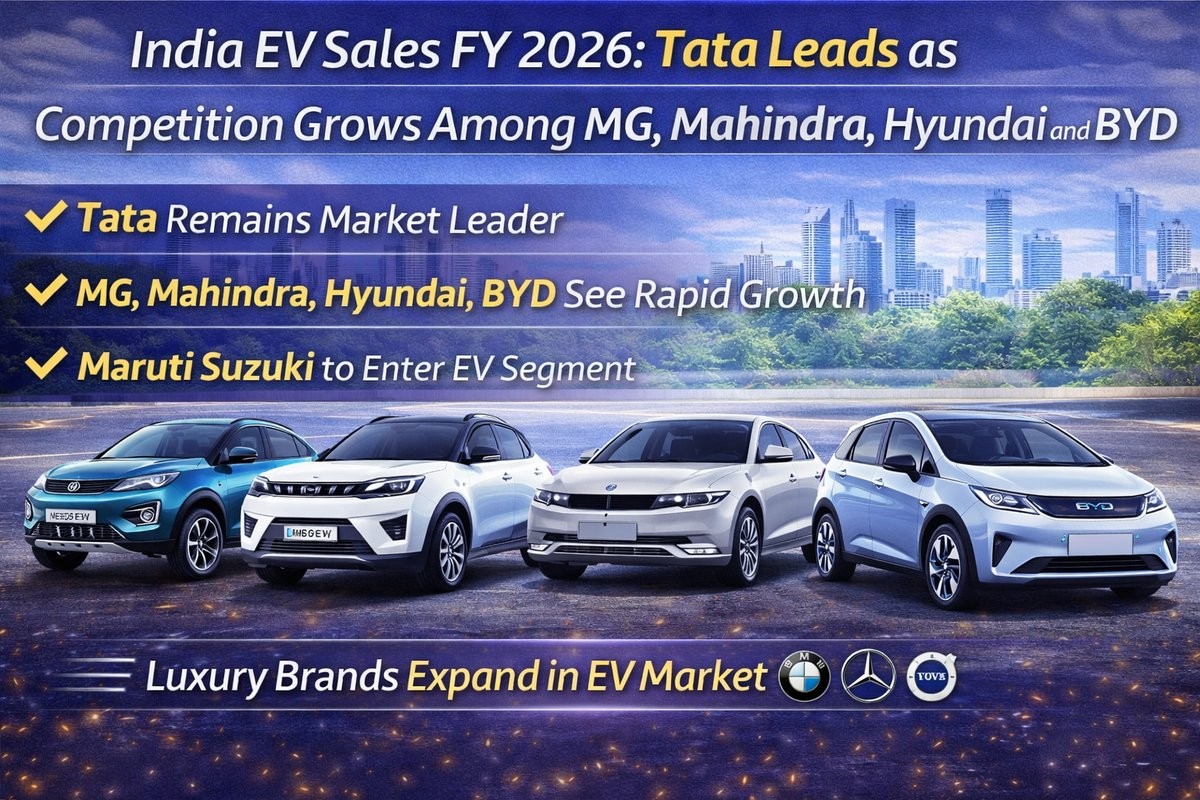
India’s electric car market has recorded strong growth in FY 2026, with multiple automakers expanding their presence and increasing sales. The latest sales data highlights the rapid adoption of electric vehicles across the country, driven by better infrastructure, government support, and rising consumer awareness.
nn
The EV segment is becoming highly competitive, with both domestic and global manufacturers strengthening their portfolios to capture a larger share of the growing market.
nn
Tata Motors Continues to Dominate
nn
Tata Motors has maintained its leadership position in the Indian electric car market. With popular models like the Nexon EV, Tiago EV, and Tigor EV, the company continues to attract a wide range of customers.
nn
The brand’s focus on affordability, reliability, and strong service network has played a key role in its dominance.
nn
MG and Mahindra Show Strong Performance
nn
MG Motor has recorded steady growth with its ZS EV and Comet EV models. The company’s focus on premium features and global technology has helped it build a strong customer base.
nn
Mahindra is also gaining momentum with its expanding EV lineup. The company is focusing on launching new electric SUVs and strengthening its presence in the premium segment.
nn
Hyundai, BYD and Global Brands Expand Presence
nn
Hyundai continues to perform well in the premium EV segment with models like the Ioniq 5. The company is also preparing to launch more affordable electric vehicles in India.
nn
BYD has shown significant growth, especially with its advanced battery technology and long-range electric cars. The brand is gradually expanding its footprint in the Indian market.
nn
Other global brands like Kia, BMW, Mercedes-Benz, and Volvo are also increasing their EV offerings, focusing on luxury and high-performance segments.
nn
Maruti Suzuki Enters EV Segment
nn
Maruti Suzuki has started its journey in the electric vehicle segment, marking a major shift in India’s largest car manufacturer’s strategy.
nn
The company is expected to launch new electric models in the coming years, which could significantly impact the mass-market EV segment.
nn
Segment Growth Driven by Multiple Factors
nn
The strong growth in EV sales is driven by several key factors:
nn
- n
- Rising fuel prices
- Government subsidies and incentives
- Improved charging infrastructure
- Growing environmental awareness
n
n
n
n
nn
Consumers are increasingly considering electric vehicles as a practical and cost-effective alternative to traditional fuel-powered cars.
nn
Charging Infrastructure Expanding
nn
The expansion of charging infrastructure across cities and highways has played a major role in boosting EV adoption.
nn
Both government and private companies are investing heavily in setting up fast-charging stations, reducing range anxiety among users.
nn
Challenges in the EV Market
nn
Despite strong growth, the EV market still faces certain challenges:
nn
- n
- High upfront cost of vehicles
- Limited charging infrastructure in rural areas
- Battery cost and replacement concerns
n
n
n
nn
Addressing these challenges will be crucial for achieving mass adoption.
nn
Future Outlook
nn
The future of India’s EV market looks promising, with strong growth expected in the coming years. More affordable models, better technology, and improved infrastructure will continue to drive adoption.
nn
Industry experts believe that electric vehicles will become a major part of India’s automotive market by the end of the decade.
nnn
FY 2026 has been a significant year for India’s electric vehicle market. With strong sales growth and increasing competition, the EV segment is evolving rapidly.
nn
As more companies enter the market and technology improves, consumers will have better options, making electric mobility the future of transportation in India.