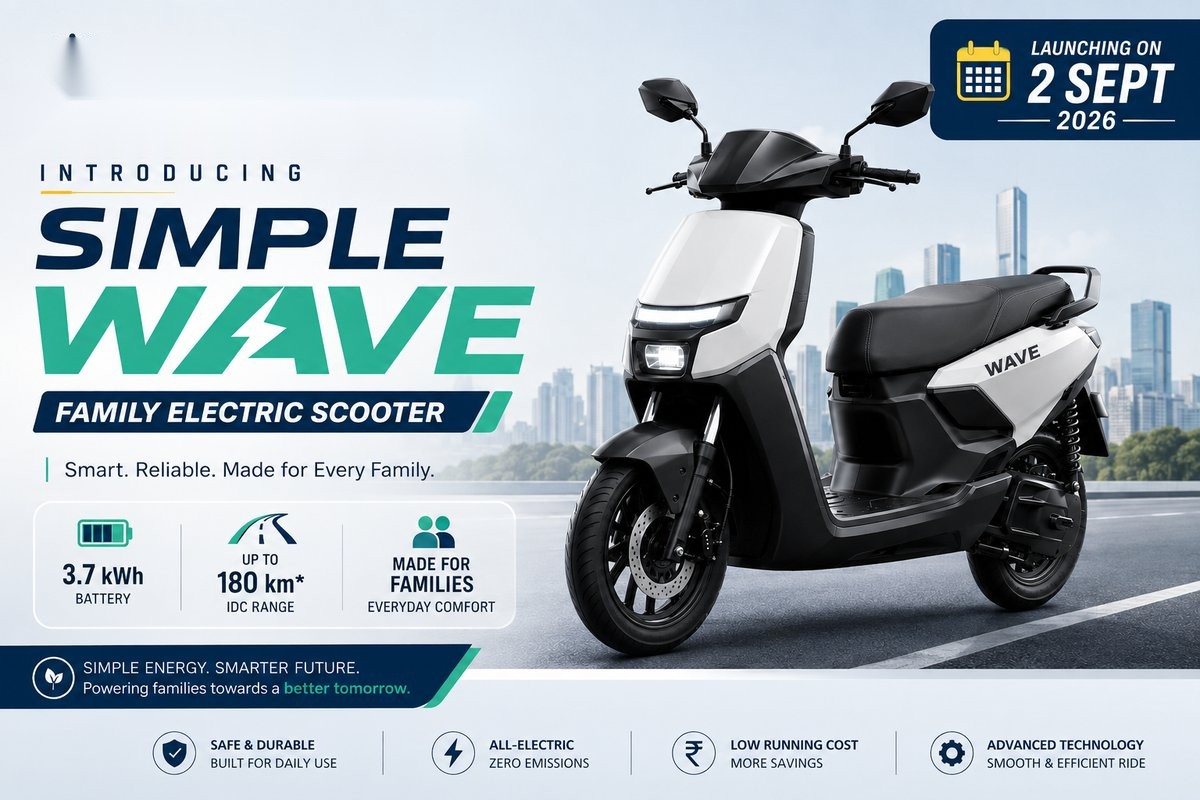
Formerly codenamed ‘Arrive’, the Wave marks Simple Energy’s pivot from performance scooters to practical, family-focused commuting — with an estimated 180–200 km range under ₹1.5 lakh.
Bengaluru-based Simple Energy is set to launch its first family-oriented electric scooter on 2 September 2026. Officially named the Simple Wave, the model was previously known internally as ‘Arrive’ and represents a deliberate shift away from the performance-first identity of the Simple One series, aiming instead at practical daily commuting for buyers in tier-2 and tier-3 cities.
Design & Ergonomics
Unlike the sharp, aggressive styling of the Simple One and One S, the Wave adopts a boxier, more conventional scooter silhouette built around comfort and everyday usability. Up front, it gets full-width LED daytime running lights with the main LED headlamp positioned on the apron below. A long, flat single-piece seat is designed to comfortably accommodate two adults, paired with an upright handlebar, a spacious flat floorboard for carrying groceries or bags, small storage cubbies up front, and a standard center stand.
Mechanically, the Wave swaps the One’s sporty rear monoshock for a comfort-tuned setup with telescopic front forks and twin rear shock absorbers, braking via a front disc and rear drum on alloy wheels, and a 7-inch digital TFT display for telemetry and navigation.
Expected Specifications
| Specification | Simple Wave (Estimated) |
|---|---|
| Starting Price | ₹1.35 Lakh – ₹1.50 Lakh (ex-showroom) |
| Battery Capacity | 3.7 kWh Lithium-ion |
| IDC Claimed Range | 180 – 200 km |
| Peak Power | 6.0 kW (~8.04 bhp) |
| Top Speed | 85 km/h |
| Front Suspension | Telescopic Forks |
| Rear Suspension | Twin Shock Absorbers |
| Brakes (F/R) | Disc / Drum |
| Console | 7.0-inch Digital TFT |
Where It Sits in Simple Energy’s Lineup
Until now, Simple Energy’s range has been entirely premium and performance-oriented:
At under ₹1.5 lakh, the Wave becomes Simple Energy’s most accessible model yet, aimed squarely at value-conscious buyers switching from petrol family scooters. To support this mass-market push, the company plans to grow its dealership network from the current 75 outlets to 150–200 touchpoints across India by the end of FY2026.
How It Compares to Rivals
| Spec | Simple Wave (Est.) | Ather Rizta S | TVS iQube 3.4 kWh |
|---|---|---|---|
| Ex-showroom Price | ₹1.35–1.50 L | ₹1.12 L | ₹1.37 L |
| Battery | 3.7 kWh | 2.9 kWh | 3.4 kWh |
| Claimed Range | 180 km | 123 km | 100 km |
| Top Speed | 85 km/h | 80 km/h | 78 km/h |
| Rear Suspension | Twin Shock | Monoshock | Twin Shock |
| Focus | Range & Utility | Storage & Tech | Comfort & Build |
If the estimated figures hold at launch, the Wave’s battery and range advantage over the Rizta S and iQube could be its strongest selling point in the family-scooter segment.
Quick FAQ
The Bottom Line
The Simple Wave is a strategic pivot for Simple Energy — from niche performance EVs to mass-market family utility. With a comfort-tuned chassis, a wide bench seat, and a competitive estimated range of up to 200 km for under ₹1.5 lakh, it has the fundamentals to challenge established players like the Ather Rizta and TVS iQube once official numbers are confirmed on 2 September.