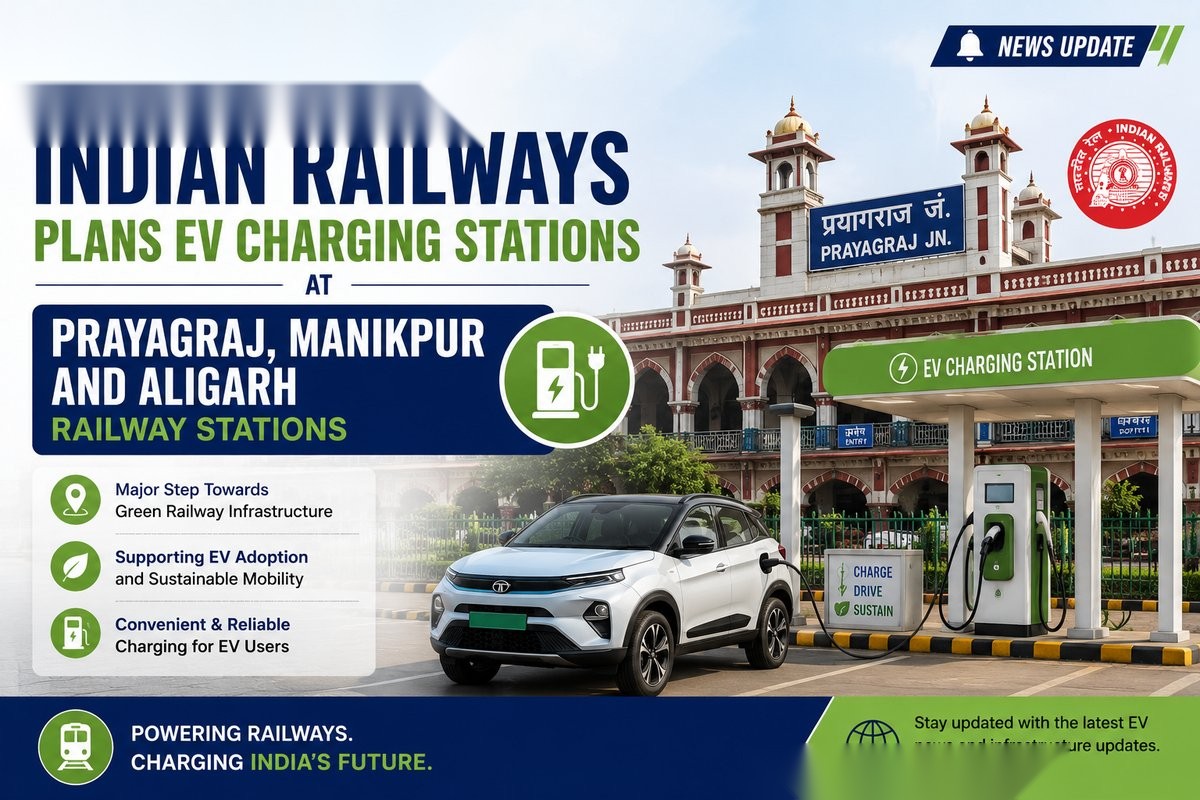
Indian Railways is moving to add electric vehicle charging infrastructure at railway stations, with the < cite index=”30-1″>North Central Railway (NCR) zone floating a tender for the installation of EV charging stations at Prayagraj Junction, Manikpur, and Aligarh railway stations, according to a recent zonal notification. The move extends charging-station development to locations that see heavy daily footfall and already have strong electrical infrastructure in place.
What Has Been Announced
Under the tender, NCR is inviting bids for setting up EV charging points at three of its stations spread across Uttar Pradesh: < cite index=”30-1″>Prayagraj Junction, Manikpur, and Aligarh. Records from the zone’s e-procurement listings confirm the structure of at least one of these awards: at Manikpur, the tender covers < cite index=”32-1″>the installation, operation and maintenance of an electric vehicle charging station on railway land for a period of five years, based on a jointly identified site plan. This “build-operate” model — where a private charging operator sets up and runs the facility on railway land under a fixed-term agreement, similar to how railways lease out parking and retail space — is consistent with how Indian Railways has structured EV charging tenders at other stations in recent years.
The Three Stations Involved
| Station | Station Code | Zone / Division | Significance |
|---|---|---|---|
| Prayagraj Junction | PRYJ | North Central Railway (headquarters) | < cite index=”25-1″>A major junction on the Howrah–Delhi main line and Howrah–Prayagraj–Mumbai line, and the headquarters of the North Central Railway zone, with 10 platforms and heavy daily passenger traffic. |
| Manikpur Junction | MKP | North Central Railway | < cite index=”23-1″>Located on the Prayagraj–Jabalpur section and the Jhansi–Manikpur line, an important junction connecting central and eastern Uttar Pradesh. |
| Aligarh Junction | ALJN | North Central Railway | A key stop on the Delhi–Kanpur trunk route, serving one of western Uttar Pradesh’s largest industrial and university towns. |
Why Railway Stations Are Being Chosen as Charging Hubs
Officials and industry commentary point to a straightforward logistical rationale: railway stations already offer much of what an EV charging site needs. < cite index=”30-1″>Such stations can offer good accessibility and grid connectivity, as they are generally located within main routes, and can serve as supplementary charging points while contributing to the wider expansion of public charging infrastructure. More broadly, the initiative reflects the < cite index=”30-1″>growing overlap between transport infrastructure and energy infrastructure, given that railway stations already have electrical linkages, dedicated parking areas, and large volumes of daily footfall — the same combination that made metro stations and highway plazas early targets for charger rollouts elsewhere in India.
Part of a Longer-Running National Push
The Prayagraj–Manikpur–Aligarh tender is the latest step in a policy effort that has been building for several years. As far back as 2018, Indian Railways < cite index=”39-1″>identified New Delhi and Nizamuddin stations to host fast DC charging points capable of charging ten cars simultaneously, in a project executed with Delhi’s BSES Rajdhani Power. By 2022, the scope had widened considerably: a government document showed Indian Railways < cite index=”40-1″>planned to install EV charging points at all major stations across the country over three years, starting with megacities of over four million people — including Mumbai, Delhi, Bengaluru, Hyderabad, Ahmedabad, Chennai, Kolkata, Pune and Surat — by December 2024.
Around the same time, < cite index=”41-1″>NITI Aayog prepared a draft policy recommending that Indian Railways roll out EV charging stations at all stations nationwide in a phased manner through 2030, with charging facilities immediately viable at 123 already-redeveloped stations. The Ministry of Railways has since formalised its own internal roadmap: an official policy document lays out a < cite index=”44-1″>two-pronged e-mobility strategy — first, timelines for replacing the railways’ own fleet of fossil-fuel vehicles with EVs, and second, timelines for installing charging infrastructure across railway office complexes and railway stations, with different implementation models detailed for each.
Backed by a Larger Central Funding Push
The North Central Railway tender also sits within a much larger central government effort to expand India’s public charging network. Under the Ministry of Heavy Industries’ PM E-DRIVE scheme, < cite index=”42-1″>an overall outlay of ₹10,900 crore has been approved, with ₹2,000 crore specifically earmarked for public EV charging and battery-swapping infrastructure across cities, highways, airports, ports and other public premises nationwide. Significantly for railway-based projects, < cite index=”42-1″>government premises that offer free public access to chargers are eligible for a 100 percent subsidy on infrastructure and EV Supply Equipment (EVSE) costs, and railway stations are explicitly named among the eligible site categories.
Coordination for this rollout is being handled centrally: < cite index=”46-1″>demand aggregation for the national charging push is being coordinated across bodies including the National Highways Authority of India, the Airports Authority of India, Indian Railways, and state governments, with Indian Railways specifically tasked with assessing charging requirements at its own stations, while < cite index=”46-1″>the broader scheme aims to deploy over 72,000 chargers nationally and has been extended through FY28.
What It Means for Commuters and EV Owners
- Supplementary charging, not destination charging: These stations are designed to serve as top-up points for private vehicle owners dropping off or picking up passengers, rather than long-duration charging hubs.
- Five-year operating model: At least one of the three sites (Manikpur) is being tendered as a five-year build-operate arrangement, suggesting the facility will be run by a private charge point operator rather than the railway itself.
- Existing parking infrastructure leveraged: All three stations already have dedicated parking areas, meaning EV charging points can likely be integrated into existing lots rather than requiring new land acquisition.
- Part of a revenue and sustainability strategy: Beyond convenience for commuters, such projects have historically been framed by Railways as a way to generate ancillary revenue while supporting the organisation’s broader net-zero carbon emissions target.
What Happens Next
With the tender floated, the process now moves to bid evaluation and operator selection, followed by site preparation and installation. Based on similar past projects, timelines from tender award to commissioning have typically run into several months, depending on grid connectivity work and civil approvals at each site. No official commissioning date has yet been announced for the Prayagraj, Manikpur or Aligarh facilities.
Eletimes · TenderDetail (North Central Railway tender listings) · Business Standard · Energetica India · The Statesman · Construction World · OpIndia · Electronics For You · Ministry of Railways E-Mobility Policy document · Wikipedia (station data)