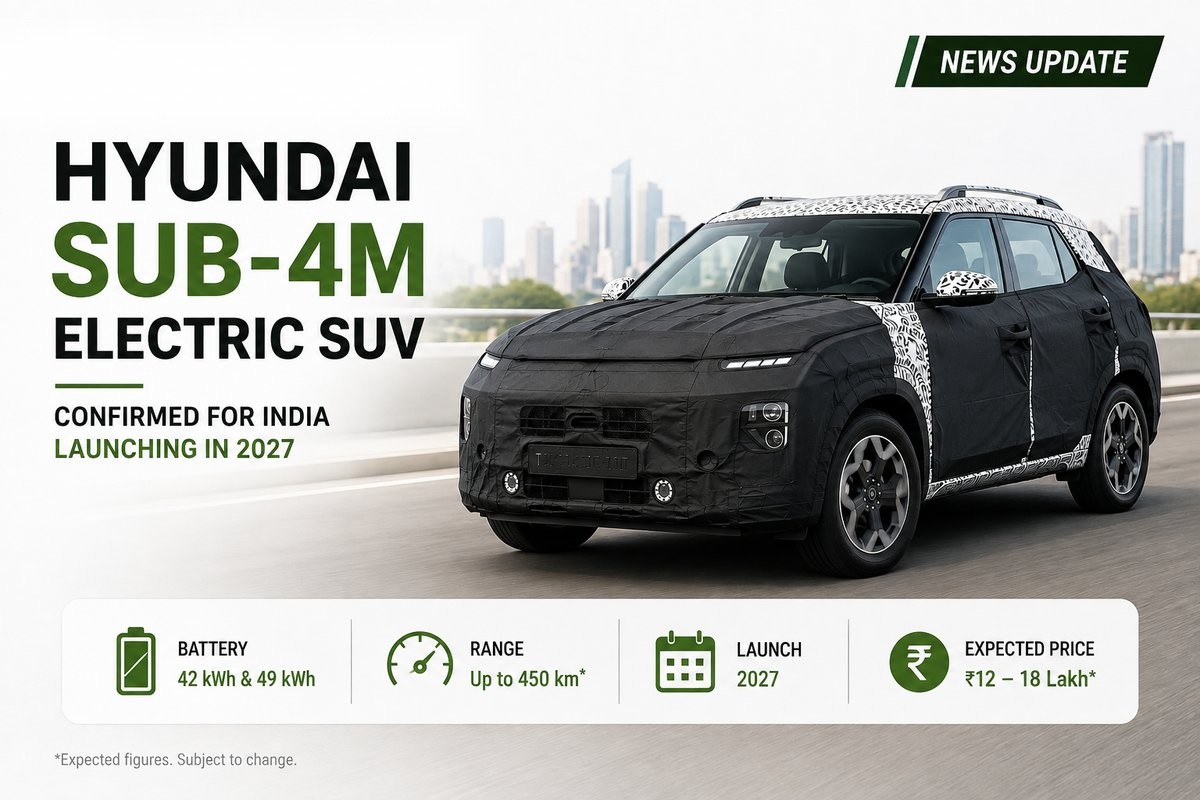
For over a year now, spy shots of a camouflaged Hyundai test mule have been doing the rounds — spotted everywhere from South Korea to Goa, wearing thick disguise but giving away just enough to fuel constant speculation. That guessing game is now largely over. Hyundai has officially confirmed it’s bringing a sub-4-metre electric SUV to India, and this time it’s coming straight from the top: Tarun Garg, Hyundai India’s CEO, has publicly stated the car will launch within the current financial year, which runs through to March 2027. It’s a significant moment for the brand, because this isn’t just another EV — it’s Hyundai’s first genuinely mass-market, India-built electric vehicle, and the company is talking about it in terms usually reserved for a segment-defining product.
What’s Actually Been Confirmed
Let’s separate what Hyundai has said on the record from what’s still industry speculation, because there’s a fair bit of both floating around right now. The confirmed part is fairly simple: at Hyundai’s 2026 CEO Investor Day, Jose Munoz, President and CEO of Hyundai Motor Company, stated plainly that “a brand-new compact SUV is coming, designed and localised in India.” That confirmation has since been backed up by Tarun Garg, who told media the car — internally codenamed HE1i — will arrive during FY2026-27.
A few other details have moved from rumour to official territory too. The SUV will be built on the E-GMP (K) platform, the same modular electric architecture that underpins the Hyundai Inster sold overseas. It will be manufactured domestically at Hyundai’s Sriperumbudur facility in Tamil Nadu. And it’s confirmed to come with a “next-gen infotainment” system along with Level 2 ADAS — a feature set that’s becoming table stakes in this segment rather than a genuine differentiator at this point.
Why Hyundai Is Building This Car
— Tarun Garg, CEO, Hyundai Motor India (paraphrased from recent media remarks)
Garg’s comments make Hyundai’s intent pretty clear: this isn’t meant to be a niche halo product sitting quietly in showrooms. It’s designed to become Hyundai’s first mass-market dedicated EV for India, positioned below the existing Creta Electric in the brand’s lineup. The goal, in Garg’s own framing, is to make EV ownership genuinely accessible while still giving buyers the technology and connected-car ecosystem they’ve come to expect — essentially, take everything people like about Hyundai’s larger EVs and repackage it at a price point that can actually move volume.
That ambition lines up with Hyundai’s broader roadmap. The company has previously committed close to ₹45,000 crore in India investment through FY2030, alongside plans for 26 new product launches across that period. The HE1i is one of four all-new Hyundai models expected in India by 2027, sitting alongside a Bayon-based compact SUV, the next-generation Creta Hybrid, and a premium three-row electric SUV at the opposite end of the price spectrum. In other words, this compact EV isn’t a standalone bet — it’s the affordable anchor of a much larger electrification push.
Battery and Range: What to Expect
Since the HE1i rides on the same E-GMP (K) platform as the global-market Inster, most reporting expects Hyundai to carry over a similar dual-battery strategy for India, likely branded as Standard Range and Long Range variants. The Inster itself offers a 42kWh pack good for a WLTP-certified 300km, and a larger 49kWh pack rated at 355km. Power outputs on the international car sit at 97bhp/147Nm for the smaller battery and 115bhp/147Nm for the larger one — figures that could carry over reasonably closely, though Hyundai may tune the India-spec car differently depending on cost and performance targets.
It’s worth flagging that not every report agrees on the exact numbers. A separate line of coverage has suggested a single ~40kWh pack with a more optimistic real-world range window of 400-500km, alongside possible Vehicle-to-Load (V2L) and Vehicle-to-Vehicle (V2V) charging support — though this appears to be less consistently corroborated than the Inster-based dual-battery expectation, so treat it as a secondary possibility rather than the likely outcome. What is more consistently reported is DC fast-charging support of up to 120kW, which would allow a 10-80% charge in around 30 minutes if it makes it to the India-spec car unchanged.
One detail that is genuinely confirmed: the battery packs themselves are expected to be locally sourced from Exide, as part of Hyundai’s broader localisation strategy for the car — a decision that speaks directly to how the company plans to hit its price targets.
Expected Price
Again, nothing here is officially confirmed, but the pricing conversation around this car has been remarkably consistent across industry coverage. Multiple reports point to a starting price in the region of ₹10 lakh for the base variant, climbing to somewhere between ₹14-15 lakh for the fully loaded top-spec version. One data point that adds some credibility to that range: with Level 2 ADAS confirmed as part of the package, at least one outlet has suggested the top-spec variant alone could exceed ₹15 lakh on its own, which broadly tracks with the wider ₹14-15 lakh estimate being floated elsewhere.
Design and What We’ve Seen So Far
Every sighting of the test mule so far has come wrapped in heavy camouflage, so exact styling details remain genuinely under wraps. That said, repeated spy shots — including a recent round spotted testing in Goa with a new set of alloy wheels — suggest development has progressed well past early-stage testing and into final validation territory. Based on what’s visible under the wrapping, expect a boxy, upright SUV silhouette broadly in line with Hyundai’s current design language, sized to sit clearly below the Creta Electric and Venue in the brand’s SUV hierarchy.
Where It Fits in Hyundai’s India Line-Up
| Model | Position | Segment |
|---|---|---|
| HE1i (this SUV) | New, most affordable EV | Sub-4m compact electric SUV |
| Creta Electric | Existing, one tier up | Compact electric SUV |
| Ioniq 5 | Existing, premium | Mid-size electric crossover |
| Upcoming 3-row EV | Future, flagship | Premium electric SUV (₹55 lakh+) |
Who It’s Up Against
The rival list here is short and fairly obvious. The Tata Punch EV is named consistently across every piece of coverage as the car Hyundai is directly targeting, given its dominant position in the affordable electric SUV bracket. Some reports also bring the Tata Nexon EV and Mahindra XUV 3XO EV into the conversation, depending on how the final variant lineup and pricing shake out — a fully-loaded top variant pushing past ₹15 lakh would put it in Nexon EV territory, while the base variant would sit squarely against the Punch EV.
That’s not a small ask. The Nexon EV and Punch EV together have been central to Tata Motors’ EV market leadership in India, and neither is going to cede ground easily. But Hyundai’s brand strength, its next-gen infotainment push, and the sheer scale of its dealer network give it a genuinely credible shot at disrupting that dynamic — provided the pricing lands where current reports suggest it will.
What Happens Next
With platform, manufacturing location, and a launch window now officially confirmed, the next milestones to watch for are the reveal of the car’s actual name, detailed specifications, and pricing — none of which Hyundai has committed to yet. Some reports have floated a Diwali 2026 launch window, though that remains unconfirmed and Hyundai’s own language has stuck to the broader “FY2026-27” framing, which technically extends the window all the way to March 2027. Given how frequently the test mule has been spotted in recent months, a formal unveiling in the coming quarters looks increasingly likely — but until Hyundai puts a number and a date on it, everything beyond the platform and manufacturing confirmation should still be read as an educated industry estimate rather than a locked specification.
Autocar India · CarToq · AutoX · Rushlane · CarWale · AutoPunditz · CarLelo · IndiaCarNews · Carbike360