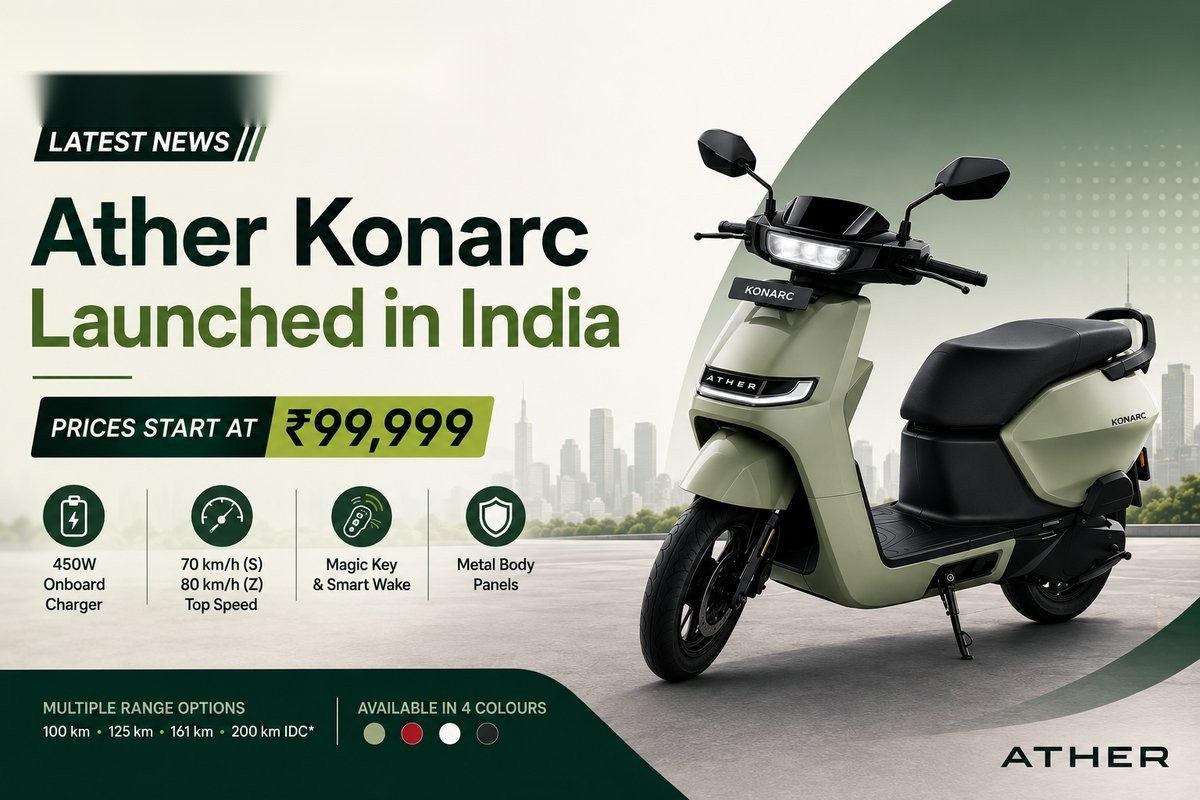
Ather Energy has never really had a scooter for everyone. The 450 series was always the performance pick, and the Rizta, even at its cheapest, starts at ₹1.30 lakh — which quietly locked the brand out of a huge chunk of the market. That’s the gap the Konarc is built to close. Unveiled today at the fourth edition of Ather Community Day 2026 in Bengaluru, the Konarc starts at ₹99,999 (ex-showroom, Bengaluru) and marks Ather’s first genuine attempt at a true mass-market electric scooter — one built for comfort and everyday commuting rather than the punchy, sporty character the brand is known for.
Why Ather Built This Scooter
Ather’s own co-founder and CEO, Tarun Mehta, was refreshingly candid about the thinking behind the Konarc while speaking to reporters at the launch. “With Ather 450 and family scooter Rizta, we had a product for most customers but we didn’t have all the price points. Rizta’s cheapest variant is at Rs 1.30 lakh,” he said, adding that Konarc was built specifically for the customers sitting just below that mark.
— Tarun Mehta, Co-founder & CEO, Ather Energy
That’s a striking number when you sit with it. Nearly half the entire electric scooter market in India lives in that band, and Ather simply wasn’t competing there at all until today. The Konarc changes that in one move.
Price and Variants: What You Can Actually Buy Right Now
The Konarc is being sold across two distinct lineups — S and Z — spanning six variants in total, though not all of them are available or priced just yet. Here’s what’s confirmed:
| Variant | Battery | Claimed IDC Range | Price (Ex-Showroom, Bengaluru) |
|---|---|---|---|
| Konarc S 100 | 2.1 kWh | 100 km | ₹99,999 |
| Konarc S 125 | 2.7 kWh | 125 km | ₹1,21,999 |
| Konarc S 161 | 3.5 kWh | 161 km | ₹1,44,999 |
| Konarc S 200 | Not yet disclosed | 200 km | Not yet announced |
| Konarc Z 125 | 2.7 kWh | 125 km | Not yet announced |
| Konarc Z 161 | 3.5 kWh | 161 km | Not yet announced |
The S line is the one to think of as the everyday, range-focused option, while the Z line is being pitched as the more performance-oriented pick — Ather has confirmed the Z variants will get a claimed top speed of up to 80km/h, noticeably quicker than what the S line offers. Frustratingly, if you specifically want a Z variant, you’ll need to wait: Ather has said those won’t hit the market until Q2 2027, with pricing to be announced closer to that window.
Design: Familiar, But Not a Copy-Paste
If the Konarc looks a little familiar at first glance, that’s not an accident. It shares a boxy, practical family-scooter silhouette that’s clearly cut from the same cloth as the Rizta, right down to the LED headlight mounted on the handlebar cowl and a wide LED daytime running light stretched across the apron. But Ather has given it its own identity rather than just shrinking the Rizta down — most notably with a steel unibody chassis and genuine metal body panels, a real departure from the plastic-bodied construction used across the rest of Ather’s existing range.
That metal construction does come with a trade-off worth knowing about upfront: it will likely add some kerb weight compared to Ather’s other scooters. Whether that’s a meaningful downside in daily use remains to be seen, but it’s the kind of engineering choice that trades a bit of weight for a more premium, durable feel — a fair swap for a scooter positioned around long-term ownership rather than outright performance.
On the wheel front, the Konarc rides on a 14-inch front and 12-inch rear wheel combination, wrapped in 90/90-14 and 100/90-12 tyres respectively. Mehta noted the larger front wheel specifically was chosen with India’s patchy road conditions in mind, to help with stability over potholes — a very India-specific engineering call that’s easy to appreciate if you’ve ridden a scooter on anything less than a freshly paved road.
Features: Where the Variants Start to Differ
Feature content scales up noticeably as you move up the Konarc range, and it’s worth knowing exactly what you’re getting (or not getting) at each price point before you book.
- Displays: The entry-level Konarc S 100 gets a smaller 4.2-inch DeepView display, while the S 125 and S 161 step up to a larger 7-inch DeepView screen.
- Braking: The base S 100 makes do with drum brakes at both ends. The S 125 and S 161 add a 220mm front disc brake, a meaningful upgrade in stopping power for anyone doing regular city or highway riding.
- Storage and practicality: All variants get 31 litres of underseat storage, along with USB charging and a reverse Park Assist function — genuinely useful for tight parking spots.
- MagicKey: A new keyless start system, letting riders start the scooter without physically inserting a key.
- AutoPop: A hands-free way to access the under-seat storage, without needing to fumble for a button or key.
- Connected features (higher variants only): AirWalk, AutoHold, Bluetooth call and music alerts, theft and tow alerts, ride stories, Find My Scooter, and remote charging status — all reserved for the S 125 and S 161, and presumably the Z line as well.
- Grabrail: The two higher S variants also get a cushioned grabrail, a small but genuinely appreciated comfort touch for pillion riders.
Charging: A Genuine Convenience Play
Charging is one area where Ather seems to have put real thought into everyday usability rather than just chasing a bigger number. Every Konarc comes with a 450W onboard charger built in, and buyers have the option to add a second 450W offboard charger as well. Used together, that combined 900W setup can cut home charging time by up to half compared to relying on the onboard charger alone — a genuinely practical option for anyone who’s ever been stuck waiting overnight for a scooter to top up.
For faster top-ups on the go, Ather Grid — the company’s public fast-charging network — comes bundled in as standard on the 125km and 161km variants, and is available as a paid add-on on the base 100km model. On Grid chargers, Ather is claiming a charging speed of 13km of range in 10 minutes on the entry model, rising to 15km in 10 minutes on the larger-battery variants.
Battery Warranty: A Genuinely Bigger Deal Than It Sounds
Bookings, Deliveries, and Where It’ll Be Built
Here’s where patience becomes part of the deal. Bookings and deliveries for the Konarc S 125 and S 161 will begin in mid-September 2026, but only in a phased rollout — starting with select variants and select states before gradually expanding nationwide. There’s no confirmed word yet on exactly when the base S 100 variant will start reaching buyers, or when the higher S 200 and both Z variants will follow.
On the manufacturing side, Ather has confirmed it plans to roll out the first batch of Konarc scooters from its upcoming manufacturing plant in Maharashtra, with production targeted to begin by November 2026. That’s a new facility for the company, and its timeline is effectively tied to how quickly the Konarc rollout can scale up beyond its initial phased launch cities.
The EL Platform: More Than Just One Scooter
The Konarc is also significant for what it represents architecturally. It’s the first production scooter built on Ather’s new EL platform, and the company has been fairly upfront that this isn’t a one-off — the EL platform is designed to give Ather a common, shared architecture from which it can build further mass-market electric scooters down the line. In other words, the Konarc is likely just the first of several models we’ll see riding on this same underlying foundation over the next few years.
Where It Sits Against the Competition
At ₹99,999, the Konarc S 100 lands directly in the price zone occupied by some of India’s best-selling electric scooters — the Bajaj Chetak (from ₹1.19 lakh), Hero Vida VX2 (from ₹84,999), and TVS iQube (from around ₹1.16-1.20 lakh) all sit in broadly similar territory. That’s precisely the segment Ather has been absent from until now, and with the Chetak and iQube currently the two best-selling electric scooters in the country by volume, the Konarc is walking straight into the most competitive, highest-volume part of the entire EV two-wheeler market.
The Bottom Line
The Konarc isn’t Ather trying to out-sport itself or chase another range record — it’s a fairly deliberate, humble admission that the company needed a genuinely affordable, family-friendly product to compete in the segment where most Indian buyers actually shop. A steel body, a proper battery warranty, sensible charging flexibility, and a starting price under ₹1 lakh make a compelling case on paper. Whether it can actually dent the Chetak and iQube’s dominance in this bracket will come down to real-world range, service network reach, and how quickly Ather can move past this initial phased rollout into full national availability — none of which we’ll know for certain until deliveries actually begin in mid-September.
BikeAdvice · BikeWale · RushLane · Business Today · Sunday Guardian Live · ZigWheels · Electrical Mirror · AutoPunditz