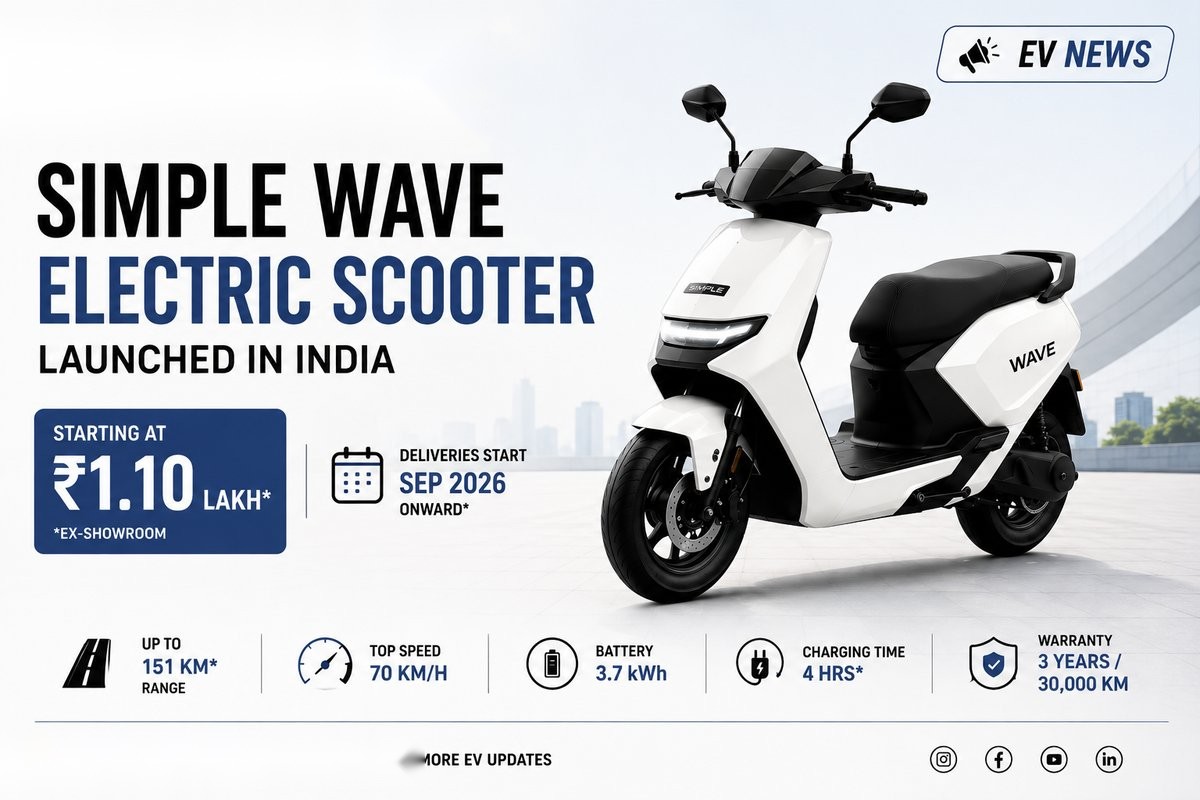
Simple Energy has officially launched the Wave, its first genuinely mass-market electric scooter, at an introductory price of ₹1,09,999 (ex-showroom, Bengaluru). It’s a scooter that’s been talked about for a while now — earlier reporting had it codenamed ‘Arrive’ — and it arrives as a deliberate pivot for the Bengaluru-based EV maker, moving away from the sportier, performance-first character of the Simple One series toward something built specifically for everyday family use.
Price: An Introductory Offer, With Some Blanks Still to Fill
The headline number is ₹1,09,999, and that’s the starting price for the base variant. But it’s worth being precise about what “starting price” actually means here: Simple has confirmed pricing for the base Wave S variant, but pricing for the higher Wave and Wave+ variants hasn’t been revealed yet. The company also hasn’t clarified whether the September 25 delivery date applies across the entire range or just the base model. If you’re specifically after one of the longer-range variants, it’s worth waiting for that pricing confirmation before getting too attached to the ₹1.10 lakh figure.
Variants: Six Configurations, Four Batteries
The Wave comes in a total of six variants, built around four distinct battery pack sizes: Wave S EBN 2.2kWh, Wave S EBN 2.7kWh, Wave S TFT 2.7kWh, Wave EBN 3.7kWh, Wave TFT 3.7kWh, and the range-topping Wave+ with a 5kWh pack. “EBN” and “TFT” refer to the two different display options on offer — a simpler digital cluster on the EBN trims versus a proper TFT screen on the higher ones — which is a fairly unusual way to split a lineup and worth keeping in mind if display type matters to you as much as battery size does.
Range: The Number Simple Is Leading With
| Variant | Battery | Claimed IDC Range |
|---|---|---|
| Wave S | 2.2 kWh | 110 km |
| Wave S | 2.7 kWh | 132 km |
| Wave | 3.7 kWh | 171 km |
| Wave+ | 5 kWh | 243 km |
That 243km figure on the top-spec Wave+ is genuinely the standout number here, and Simple isn’t being shy about it — Autocar India’s own coverage points out this gives the Wave the highest claimed range in its segment, ahead of established rivals. It’s worth remembering these are IDC-certified figures rather than guaranteed real-world numbers, which almost always come in somewhat lower depending on load, riding style, and terrain — but even accounting for that gap, a base claimed figure this high gives the Wave real breathing room over scooters that are already tight on range before real-world conditions are even factored in.
Performance and Powertrain
Every variant of the Wave uses the same 6.4kW PMSM (Permanent Magnet Synchronous Motor) paired with a chain-drive transmission, allowing a claimed top speed of 90km/h and a 0-40km/h sprint in a brisk 3.3 seconds. That’s a genuinely quick number for a scooter positioned around family use and daily practicality rather than outright performance — a nice reminder that “family-focused” doesn’t have to mean “slow.”
It’s also worth understanding where this powertrain actually comes from, because it isn’t a clean-sheet design. The Wave shares its underlying architecture with Simple’s existing One series, but with genuine third-generation updates: both the motor and the Battery Management System have been upgraded, and the motor itself has shrunk by 15 percent in overall size. For context on how the Wave now sits relative to its stablemates — the One uses a larger 5kWh battery and 8.8kW motor for a claimed 265km range, while the One S runs a 3.7kWh battery and the same 6.4kW motor as the Wave for a claimed 190km range. There’s also a One Ultra with a 6.5kWh pack and 8.8kW motor claiming 400km, though Simple hasn’t confirmed delivery dates for that variant yet.
Riders get multiple modes to work with too — Ride, Eco, and ECOX come standard across the entire line-up, while the higher variants additionally receive a Sport mode for when you actually want to use that quick 0-40km/h time.
Design: Function Wrapped Around a Dolphin
The Wave’s styling takes a clear departure from the sharper, more aggressive look of the Simple One, going instead for a design the company says is inspired by how a dolphin cuts through water — you can see that influence in the smoothed-out, boxier-but-flowing body panels. Functionally, it’s built around a tubular steel frame with a 1,347mm wheelbase and a 775mm saddle height, sitting on 12-inch wheels at both ends.
On the practicality front, the Wave leans hard into storage as a genuine selling point: 70 litres of total boot space, including a dedicated 4-litre ‘Pill’ storage compartment for smaller items — Simple is calling this segment-leading storage capacity, and at 70 litres, that’s a meaningfully large number for a scooter in this price bracket. Payload capacity is rated at a solid 150kg, and the seat itself measures 920mm in length, giving both rider and pillion genuine room rather than a cramped perch.
Features
- Display: A 7-inch TFT screen with smartphone connectivity on the TFT variants (simpler EBN display on entry trims).
- Safety: Hill hold assist, traction control, and a Combined Braking System (CBS) linking the front disc and rear drum brakes.
- Suspension: Telescopic front forks paired with dual rear shock absorbers.
- Weatherproofing: An IP67 rating for both the battery pack and motor, protecting against dust and water ingress.
- Charging: A 750W portable charger included for home use, with fast-charging support that Simple claims can take the range-topping Wave+ from 0-80% in just 2 hours 15 minutes.
- Colours: Six options at launch — Polar Blue, Pearl White, Twilight Black, Dolphin Grey, Forest Green, and Coral Red.
Warranty
Simple is backing the Wave’s battery and motor with a 3-year or 30,000km warranty as standard, extendable to 5 years or 50,000km for buyers who want longer coverage. The portable charger gets its own separate 3-year or 20,000km warranty. It’s a reasonably competitive package for the segment, though not the standout 8-to-10-year battery warranties some rivals — including Ather’s new Konarc — have recently started offering.
Full Spec Sheet
| Specification | Detail |
|---|---|
| Motor | 6.4 kW PMSM, chain-drive |
| Top Speed | 90 km/h (claimed) |
| 0-40 km/h | 3.3 seconds (claimed) |
| Battery Options | 2.2 kWh / 2.7 kWh / 3.7 kWh / 5 kWh |
| Max Claimed Range | 243 km (IDC, Wave+ 5kWh) |
| Frame | Tubular steel |
| Wheelbase | 1,347 mm |
| Seat Height | 775 mm |
| Seat Length | 920 mm |
| Wheels | 12-inch, front and rear |
| Brakes | Front disc, rear drum, with CBS |
| Underseat Storage | 70 litres (incl. 4L ‘Pill’ compartment) |
| Payload Capacity | 150 kg |
| Ingress Protection | IP67 (battery & motor) |
| Charger | 750W portable, fast-charging capable |
| Warranty | 3 yrs/30,000km (extendable to 5 yrs/50,000km) |
| Price (Ex-Showroom, Bengaluru) | From ₹1,09,999 (base variant only, confirmed) |
Where It Sits Against the Competition
The Wave enters what is currently the single most competitive corner of India’s EV two-wheeler market. Autocar India’s coverage frames the comparison plainly: with its pricing, the Simple Wave directly rivals scooters like the new Ather Konarc, the Bajaj Chetak, Hero Vida, and the TVS iQube — and range is being positioned as the Wave’s biggest trump card over all of them. That’s a meaningful claim to make, because those four brands together account for roughly 76 percent of all electric two-wheelers sold in India so far in 2026, according to the same report. In other words, the Wave isn’t launching into a quiet corner of the market to slowly build a following — it’s walking straight into the segment that dominates EV two-wheeler sales in the country, against rivals with far larger existing dealer networks and brand recognition.
Bookings and Deliveries
Deliveries are confirmed to begin on September 25, 2026 — though, as noted earlier, Simple hasn’t clarified whether that date applies to every variant or just the base Wave S. For buyers specifically eyeing the Wave or Wave+ trims, it may be worth checking directly with a Simple Energy dealership before assuming the same delivery window applies.
Team-BHP · Autocar India · BikeAdvice · The Bike Junction