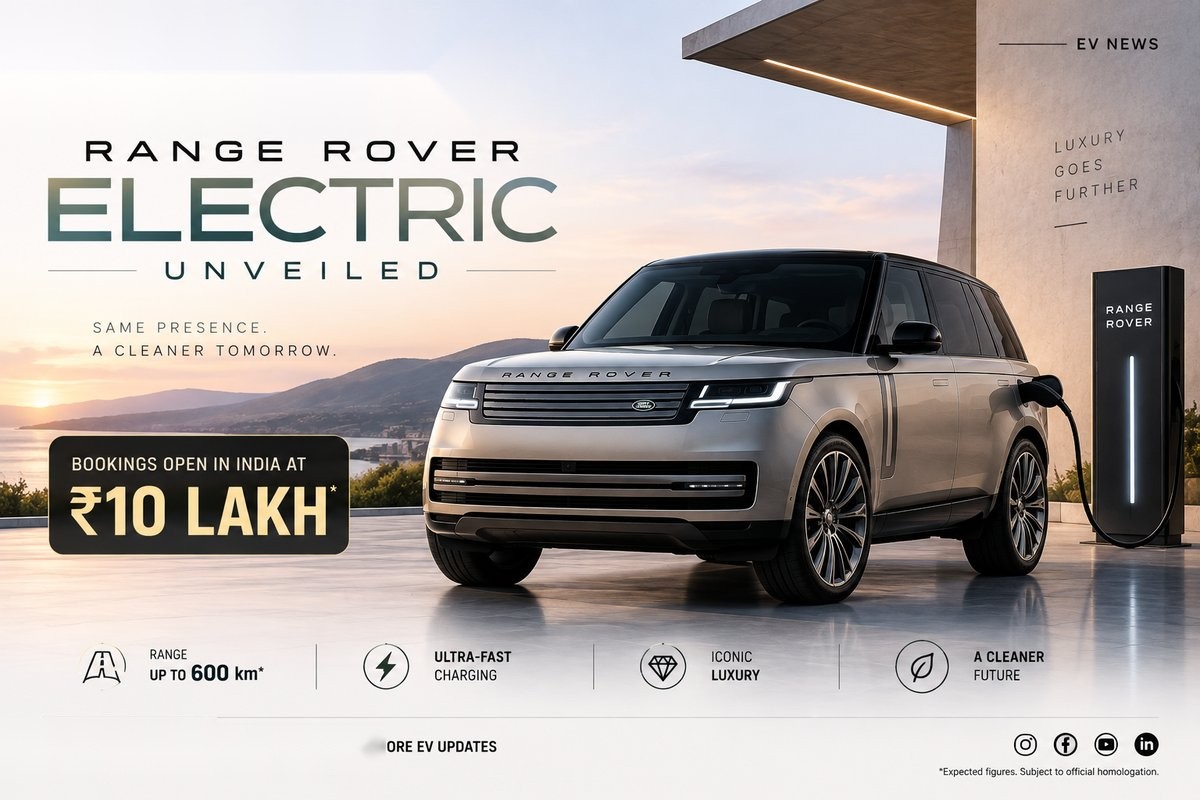
JLR has officially revealed the production-spec Range Rover Electric — the first fully electric version of its flagship luxury SUV — and opened bookings for it in India on the very same day. It’s a significant moment for a nameplate that’s spent decades building its identity almost entirely around big, thirsty combustion engines, and it marks Range Rover’s first genuine step into the battery-electric space with its most important model.
Bookings: What ₹10 Lakh Actually Gets You
For that ₹10 lakh token amount, prospective buyers aren’t just joining a generic waitlist — JLR is letting customers reserve specific configurations right from the start. Bookings are open for the standard-wheelbase model in Autobiography trim, along with the long-wheelbase version across SV, SV Ultra, and SV Black variants. There’s also a standard-wheelbase First Edition available to reserve, offered in three exterior finishes: Belgravia Green, Santorini Black, and Varesine Blue.
Final pricing and delivery timelines will be announced closer to the vehicle’s actual India launch, which JLR hasn’t confirmed a date for yet. So while the booking window is open now, this is very much a “reserve your place in line” moment rather than a “buy the car today” one.
Range: The Headline Number, and the More Honest One
The 600km figure that’s been leading most of the coverage is real, but it comes with an asterisk worth knowing: that’s the claimed range on the WLTP testing cycle, which tends to be a fairly optimistic laboratory measure. JLR itself has been upfront about the more realistic figure, quoting a real-world range of 535km under everyday driving conditions. A 65km gap between the claimed and real-world numbers is actually a relatively honest spread by industry standards — plenty of manufacturers see a much larger drop-off between lab-cycle claims and what owners actually experience.
That range comes from a substantial 118.5kWh battery pack, built from 344 prismatic cells. For context on scale, that’s a genuinely enormous battery by current EV standards — roughly double the size of what you’d find in most mainstream electric SUVs sold in India today.
Performance: More Power Than the Petrol V8
Power comes from two electric motors, each developed and produced in-house by JLR, generating 260kW (354PS) individually for a combined output of 405kW — or 550PS in more familiar terms — alongside 850Nm of torque. That torque figure is notable in its own right: it’s the highest ever recorded for any Range Rover model, electric or otherwise. JLR is claiming a 0-100km/h time of 4.5 seconds, a genuinely quick number for a vehicle of this size and weight.
Charging
The Range Rover Electric supports DC fast charging at up to 350kW, and under favourable conditions, JLR claims a 10-80% top-up in approximately 22 minutes. For quick top-ups on the move, the company also claims that just 10 minutes on a fast charger can add up to 220km of range — a genuinely useful figure for anyone planning long-distance drives who doesn’t want to be tied to lengthy charging stops.
Built to Still Be a Proper Range Rover Off-Road
This is arguably the more interesting engineering story here, because it’s the part that’s genuinely hard to get right on an EV: JLR has clearly worked to ensure the electric powertrain doesn’t compromise the off-road capability the Range Rover name is built on. In single-pedal driving mode, the SUV is claimed to be capable of tackling gradients as steep as 45 degrees. Its Intelligent Driveline Dynamics system continuously adjusts torque distribution based on available traction, while the traction management system can alter individual motor speed within just 50 milliseconds — a response time JLR says significantly outpaces what’s achievable with a comparable combustion-powered setup, where mechanical linkages simply can’t react that fast.
Design: Deliberately, Almost Stubbornly Familiar
If you were expecting the Range Rover Electric to look dramatically different from its petrol and plug-in hybrid siblings, that’s not the approach JLR has taken here. The exterior design stays remarkably close to the existing ICE model rather than chasing a distinct “EV look” the way many rivals have. It carries over the same LED headlights and tail-lights, the same door-handle graphics, dual shark fin antennas, and even the spoiler that conceals the rear wiper. The most visible changes are an aero-optimised front grille and a dedicated wheel design — and, tellingly, there’s no “Electric” badge anywhere on the body. The absence of exhaust pipes is really the only giveaway that this isn’t a combustion model.
The interior follows the same logic. The cabin mirrors the ICE version closely, sharing the same steering wheel, dashboard, drive selector, and centre console layout, along with dual screens — a 13.7-inch digital driver’s display and a 13.1-inch central touchscreen. The EV-specific additions are software-driven rather than visual: an AI-based range predictor, and a standard “digital twin” feature that JLR is introducing with this model.
It’s a design philosophy that essentially says: if you want the world to know you’re driving an electric Range Rover, you’ll have to know it yourself, because the badge won’t tell your neighbours.
Manufacturing and Import Route
The Range Rover Electric will be built at JLR’s Solihull plant in the UK and brought into India via the CBU (Completely Built Unit) route — meaning it’s fully imported rather than locally assembled. There’s a specific reason this matters for pricing: because it’s an EV, the Range Rover Electric will not qualify for the tariff concessions available under the India-UK Free Trade Agreement, which apply to combustion vehicles imported from the UK. That’s part of why the eventual sticker price is expected to sit meaningfully higher than what an equivalent ICE Range Rover import might command.
Platform Sharing
Under the skin, the Electric version is built on JLR’s Flexible Modular Longitudinal Architecture (MLA-Flex) — the same underlying platform used by both the combustion-engine and plug-in hybrid Range Rover models. That shared architecture is likely a big part of why the exterior and interior design have stayed so close to the existing lineup; the EV isn’t a ground-up reinvention so much as a genuinely capable third powertrain option layered onto a platform JLR has already spent years refining.
Who It’s Up Against
Once pricing is confirmed, the Range Rover Electric will enter a genuinely rarefied corner of the Indian luxury EV market, going up against the Mercedes-Benz EQS SUV, BMW iX, and Volvo EX90. It’s a tough brief to fulfil all at once — the Range Rover Electric needs to deliver genuine luxury, strong performance, and the kind of off-road ability the badge has always promised, all in a single package, at a price point that’s likely to sit above most of that direct competition.
Charging Infrastructure Backing the Launch
JLR isn’t launching this SUV into a vacuum on the charging front, either — the company has installed over 2,000 exclusive chargers in India already and is targeting more than 1 lakh charging points by the end of the year, a scale of infrastructure investment that suggests JLR is treating this as a genuine long-term EV push in India rather than a one-off flagship halo product.
What Happens Next
With bookings now open and the technical details revealed, the next milestones to watch for are the confirmed India launch date, final pricing across the full trim range, and delivery timelines. None of those have been locked in yet, so anyone booking today is genuinely reserving a place in line on trust in JLR’s eventual numbers rather than committing to a known price.
Autocar India · MotorBeam · RushLane · DriveSpark · Motoroids · CarBikeGPT