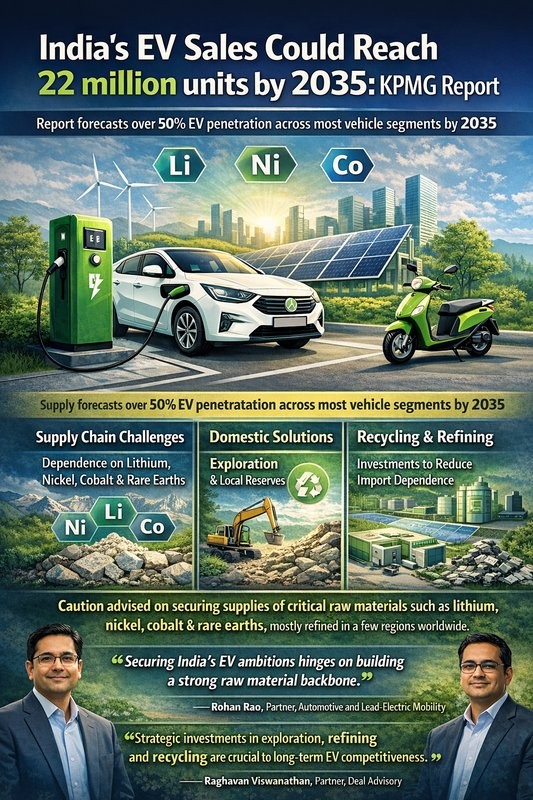
Electric vehicle (EV) sales in India are projected to surge to 22 million units annually by 2035, with overall EV penetration expected to exceed 50% across most vehicle categories, according to a recent report by KPMG India. The study underscores that rising consumer demand, rapid urbanisation, improving charging infrastructure, and supportive government policies will act as major catalysts in accelerating the country’s transition toward electric mobility.rnrnStrong Demand and Policy Push:rnrnThe report highlights that India’s EV growth is being driven by multiple structural factors. Increasing fuel prices, stricter emission norms, and growing environmental awareness among consumers are pushing adoption across two-wheelers, three-wheelers, passenger vehicles, and commercial fleets.rnrnGovernment initiatives such as production-linked incentives (PLI), state-level EV subsidies, tax benefits, and investments in public charging infrastructure are also playing a crucial role. Several state governments have announced dedicated EV policies aimed at attracting manufacturing investments and boosting local adoption. The expansion of battery manufacturing plants and localisation of components is expected to further reduce costs over time, making EVs more affordable for mass consumers.rnrnFleet electrification, especially in last-mile delivery, ride-hailing, and public transport segments, is likely to be a significant contributor to overall sales growth. Corporates are increasingly committing to sustainability targets, which is encouraging bulk procurement of electric vehicles.rnrnSupply Chain Risks and Raw Material Dependency:rnrnDespite the positive outlook, the report cautions that India’s EV ambitions face a critical challenge — securing access to key raw materials. Lithium, nickel, cobalt, and rare earth elements are essential for EV batteries and motors, and demand for these minerals is projected to rise sharply over the next decade.rnrnCurrently, more than 70% of global refining capacity for these minerals is concentrated in a limited number of regions. This concentration exposes India to geopolitical uncertainties, trade restrictions, and price volatility. Any disruption in global supply chains could impact battery costs and slow down EV production.rnrnThe report notes that without a resilient raw material strategy, rapid EV adoption may strain supply chains and increase import dependence, potentially widening the trade deficit.rnrnDomestic Exploration and Recycling Strategy:rnrnTo reduce vulnerability, KPMG recommends accelerating domestic mineral exploration, including recently identified lithium reserves in Jammu and Kashmir. Strengthening partnerships with resource-rich countries through long-term supply agreements is also considered essential.rnrnEqually important is investment in refining and processing infrastructure within India. Building local capabilities in mineral processing would reduce reliance on imported refined materials and create additional value within the domestic ecosystem.rnrnBattery recycling is identified as a strategic priority. As EV adoption rises, end-of-life batteries will become a valuable source of recoverable materials. Developing a circular economy model through advanced recycling technologies can help reduce raw material imports, lower environmental impact, and ensure long-term resource security.rnrnThe report also calls for research into alternative battery chemistries that reduce dependency on scarce minerals. Innovation in sodium-ion and solid-state battery technologies could play a role in diversifying material requirements in the future.rnrnIndustry Outlook and Long-Term Competitiveness:rnrnRohan Rao, Partner and Lead – Electric Mobility at KPMG India, stated that India’s EV ambitions depend not only on scaling up manufacturing capacity but also on securing a reliable raw material backbone. He emphasized that supply chain resilience will determine the sustainability of India’s EV expansion.rnrnRaghavan Viswanathan, Partner, Deal Advisory, added that strategic investments in exploration, refining, and recycling will be essential for ensuring India’s long-term competitiveness in the global EV ecosystem. According to the report, countries that successfully integrate manufacturing with secure resource access will emerge as leaders in the next phase of automotive transformation.rnrnThe Road Ahead:rnrnWith a projected 22 million annual EV sales by 2035, India stands at a transformative moment in its automotive history. The coming decade will likely witness rapid technological advancements, deeper localisation, and expanded charging networks across urban and semi-urban areas.rnrnHowever, the pace and sustainability of this transition will depend on coordinated action between government, industry, and global partners. A balanced approach that combines demand growth with raw material security and infrastructure development will be crucial in positioning India as a major player in the global electric mobility revolution.