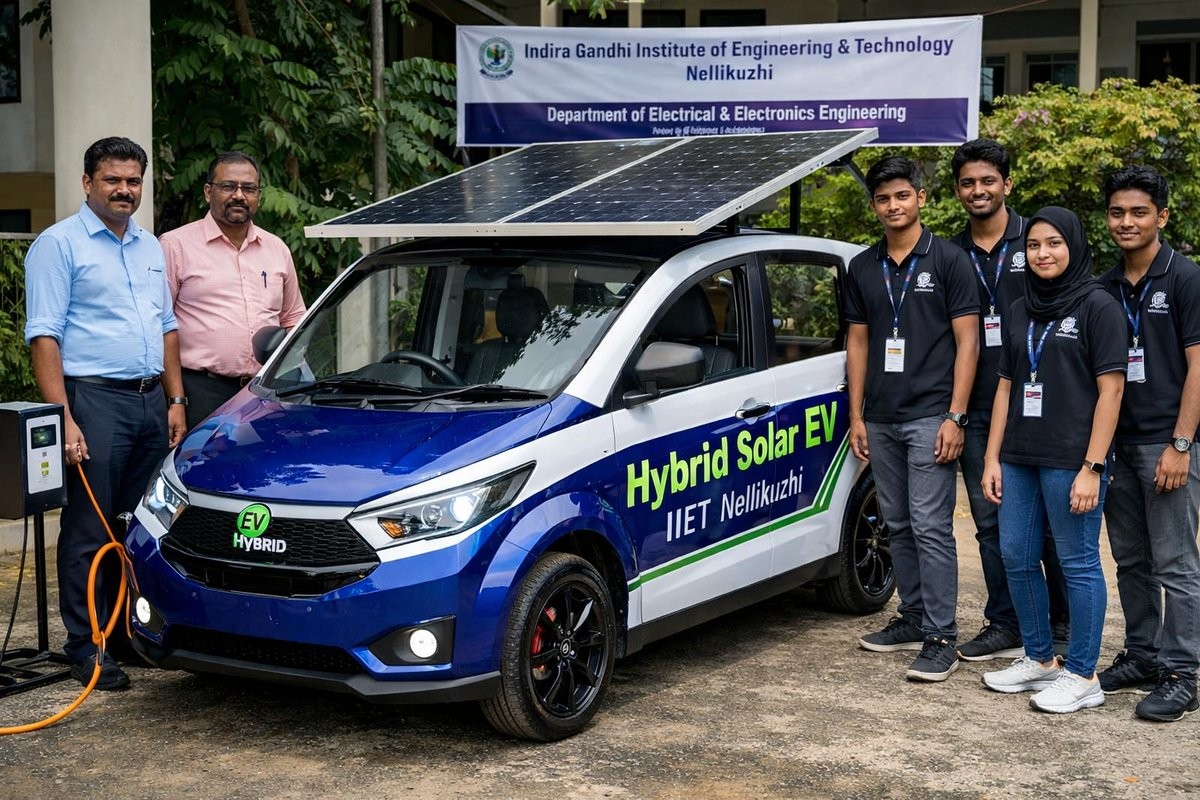
Engineers and students at the Indira Gandhi Institute of Engineering and Technology (IIET) in Kothamangalam, Kerala, have developed a groundbreaking hybrid electric vehicle (EV) that integrates both plug-in and solar charging along with a hybrid transmission system. The prototype EV, which seats 6–8 passengers and targets a range of 30–50 km, was showcased recently and is now undergoing further testing and certification. Future development aims to boost range, battery capacity, solar efficiency and incorporate AI technology in the vehicle. rnrnKothamangalam, Kerala — February 18, 2026:rnIn a remarkable step for sustainable mobility innovation, students and faculty at the Indira Gandhi Institute of Engineering and Technology (IIET) have developed a first-of-its-kind hybrid electric vehicle (EV) that can be charged via both plug-in electricity and on-board solar power. rnrnLed by Assistant Professor Muhammad Jaseem of the Department of Electrical and Electronics Engineering, the project was a collaborative effort involving researchers and students from multiple departments, with logistical support from Garage B, Muvattupuzha. The vehicle was officially unveiled in Kothamangalam in a function inaugurated by local MLA Antony John. rnrnrn⚡ Innovative Hybrid Charging SystemrnrnUnlike conventional EVs that rely solely on grid electricity, this prototype features an integrated solar charging module— a 590-watt solar panel mounted on its roof equipped with a DC converter. This allows the vehicle’s 72 V, 100 Ah lithium-iron phosphate battery pack to charge not only through plugs but also from renewable solar energy when parked or on the move in sunlight.rnrnThis innovation could reduce dependence on grid power and bring down operational costs in sunny regions like Kerala, where solar energy potential remains largely untapped for EV mobility.rnrnrn? Dual Transmission SystemrnrnAnother standout feature is the hybrid transmission design. Unlike typical EVs with fixed automatic gear sets, the vehicle allows motorists to shift between automatic and manual gears, potentially giving drivers better control and efficiency depending on road conditions and power needs. rnrn? Specifications and PerformancernrnAccording to researchers, key specifications of the hybrid solar EV include: ([@onmanorama][1])rnrn* Seating Capacity: 6–8 passengersrn* Battery: 72 V, 100 Ah lithium phosphatern* Solar Panel: 590 W with DC converterrn* Top Speed: 30–80 km/hrn* Driving Range: 30–50 km (combined solar + plug-in potential)rnrnrnrn? Ongoing Development and Future PlansrnrnThe IIET team has emphasized its commitment to elevating the vehicle’s capabilities further. Ongoing research focuses on:rnrn* Increasing overall mileage and rangern* Enhancing battery storage capacityrn* Improving solar harvesting efficiencyrn* Integrating artificial intelligence (AI) for advanced energy management and predictive performance tuning rnrnrn? Significance for Sustainable MobilityrnrnThis hybrid solar EV project exemplifies how **renewable energy and electric mobility** can be combined at the grassroots level. In a state like Kerala, where solar power adoption and electric mobility policies are gaining traction, such innovations could pave the way for more **eco-friendly transportation solutions** and inspire further research collaborations between academia and industry. ([@onmanorama][1])