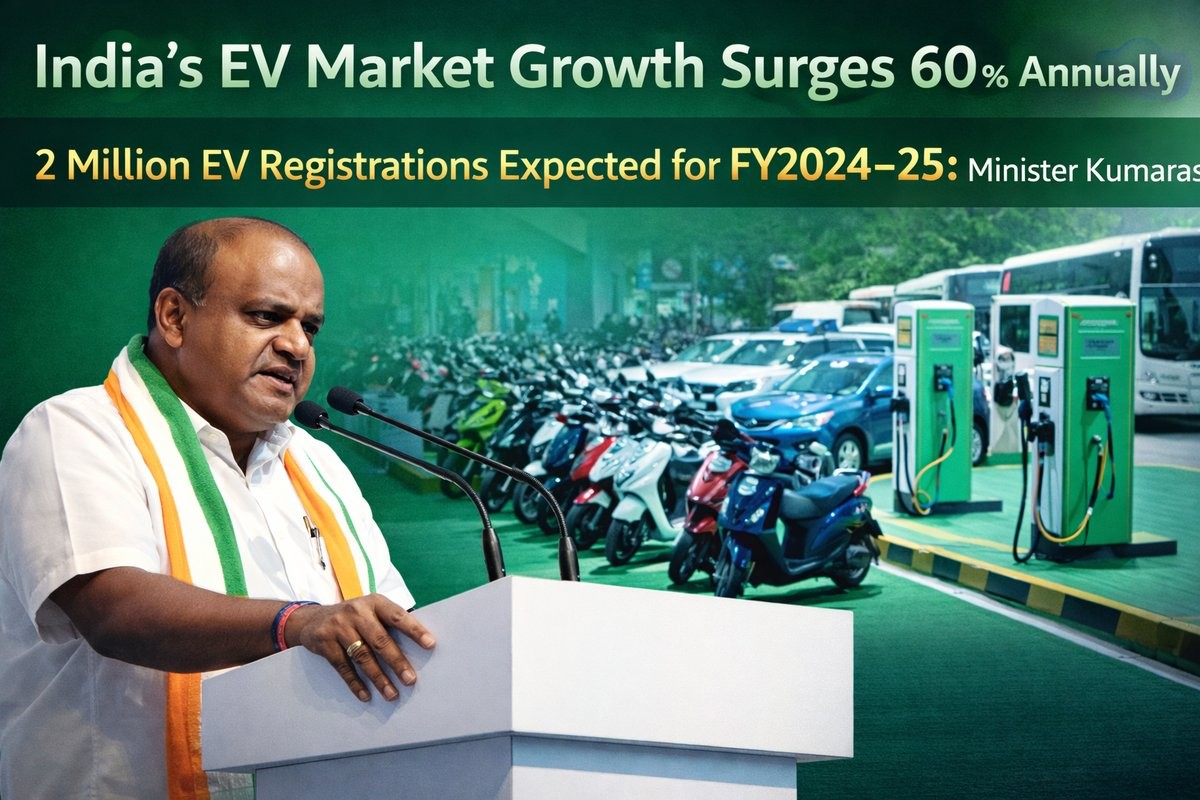
India’s electric vehicle (EV) sector has witnessed rapid expansion over the last six years, growing at an annual rate exceeding 60%, Union Minister HD Kumaraswamy said on Saturday. Addressing an electric mobility expo in Bengaluru, he noted that EV registrations are set to touch nearly 2 million units in the financial year 2024–25, reflecting accelerating consumer acceptance and policy momentum.rnrnThe minister highlighted that electric two-wheelers continue to dominate the transition, driving mass-market adoption due to their affordability and practicality in urban environments. At the same time, electric passenger vehicles, city buses, and commercial fleet segments are expanding steadily, indicating diversification within the EV ecosystem.rnrnKumaraswamy credited the success of the ₹11,500-crore Faster Adoption and Manufacturing of Hybrid and Electric Vehicles (FAME-II) scheme for strengthening India’s EV push. According to official figures, the scheme has supported more than 16.7 lakh EVs across categories and sanctioned over 9,000 public charging stations nationwide. The initiative has played a crucial role in lowering upfront costs and building charging infrastructure to reduce range anxiety among consumers.rnrnLinking the EV growth story to India’s broader sustainability goals, the minister said the transition to clean mobility aligns with the country’s Net Zero 2070 commitment. He emphasized that flagship initiatives such as “Make in India” and “Atmanirbhar Bharat” are enabling domestic manufacturing of EV components, batteries, and advanced automotive technologies, reducing reliance on imports and strengthening supply chains.rnrnKumaraswamy also pointed to the increasing integration of digital technologies in mobility, stating that the future of transportation will be driven by connected, data-based systems. Smart charging networks, telematics, battery analytics, and AI-powered fleet management are expected to transform the EV landscape in the coming decade.rnrnHighlighting regional strengths, he said Karnataka, particularly Bengaluru, is well positioned to emerge as a global hub for electric mobility innovation and manufacturing. The city’s robust startup ecosystem, established automotive supply chain, and technology talent pool provide a competitive advantage in developing next-generation EV solutions.rnrnWith policy backing, infrastructure expansion, and rising consumer awareness, India’s EV market appears set to sustain its growth trajectory, reinforcing its ambition to become a global leader in clean mobility.