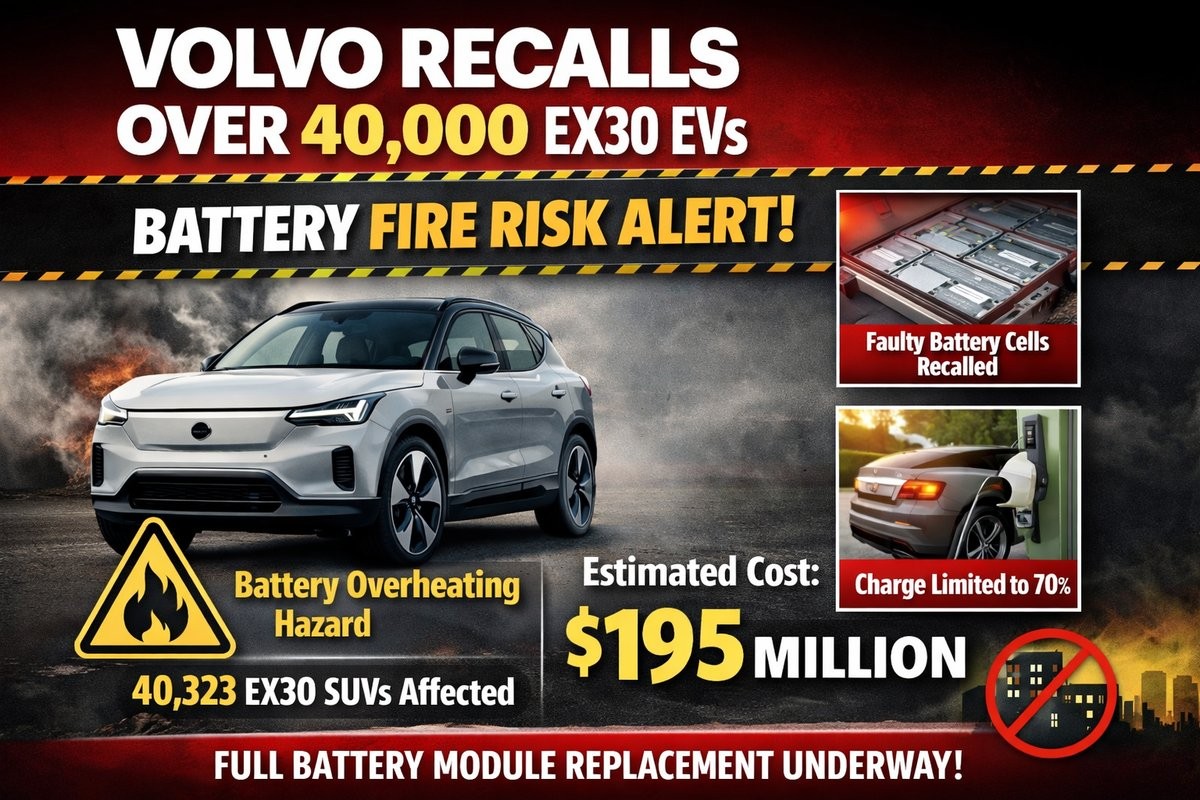
Volvo Cars has announced a major global recall of 40,323 units of its fully electric EX30 SUV after identifying a potential overheating risk in the vehicle’s high-voltage battery packs. The issue affects EX30 Single-Motor Extended Range and Twin-Motor Performance variants equipped with battery cells supplied by Shandong Geely Sunwoda Power Battery Co., a joint venture backed by parent company Geely.rnrnThe recall requires replacement of battery modules within the high-voltage pack, a critical component in any electric vehicle. Volvo confirmed it has begun contacting affected customers across more than a dozen markets, including the United States, Australia, Brazil, and several European countries. Owners are being advised to limit charging to 70% and park vehicles away from buildings until repairs are completed, as a precautionary safety measure.rnrnThe development comes at a sensitive time for Volvo. The EX30 is a cornerstone model in the company’s electrification strategy and a key product in its effort to compete with rapidly expanding Chinese EV manufacturers. As Volvo continues its $1.9 billion cost-saving initiative and deepens integration with Geely, the recall adds both financial and reputational pressure.rnrnFollowing reports of the recall, Volvo’s shares dropped approximately 4%, reflecting investor concerns over potential costs and brand impact. Industry analysts estimate that replacing the battery modules could cost as much as $195 million, excluding logistics and service expenses. Volvo, however, described such cost calculations as speculative and said discussions with the supplier are ongoing regarding financial responsibility.rnrnBattery safety remains one of the most critical challenges in the electric vehicle industry. The sector has previously witnessed high-profile battery recalls, including General Motors’ recall of 140,000 Chevrolet Bolt EVs in 2020 due to fire risks linked to batteries supplied by LG Electronics, a fix that ultimately cost the automaker nearly $2 billion. Such incidents underline the high stakes involved when battery defects arise.rnrnFor Volvo, the issue strikes at the core of its brand identity. The Swedish automaker has long built its global reputation around safety leadership. Industry veteran Andy Palmer, who oversaw the launch of the Nissan Motor Leaf in 2010, emphasized that Volvo has less tolerance for safety setbacks compared with rivals, given that consumer trust in safety forms the foundation of its brand promise.rnrnThe recall has already begun affecting customer sentiment. Some EX30 owners have expressed frustration, citing reduced driving range due to the imposed 70% charging limit. A British owner stated he selected the vehicle specifically for its safety credentials and long range, arguing that Volvo should take full responsibility for delivering a potentially dangerous product. In New Zealand, another owner said the temporary charging restriction has led to increased operational costs and inconvenience, adding that he would welcome a buyback offer.rnrnVolvo has assured customers that all battery module replacements will be performed free of charge. The company also confirmed that the supplier has resolved the identified defect and will provide updated battery cells for installation. Despite these assurances, the recall represents a significant test for Volvo’s quality control systems and supplier oversight as the global EV market becomes increasingly competitive and scrutinized.rnrnThe incident highlights the broader challenges facing automakers in the rapid transition toward electrification. As manufacturers race to scale production and introduce new models, ensuring battery safety and reliability remains paramount. For Volvo, the successful handling of this recall may determine whether the EX30 continues to serve as a growth driver or becomes a cautionary example in the evolving electric vehicle landscape.