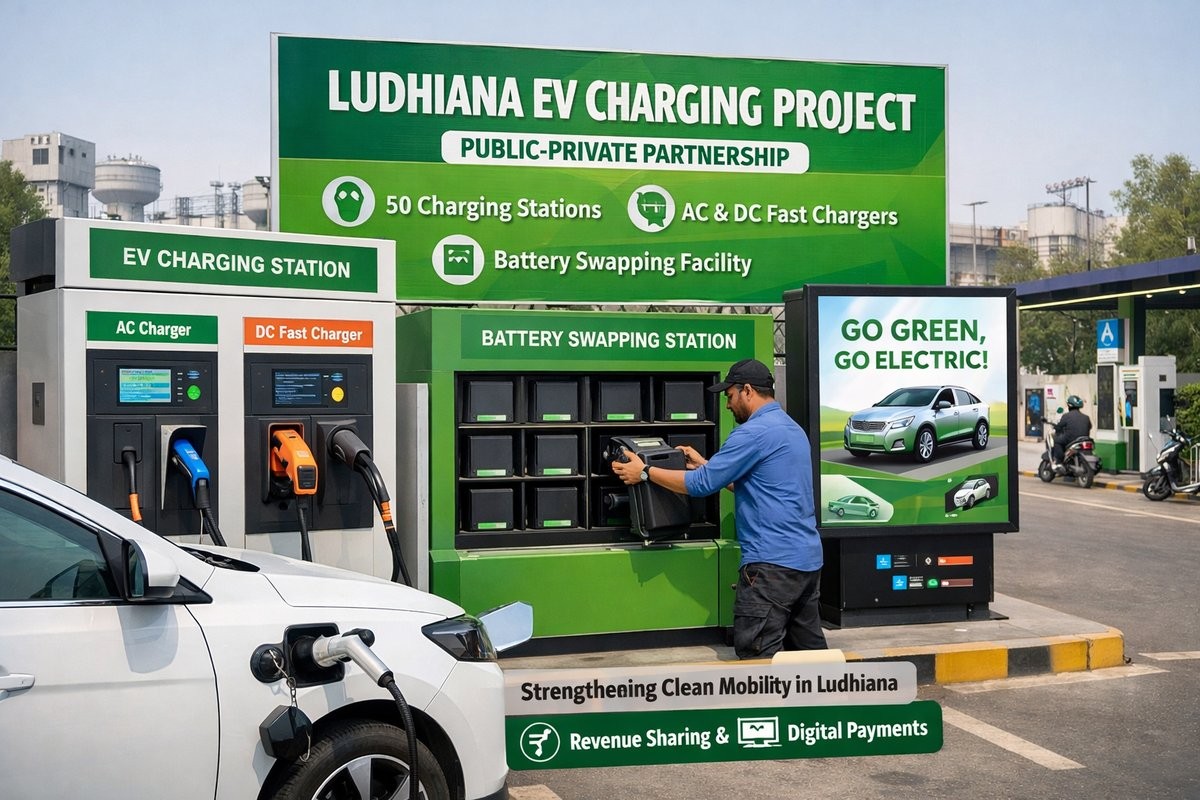
Ludhiana Municipal Corporation (MCL) has taken a major step toward strengthening the city’s green energy infrastructure by floating a tender to establish 50 electric vehicle charging stations under a 10-year public-private partnership model. As electric vehicles now account for nearly 6 percent of local registrations, the civic body is aiming to accelerate Ludhiana’s transition into a carbon-neutral transport hub through a self-sustaining “user-pays” revenue model. The initiative is designed to address rising demand for EV charging facilities in one of Punjab’s busiest industrial centres while ensuring steady per-unit revenue generation for the municipal corporation.rnrnThe project is open exclusively to Central and state public sector undertakings, ensuring operational reliability and compliance with public sector standards. According to officials, Ludhiana’s existing EV charging infrastructure remains limited compared to the rapid rise in electric cars, two-wheelers and commercial vehicles on city roads. With EV adoption steadily increasing, the municipal corporation sees this expansion as critical to supporting clean mobility growth and reducing carbon emissions in the region.rnrnThe selected PSU will handle the end-to-end implementation of the charging network, covering installation, technical deployment, digital integration, safety compliance and long-term operational resilience. The infrastructure will include compatible AC and DC chargers along with modular battery-swapping facilities to accommodate various EV segments. Each charging station will be equipped with RFID or QR code authentication, mobile app connectivity for bookings and integrated digital payment systems to deliver a seamless, digital-first experience for users.rnrnTo ensure durability and safety, the charging hubs will feature weatherproof enclosures, fire safety systems, CCTV surveillance and waterlogging-resistant drainage certified by the municipal corporation. The civic body will support the project by providing land allocations and coordinating with power distribution companies to ensure reliable electricity supply for uninterrupted operations.rnrnFinancially, the project is structured as a revenue-sharing model. The municipal corporation will receive a minimum of one rupee per kilowatt-hour of energy dispensed at the stations. In addition, the agreement includes provisions for space premiums and advertising rights. If a concessionaire requires space exceeding three equivalent car spaces, a monthly levy of ₹2,000 per additional space will apply. Revenue generated from branding and advertising at the charging hubs will be shared equally between the concessionaire and the municipal corporation.rnrnExecutive Engineer Raman Kaushal confirmed that the request for proposal has been officially floated, describing the initiative as a significant milestone for Ludhiana’s clean mobility ambitions. Beyond basic charging services, the proposed hubs are expected to incorporate advanced features such as IoT-enabled battery locker systems and solar-integrated rooftops where feasible. These additions align with central government incentives aimed at promoting electric vehicle adoption and sustainable energy use across urban India.rnrnWith this move, Ludhiana positions itself as a forward-looking industrial city preparing for a rapid rise in electric mobility. By combining infrastructure expansion, digital integration and a revenue-backed operational model, the municipal corporation aims to future-proof the city’s transport ecosystem while encouraging wider EV adoption.