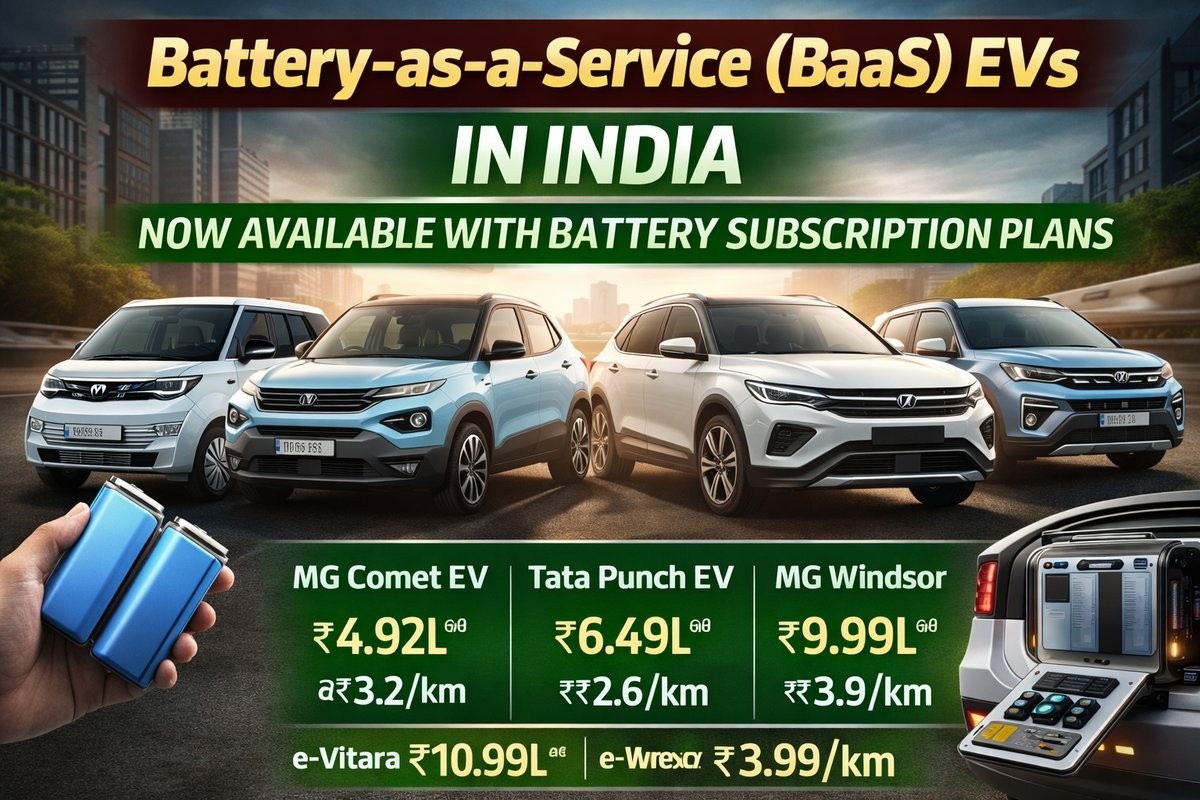
nBattery-as-a-Service (BaaS) is gaining attention as an alternative ownership model in India’s rapidly growing electric vehicle market. The concept is designed to reduce the upfront cost of EVs by separating the battery price from the vehicle’s purchase cost. Under this system, customers buy the electric vehicle at a lower price and pay for the battery through subscription-based plans or usage-based charges.n
nn
nSince the battery is the most expensive component of an electric vehicle, separating its cost can significantly reduce the initial purchase price. Buyers instead pay a monthly fee or a per-kilometre charge for battery usage depending on the scheme offered by the manufacturer. This approach aims to make EVs more affordable and accessible, especially for buyers who are hesitant about the high initial cost of electric vehicles.n
nn
nSeveral manufacturers in India have started introducing BaaS programmes for select electric vehicles as part of efforts to accelerate EV adoption. These programmes may also include additional benefits such as battery monitoring, service support, and potential battery replacement or upgrade options.n
nn
nAlthough the BaaS concept is still relatively new in the Indian passenger vehicle market, it is already attracting interest from buyers looking for lower entry costs into electric mobility. Currently, only a limited number of electric vehicles in India are offered with this option.n
nnn
1. MG Comet EV
n
nn
nThe MG Comet EV is one of the most affordable electric cars in India available with a BaaS scheme. Choosing this option reduces the vehicle’s upfront price by about ₹2.71 lakh compared with the standard purchase model.n
nn
nThe Comet EV uses a 17.3 kWh battery pack paired with a single electric motor producing 42 hp and 110 Nm of torque. The battery is IP67 rated for water and dust resistance and offers an ARAI-certified range of 230 km on a single charge.n
n
nnn
2. Tata Punch EV
n
nn
nThe Tata Punch EV is available with two battery options – 30 kWh and 40 kWh. Choosing the BaaS scheme reduces the upfront purchase price by approximately ₹3.20 lakh.n
nn
nThe larger battery pack offers an ARAI-certified range of 468 km and supports 65 kW DC fast charging, enabling the battery to charge from 20 to 80 percent in about 26 minutes.n
n
nnn
3. MG Windsor EV
n
nn
nThe MG Windsor EV is offered with two battery pack options – 38 kWh and 52.9 kWh – paired with an electric motor producing 136 hp and 200 Nm of torque.n
nn
nKey features include a 15.6-inch infotainment screen, wireless smartphone connectivity, panoramic glass roof, premium sound system, and advanced charging technologies such as vehicle-to-load (V2L) and vehicle-to-vehicle (V2V) functionality.n
n
nnn
4. Maruti Suzuki e-Vitara
n
nn
nThe Maruti Suzuki e-Vitara is offered with 49 kWh and 61 kWh battery packs using LFP blade cell technology sourced from BYD.n
nn
nThe smaller battery variant produces 144 hp while the larger battery produces 174 hp. The electric SUV offers a claimed driving range of up to 543 km on a single charge.n
n
nnn
5. MG ZS EV
n
nn
nThe MG ZS EV comes with a 50.3 kWh battery pack paired with a front-mounted electric motor producing 176 hp and 280 Nm of torque. The SUV offers a claimed range of 461 km.n
nn
nCharging using a 7.4 kW AC wall charger takes around 8.5 to 9 hours, while a 50 kW DC fast charger can charge the battery from 0 to 80 percent in approximately 60 minutes.n
n
nnn
nThe Battery-as-a-Service model is still in its early stages in India but has the potential to significantly improve EV adoption. By lowering upfront costs and offering flexible payment options, BaaS schemes are expected to make electric vehicles more accessible to a broader range of buyers in the coming years.n