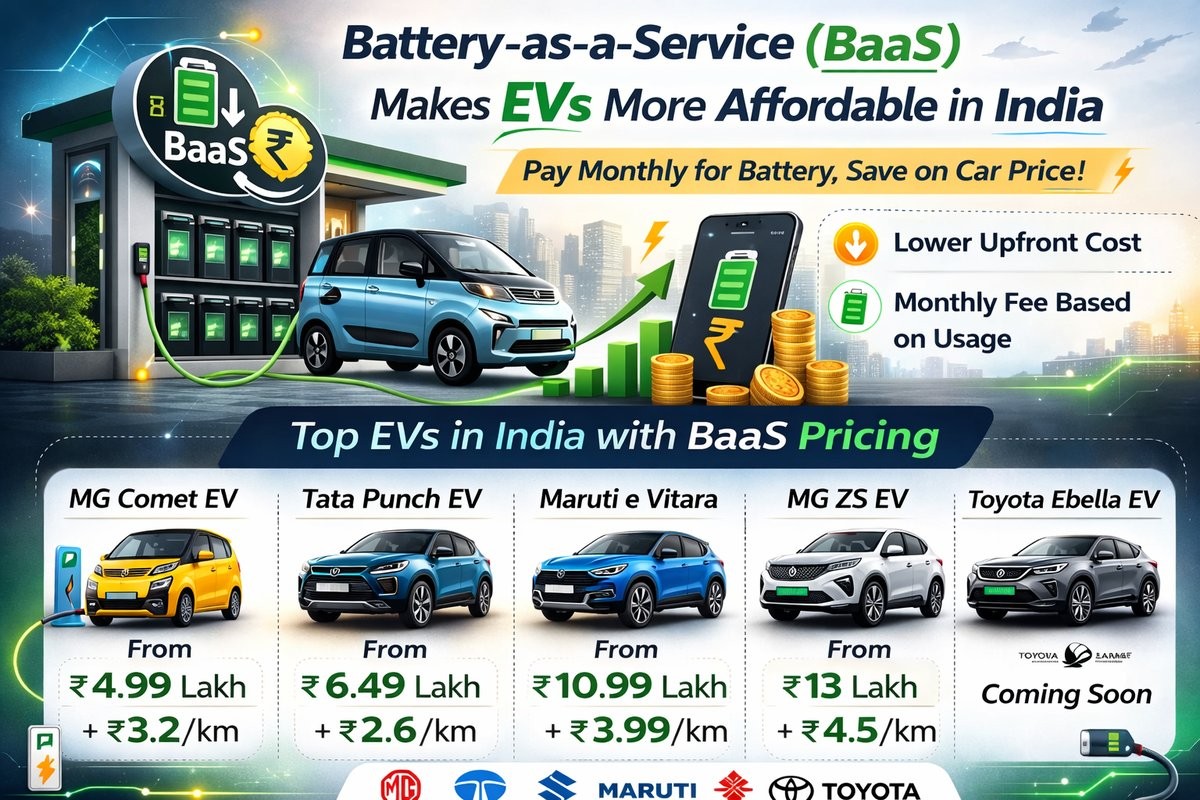
Battery-as-a-Service (BaaS) is rapidly emerging as a game-changing pricing strategy in India’s electric vehicle market. Instead of purchasing the battery along with the car, buyers can choose a subscription-based model where they pay a fixed per-kilometre fee. This approach significantly lowers the initial ex-showroom price of an EV, making electric mobility more accessible to a wider audience. While the monthly running cost increases slightly, the reduced upfront investment is proving attractive for first-time EV buyers and urban commuters.rnrnAmong the most affordable electric cars in India, the MG Comet EV stands out with BaaS pricing starting from Rs 4.99 lakh, along with a usage charge of Rs 3.2 per kilometre. Designed primarily for city driving, the compact electric hatchback offers modern features such as dual 10.25-inch screens for infotainment and instrumentation, wireless Android Auto and Apple CarPlay, connected car technology and keyless entry. Powered by a 17.3 kWh battery paired with a rear-wheel-drive motor producing 42 PS and 110 Nm, the Comet EV delivers a claimed range of 230 km, making it ideal for daily urban runs.rnrnAnother strong contender in the affordable EV segment is the Tata Punch EV, which is now available under a BaaS model starting from Rs 6.49 lakh plus Rs 2.6 per kilometre. Positioned as Tata’s entry-level electric SUV, the Punch EV features refreshed styling, a 10.25-inch touchscreen, a 10-inch digital driver’s display, ventilated front seats and a 360-degree camera. It comes with two battery options — 30 kWh and 40 kWh — offering claimed ranges of up to 375 km and 468 km respectively, making it a practical choice for both city and occasional highway drives.rnrnMG Motor continues to dominate the BaaS space with multiple offerings, including the MG Windsor EV. Its BaaS pricing begins at Rs 9.99 lakh with a per-kilometre charge starting from Rs 3.9. The Windsor EV stands out with its large 15.6-inch touchscreen, panoramic glass roof, powered seats and Level-2 ADAS features. Buyers can choose between 38 kWh and 52.9 kWh battery packs, with the larger option delivering a claimed range of up to 449 km.rnrnMaruti Suzuki has also entered the BaaS segment with its first electric SUV, the Maruti e Vitara. Prices under the subscription model start at Rs 10.99 lakh plus a usage fee. The e Vitara offers a premium interior layout, dual digital displays, ventilated seats and advanced safety technologies including Level-2 ADAS and a 5-star Bharat NCAP rating. It is available with 49 kWh and 61 kWh battery packs, the latter offering a claimed driving range exceeding 500 km.rnrnAnother notable player is the MG ZS EV, which has received a price revision alongside its BaaS rollout. Starting at Rs 13 lakh plus Rs 4.5 per kilometre, the ZS EV combines premium features such as a panoramic sunroof, Harman Kardon sound system and ADAS safety suite. Its 50.3 kWh battery pack produces 177 PS and 280 Nm, offering a claimed range of 461 km.rnrnLooking ahead, Toyota is preparing to introduce the Toyota Urban Cruiser Ebella EV, essentially a rebadged version of the e Vitara. It will follow a similar BaaS strategy, with expected prices ranging between Rs 11 lakh and Rs 14.3 lakh without the battery. The Ebella EV will feature dual screens, ventilated seats, Level-2 ADAS and battery options capable of delivering a claimed range of up to 543 km.rnrnBattery-as-a-Service is clearly reshaping India’s electric vehicle pricing landscape. With MG Motor leading the charge and brands like Tata, Maruti and Toyota quickly adopting the model, BaaS is making EV ownership more flexible and financially approachable. However, since subscription costs vary based on usage and brand-specific terms, prospective buyers should carefully evaluate dealership plans and long-term running expenses before making a decision. As more manufacturers explore this pricing strategy, BaaS could become a defining factor in accelerating EV adoption across India.