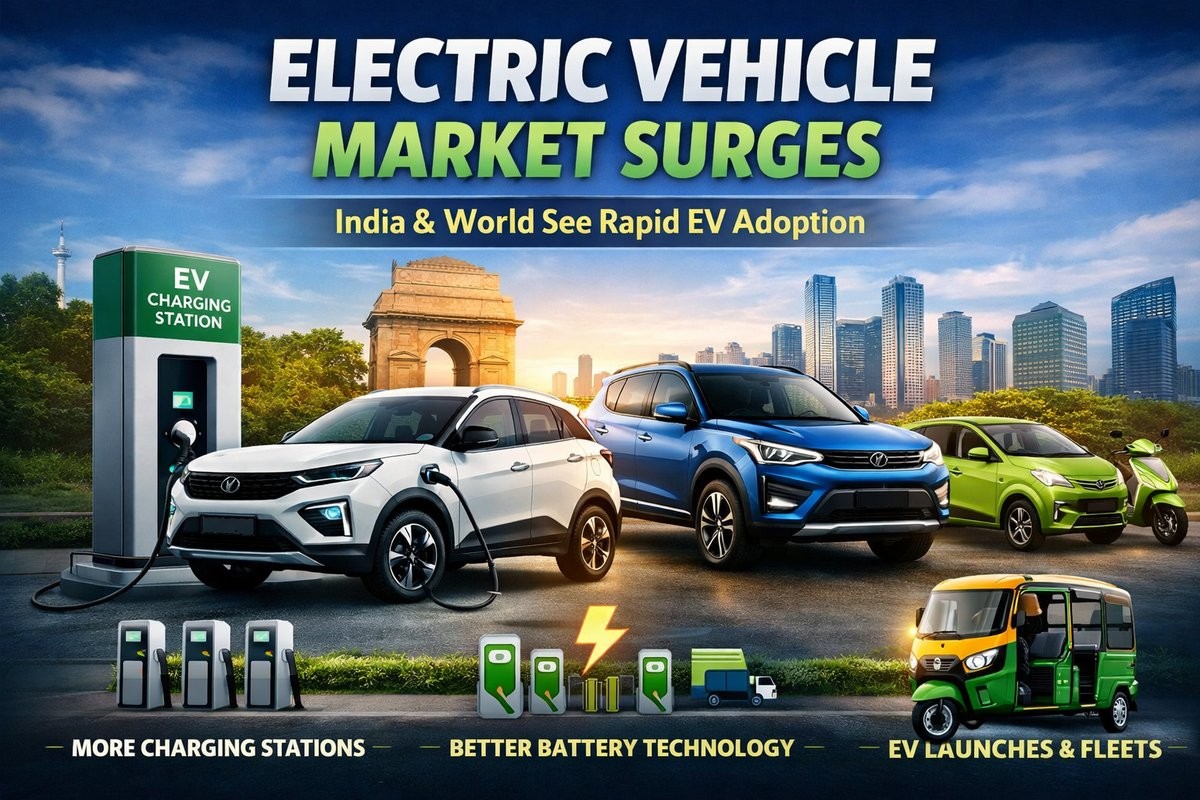
The global electric vehicle (EV) industry witnessed a major surge today as governments, automakers, and technology companies announced new initiatives aimed at accelerating the transition toward sustainable mobility. India, along with major economies such as the United States, China, and European nations, is playing a crucial role in shaping the future of electric transportation.
nn
India Strengthens EV Ecosystem with New Announcements
nn
In one of the most significant developments today, the Indian government reinforced its commitment to electric mobility by introducing new measures to boost EV adoption. Officials highlighted that the country is on track to become one of the largest EV markets globally, supported by strong policy backing and rising consumer demand.
nn
The latest updates include enhanced subsidies for electric vehicles, expansion of charging infrastructure, and increased investment in battery manufacturing. These steps are expected to reduce costs for consumers and encourage more people to shift from traditional fuel-powered vehicles to electric alternatives.
nn
Government officials stated that the focus remains on making EVs affordable, accessible, and sustainable for the average Indian consumer.
nn
Major Automakers Reveal New Electric Models
nn
Several leading automakers made headlines today with the unveiling of next-generation electric vehicles designed for both domestic and international markets.
nn
Tata Motors introduced an upgraded electric SUV with extended range and improved battery efficiency. The company emphasized its commitment to providing cost-effective EV solutions tailored for Indian conditions.
nn
Mahindra Electric also launched a new compact electric SUV, featuring advanced technology and a range exceeding 450 kilometers on a single charge. The vehicle is expected to attract urban and semi-urban buyers looking for a reliable and eco-friendly alternative.
nn
Tesla, which has been exploring entry into the Indian market, made fresh announcements regarding its plans to expand operations in Asia. The company is reportedly in discussions with local authorities to establish manufacturing facilities and charging infrastructure in India.
nn
Meanwhile, global players like Hyundai and BYD showcased their latest EV innovations, focusing on faster charging, enhanced safety, and connected car features.
nn
Charging Infrastructure Expansion Reaches New Milestone
nn
One of the most critical factors driving EV adoption is the availability of charging infrastructure. Today’s reports confirmed that both public and private sectors are aggressively investing in expanding charging networks.
nn
In India, the Ministry of Power announced plans to install over 12,000 new EV charging stations across highways, cities, and rural areas. These stations will include fast-charging capabilities, significantly reducing charging time for users.
nn
Private companies are also contributing to infrastructure growth by introducing innovative solutions such as battery swapping stations, portable chargers, and solar-powered charging hubs.
nn
This expansion is expected to address one of the biggest concerns among EV users—range anxiety—and make electric vehicles more practical for long-distance travel.
nn
Breakthroughs in Battery Technology
nn
Battery technology continues to evolve rapidly, and today’s developments highlighted several breakthroughs that could transform the EV industry.
nn
Researchers and companies are making progress in solid-state batteries, which promise higher energy density, faster charging, and improved safety compared to traditional lithium-ion batteries.
nn
Indian startups and research institutions are also actively working on developing cost-effective battery solutions suited for local conditions. These advancements are expected to:
nn
- n
- Increase driving range
- Reduce charging time
- Lower overall EV costs
n
n
n
nn
Industry experts believe that these innovations will play a crucial role in making EVs more competitive with conventional vehicles.
nn
Electric Two-Wheelers Lead Market Growth
nn
While electric cars receive significant attention, electric two-wheelers are leading the EV revolution in India. Today’s market data shows a sharp increase in sales of electric scooters and motorcycles.
nn
Companies such as Ola Electric, Ather Energy, and TVS Motor Company are expanding their product lines to cater to growing demand. These vehicles are particularly popular among urban commuters due to their affordability and low running costs.
nn
Electric three-wheelers are also gaining traction in the commercial segment, especially for last-mile delivery and passenger transport. Their adoption is being driven by cost savings and government incentives.
nn
Corporate Sector Accelerates EV Adoption
nn
Another major trend highlighted today is the increasing adoption of electric vehicles by corporate fleets. E-commerce companies, logistics providers, and ride-hailing services are transitioning to EVs to reduce operational costs and environmental impact.
nn
Companies like Amazon, Flipkart, and Uber have announced plans to electrify a significant portion of their fleets in the coming years. Today, several new partnerships were announced between these companies and EV manufacturers to speed up the transition.
nn
This shift is expected to create new opportunities in the EV ecosystem, including manufacturing, charging infrastructure, and maintenance services.
nn
Environmental Benefits Drive Policy Support
nn
The push toward electric mobility is closely linked to environmental goals. Governments around the world are focusing on reducing carbon emissions and improving air quality, particularly in urban areas.
nn
In India, air pollution remains a major concern, and EV adoption is seen as a key solution. By replacing internal combustion engine vehicles with electric alternatives, the country aims to significantly reduce greenhouse gas emissions.
nn
Experts note that while EVs are not a complete solution, they are a critical step toward achieving sustainability targets and reducing dependence on fossil fuels.
nn
Challenges Continue to Impact EV Growth
nn
Despite the positive momentum, several challenges still need to be addressed to ensure widespread EV adoption:
nn
- n
- High upfront cost of electric vehicles
- Limited charging infrastructure in remote areas
- Dependence on imported battery materials
- Lack of consumer awareness
n
n
n
n
nn
Industry leaders emphasize the need for continued collaboration between government, industry, and research institutions to overcome these challenges.
nn
Future Outlook: Strong Growth Expected
nn
The outlook for the EV industry remains highly optimistic. Analysts predict that the global EV market will continue to grow rapidly, driven by technological advancements, supportive policies, and increasing consumer awareness.
nn
In India, EV adoption is expected to rise significantly over the next decade, particularly in the two-wheeler and commercial vehicle segments. Automakers are investing heavily in research and development to stay competitive and meet evolving consumer demands.
nn
The integration of advanced technologies such as artificial intelligence, connected systems, and autonomous driving features is also expected to enhance the overall EV experience.
nnn
Today’s developments highlight the accelerating pace of the electric vehicle revolution, both in India and globally. With strong policy support, continuous innovation, and growing market demand, EVs are set to play a central role in the future of transportation.
nn
As governments and industries work together to build a robust EV ecosystem, the transition to cleaner and more sustainable mobility is becoming increasingly achievable. While challenges remain, the progress made so far indicates that the shift toward electric vehicles is not just a trend but an inevitable transformation.
nn
The coming years will be crucial in shaping the EV landscape, and all signs point toward a future where electric mobility becomes the norm rather than the exception.