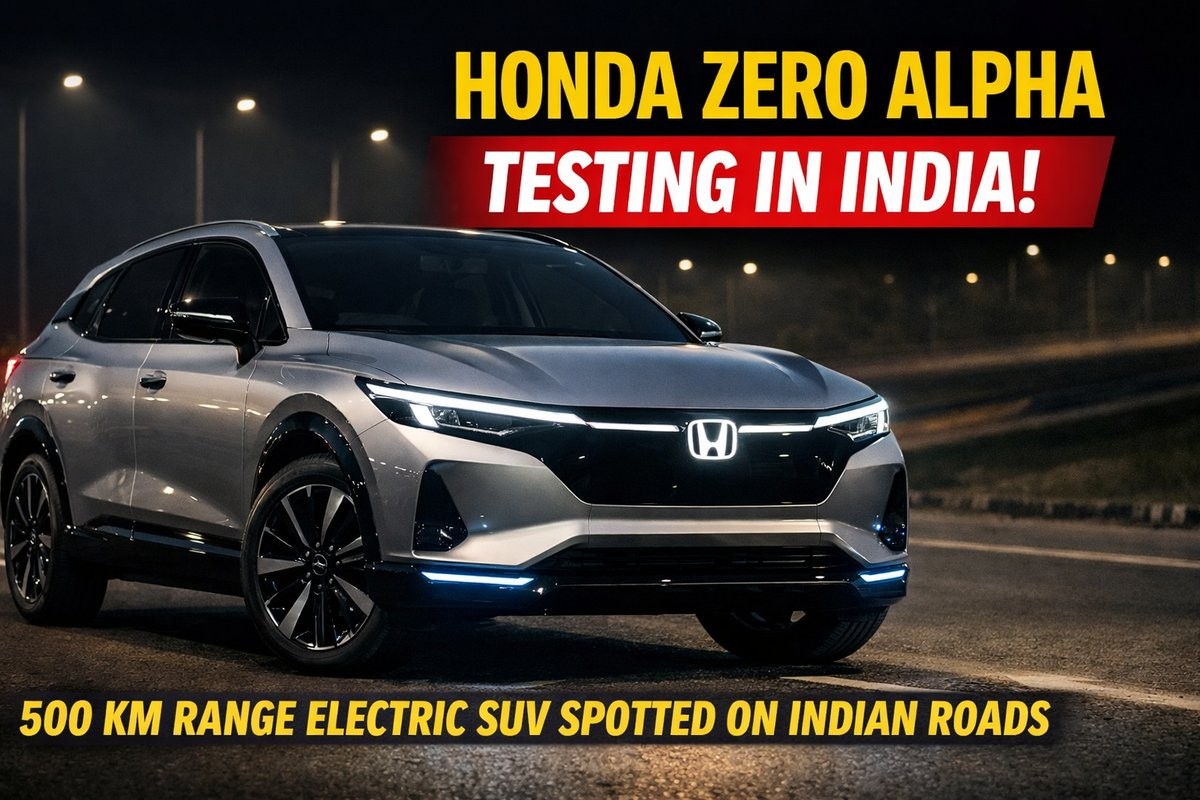
nHonda Cars India has officially begun pan-India road testing of its upcoming electric SUV, marking a major step in the company’s electric mobility strategy for the Indian market. The nationwide testing programme represents the start of the vehicle’s Public Road Verification programme, an extensive evaluation phase where engineers test the vehicle across multiple real-world driving conditions before its commercial launch.n
nn
nThe prototype of the upcoming electric SUV is globally known as the Honda 0 α (Honda Zero Alpha). The futuristic EV concept first attracted global attention when it was unveiled at the Japan Mobility Show 2025. Since then, the model has been one of Honda’s most anticipated electric vehicles worldwide. With road testing now underway in India, the automaker is preparing the vehicle for both domestic and international markets.n
nn
nHonda is planning to introduce the production version of the electric SUV in the financial year 2026–27. India and Japan are expected to be among the key markets where the vehicle will be launched initially. The EV will likely play a significant role in Honda’s long-term transition toward sustainable mobility and electrified vehicle line-ups.n
nn
Honda Starts Public Road Verification Programme Across India
nn
nThe Public Road Verification programme is one of the most important stages in the development of a new vehicle. During this phase, test prototypes are driven across different types of roads and environmental conditions to evaluate how the vehicle performs in real-world scenarios.n
nn
nFor the Honda Zero Alpha electric SUV, engineers have begun driving the prototype vehicles across several regions of India. The testing process includes driving through highways, crowded city streets, rural roads and challenging terrain conditions. The purpose of these tests is to ensure that the vehicle delivers consistent performance, reliability and safety in everyday use.n
nn
nIndia offers a wide range of driving environments, which makes it an ideal testing ground for global vehicle development. The country experiences extreme summer temperatures, heavy monsoon rains and varied road conditions, all of which provide valuable insights into how a vehicle performs under demanding circumstances.n
nn
nDuring this nationwide testing programme, Honda engineers will carefully analyze several critical factors including:n
nn
n• Vehicle durability and long-term reliability
n• Ride comfort and suspension performance
n• Handling and steering response
n• Battery efficiency and energy consumption
n• Electric motor performance
n• Charging compatibility across different infrastructure
n
nn
nThe company will also evaluate how the electric SUV behaves under extreme weather conditions. High summer temperatures and intense humidity during monsoon seasons can significantly impact battery performance and overall vehicle efficiency. By conducting tests in these conditions, Honda aims to ensure that the Zero Alpha EV will perform reliably for Indian customers.n
nn
Testing the EV With India’s Charging Infrastructure
nn
nOne of the key objectives of the testing programme is to evaluate how the upcoming electric SUV interacts with India’s growing EV charging ecosystem. Unlike conventional petrol or diesel vehicles, electric vehicles rely heavily on charging infrastructure, and compatibility with various chargers is essential for smooth daily usage.n
nn
nHonda engineers are expected to test the prototype with multiple types of charging stations available across India, including:n
nn
n• Home charging systems
n• Public AC chargers
n• DC fast-charging stations
n• Highway charging networks
n
nn
nBy testing the vehicle across these different charging environments, Honda will be able to optimize charging speed, battery management systems and energy efficiency for Indian conditions.n
nn
nThe company is also expected to focus on improving the EV’s thermal management system to maintain battery performance in hot climates. Efficient battery cooling is particularly important in countries like India where temperatures can exceed 45°C during peak summer months.n
nn
Honda Zero Alpha Electric SUV Design Highlights
nn
nAlthough the vehicles currently undergoing road testing remain heavily camouflaged, several design details of the Honda Zero Alpha electric SUV were revealed when the concept version was showcased globally.n
nn
nThe concept model featured a futuristic and aerodynamic design language that reflects Honda’s next-generation EV styling direction. The front of the SUV features a clean and minimalist design with a prominent illuminated Honda logo placed at the centre.n
nn
nOne of the unique design elements of the concept is the placement of the charging port at the front of the vehicle, integrated seamlessly near the illuminated badge. This design approach allows easy access when charging the vehicle in tight parking spaces.n
nn
nThe headlamps are sleek and modern, giving the vehicle a distinctive appearance that stands out from conventional SUVs. The front lighting design is expected to use advanced LED technology for improved visibility and energy efficiency.n
nn
nAt the rear, the Honda Zero Alpha concept features a striking full-width U-shaped tail-light signature. This lighting design stretches across the width of the vehicle and creates a futuristic visual identity. Such continuous LED lighting elements have become increasingly popular among modern electric vehicles as they enhance both visibility and styling.n
nn
nAnother design highlight is the set of large 19-inch wheels, which provide the SUV with a strong and premium road presence. The aerodynamic wheel design also helps reduce drag and improve overall efficiency.n
nn
Expected Battery Options and Driving Range
nn
nUnder the hood, or rather beneath the floor of the vehicle, the Honda Zero Alpha electric SUV is expected to offer two battery pack options. Although Honda has not yet officially revealed the exact battery specifications, industry reports suggest that the battery capacities may range between 65 kWh and 75 kWh.n
nn
nBoth battery packs are expected to use LFP (Lithium Iron Phosphate) battery technology. LFP batteries are increasingly popular in electric vehicles because they offer several advantages including improved thermal stability, longer lifespan and lower manufacturing costs compared to other battery chemistries.n
nn
nThese batteries are also considered safer under high temperature conditions, which makes them suitable for markets like India where environmental conditions can be challenging.n
nn
nThe electric SUV is expected to deliver a driving range of around 500 kilometres on a single charge. Such a range would place the vehicle among the competitive options in India’s mid-size electric SUV segment.n
nn
nFor most daily users, a 500 km range means that the vehicle could comfortably handle several days of commuting without needing frequent charging. This is particularly important in India where charging infrastructure is still expanding in many regions.n
nn
Expected Powertrain Configuration
nn
nAt launch, Honda is expected to offer the electric SUV with a single-motor front-wheel-drive setup. This configuration is commonly used in many electric SUVs as it balances performance, efficiency and cost.n
nn
nThe electric motor will likely deliver strong acceleration and smooth power delivery, which are typical advantages of electric vehicles. Unlike traditional engines that require gear shifts, electric motors provide instant torque, resulting in quick and responsive acceleration.n
nn
nAlthough Honda has not yet confirmed power figures, the electric SUV is expected to offer performance suitable for both city driving and highway cruising. Future versions may also include dual-motor all-wheel-drive variants depending on market demand.n
nn
Competition in India’s Growing Electric SUV Segment
nn
nWhen the Honda Zero Alpha electric SUV launches in India, it will enter one of the fastest growing segments in the automotive market. Electric SUVs are gaining popularity due to their practicality, long driving range and lower running costs compared to petrol and diesel vehicles.n
nn
nThe upcoming Honda EV will compete with several new and upcoming electric SUVs including:n
nn
n• Maruti e Vitara
n• Mahindra BE 6
n• Hyundai Creta Electric
n• Tata Curvv EV
n• MG ZS EV (next generation)
n
nn
nThese vehicles are expected to offer ranges between 400 km and 550 km, making the competition in this segment extremely intense. Honda will need to differentiate its product through technology, reliability and driving experience.n
nn
nHonda has traditionally built a strong reputation for engineering quality and durability, and the company will likely leverage these strengths when positioning the Zero Alpha electric SUV.n
nn
Honda’s Electric Vehicle Strategy for India
nn
nThe launch of the Zero Alpha electric SUV represents a major milestone in Honda’s electrification strategy for India. While the company has been relatively cautious about EV adoption compared to some competitors, it is now accelerating its electric vehicle plans.n
nn
nIndia is becoming one of the fastest growing EV markets in the world, supported by government incentives, improving charging infrastructure and rising consumer awareness about sustainable mobility.n
nn
nBy introducing a locally manufactured electric SUV, Honda aims to strengthen its position in the Indian automotive market while contributing to the country’s transition toward cleaner transportation.n
nn
nThe company is expected to manufacture the electric SUV in India and also export it to global markets. Local manufacturing will help Honda reduce production costs and price the vehicle competitively.n
nn
India as a Global EV Manufacturing Hub
nn
nAutomakers are increasingly viewing India as an important global manufacturing hub for electric vehicles. The country offers several advantages including a large consumer market, skilled engineering talent and government policies that encourage EV production.n
nn
nIf the Honda Zero Alpha electric SUV is manufactured locally, it could be exported to several international markets including Southeast Asia, Europe and other emerging EV markets.n
nn
nExporting EVs from India would also strengthen Honda’s global supply chain and support the company’s long-term electrification goals.n
nn
What This Means for Indian EV Buyers
nn
nFor Indian consumers, the arrival of Honda’s first electric SUV could provide another strong option in the mid-size EV segment. Buyers are increasingly looking for vehicles that offer long driving range, reliable technology and a trusted brand reputation.n
nn
nHonda’s entry into this segment could also increase competition, which may lead to better pricing, improved technology and more choices for customers.n
nn
nAs the EV market continues to expand, automakers are expected to introduce more models with advanced battery technology, faster charging capabilities and improved driving range.n
nnn
nHonda Cars India beginning the nationwide road testing of its upcoming electric SUV marks an important step toward the vehicle’s global launch. The Honda Zero Alpha EV is expected to bring modern design, advanced battery technology and a driving range of around 500 kilometres.n
nn
nWith testing now underway across different regions of India, Honda engineers will continue evaluating the vehicle’s performance, durability and charging compatibility under real-world conditions.n
nn
nIf everything proceeds according to plan, the production version of the Honda Zero Alpha electric SUV could arrive in showrooms during the financial year 2026–27. When it launches, it will compete with several new electric SUVs in India’s rapidly growing EV market.n
nn
nThe upcoming model could play a key role in Honda’s electrification strategy while offering Indian customers another compelling option in the electric SUV segment.n