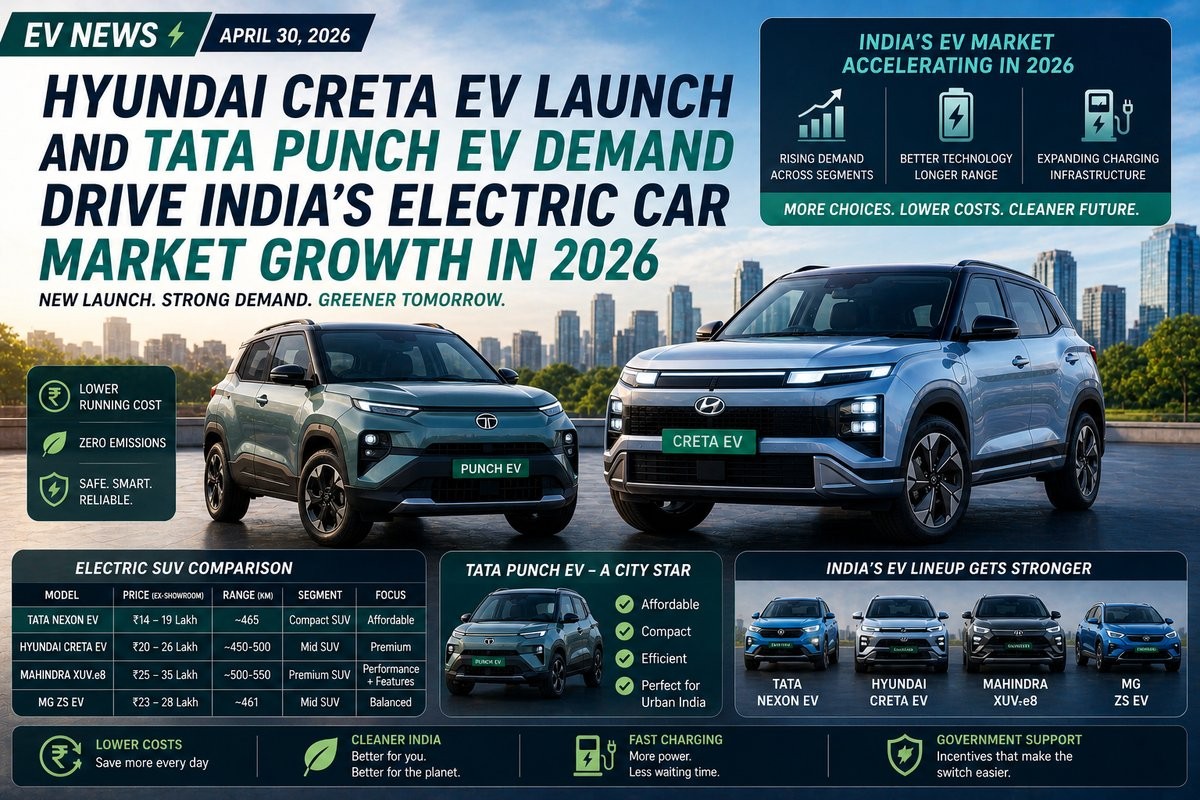
India’s electric vehicle (EV) market is witnessing a strong surge in 2026, driven by new car launches, increasing competition, and growing consumer demand. Automakers are focusing on expanding their EV portfolios with better technology, longer range, and competitive pricing, making electric cars more accessible to a wider audience.
nn
Recent developments such as the launch of the Hyundai Creta EV, rising popularity of Tata Punch EV, and intense competition in the electric SUV segment highlight the rapid evolution of the EV industry in India.
nn
Hyundai Creta EV Official Launch
nn
Hyundai has officially launched the Creta EV in India, marking a major step in the company’s electric vehicle strategy. The Creta EV is positioned in the mid-size SUV segment and is expected to compete with popular models like Tata Nexon EV, MG ZS EV, and Mahindra electric SUVs.
nn
The vehicle features a modern design with a closed grille, LED lighting, and aerodynamic styling. It retains the overall appeal of the standard Creta while incorporating EV-specific elements.
nn
Inside, the Creta EV offers a premium cabin with a large touchscreen infotainment system, digital instrument cluster, and advanced connectivity features.
nn
The SUV is expected to offer a driving range of around 450 to 500 km, making it suitable for both daily commuting and long-distance travel.
nn
Tata Punch EV Gains Strong Market Response
nn
Alongside new launches, existing models are also playing a key role in the EV market’s growth. The Tata Punch EV has emerged as one of the most popular affordable electric cars in India.
nn
The Punch EV is designed for urban users and offers a compact size, practical range, and affordable pricing. It has attracted first-time EV buyers looking for a budget-friendly option.
nn
This model highlights the importance of affordable EVs in increasing overall adoption.
nn
Electric SUV Segment Becomes Highly Competitive
nn
The electric SUV segment is currently the most competitive part of India’s EV market. Automakers are launching new models and updating existing ones to capture a larger share of this growing segment.
nn
Popular vehicles in this segment include Tata Nexon EV, Hyundai Creta EV, MG ZS EV, Mahindra XUV.e8, and upcoming models like Tata Sierra EV and Maruti eVitara.
nn
These vehicles offer a combination of performance, range, and features, making them attractive to a wide range of buyers.
nn
Electric SUV Comparison: Nexon EV vs Creta EV vs XUV.e8 vs ZS EV
nn
| Feature | Tata Nexon EV | Hyundai Creta EV | Mahindra XUV.e8 | MG ZS EV |
|---|---|---|---|---|
| Price | ₹14–19 Lakh | ₹20–26 Lakh | ₹25–35 Lakh | ₹23–28 Lakh |
| Range | ~465 km | ~450–500 km | ~500–550 km | ~461 km |
| Segment | Compact SUV | Mid SUV | Premium SUV | Mid SUV |
| Focus | Affordable | Premium | Performance + Features | Balanced |
nn
This comparison highlights the diversity of options available in the market. Buyers can choose based on their budget, performance needs, and feature preferences.
nn
Growth of Affordable EV Segment
nn
The affordable EV segment is expanding rapidly, with more companies launching budget-friendly models. These vehicles are priced between ₹8 lakh and ₹15 lakh, making them accessible to a larger audience.
nn
Affordable EVs are crucial for increasing adoption, especially in smaller cities and towns.
nn
Premium EV Segment Drives Innovation
nn
The premium EV segment continues to push technological innovation. These vehicles offer advanced features such as large digital displays, driver assistance systems, and high-performance electric powertrains.
nn
Although they are more expensive, they influence the development of future EV models.
nn
Technology Advancements Improve EV Experience
nn
Electric vehicles are becoming more advanced with improvements in battery technology, range, and charging speed. Modern EVs come equipped with connected car features, digital dashboards, and smart controls.
nn
Battery efficiency has improved significantly, allowing vehicles to travel longer distances on a single charge.
nn
Fast charging capabilities are also improving, reducing charging time and increasing convenience.
nn
Charging Infrastructure Expanding
nn
The expansion of charging infrastructure is supporting EV growth. More charging stations are being installed in cities, highways, and residential areas.
nn
Fast-charging networks are also improving, making EVs more practical for long-distance travel.
nn
However, infrastructure still needs to improve in smaller towns to support wider adoption.
nn
EV Market Growth Trends
nn
The EV market in India is growing steadily, with increasing sales across different segments. More consumers are choosing electric vehicles due to lower running costs and environmental benefits.
nn
Fleet operators and businesses are also adopting EVs, contributing to overall growth.
nn
This trend is expected to continue as more models become available.
nn
Price Reduction and Incentives
nn
Automakers are offering discounts and incentives to make EVs more affordable. Government subsidies and tax benefits are also helping reduce the cost of ownership.
nn
These measures are encouraging more buyers to switch to electric vehicles.
nn
Challenges in EV Market
nn
Despite strong growth, the EV market still faces challenges such as high initial cost and limited charging infrastructure in some areas.
nn
Battery replacement cost is another concern for buyers.
nn
Addressing these challenges will be important for long-term growth.
nn
Changing Consumer Preferences
nn
Consumer preferences are evolving as people become more aware of electric vehicles. Buyers are now looking for better range, advanced features, and cost savings.
nn
This shift is driving innovation and competition in the EV market.
nn
Future Outlook
nn
The future of India’s EV market looks promising, with strong growth expected in the coming years. More affordable models, better infrastructure, and increasing competition will drive adoption.
nn
Electric SUVs are expected to remain the most popular segment due to their practicality and demand.
nnn
The EV market in India in 2026 is evolving rapidly with new launches like the Hyundai Creta EV and strong demand for models like the Tata Punch EV.
nn
With better technology, more choices, and improving infrastructure, electric vehicles are becoming an important part of India’s automotive future.