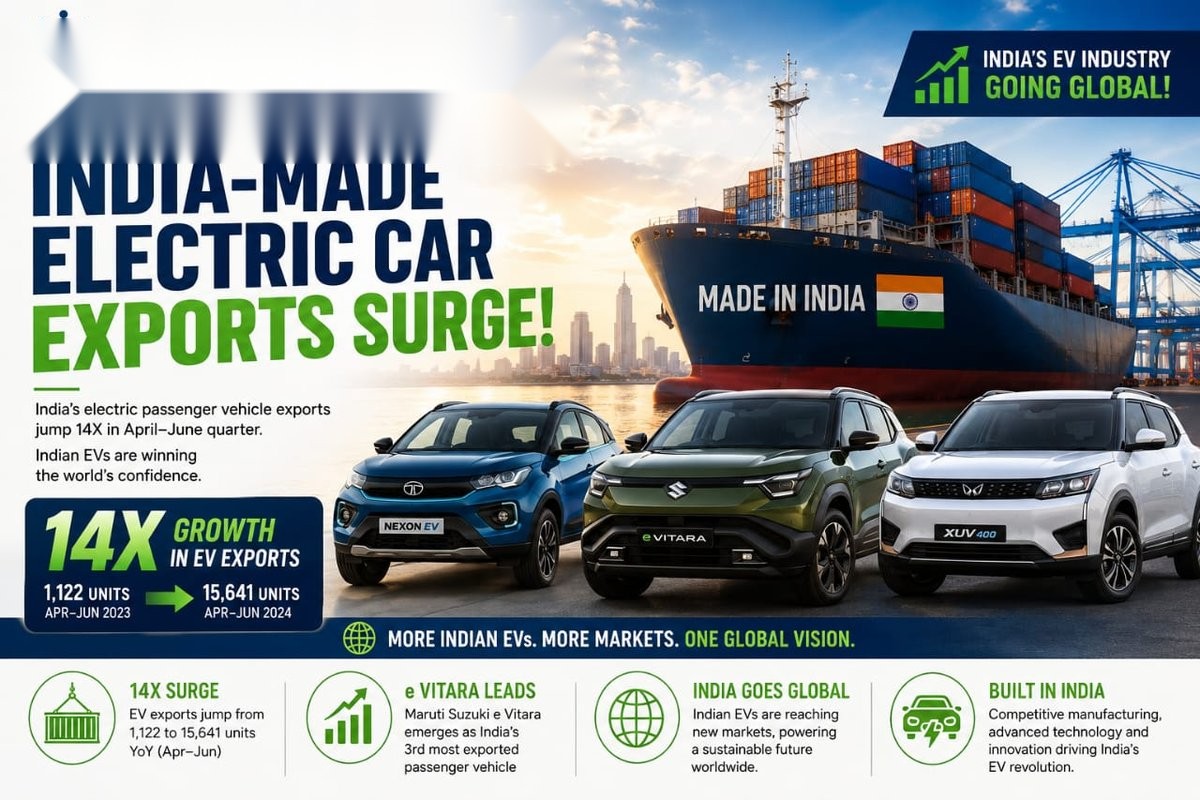
India’s electric vehicle industry has achieved a major export milestone, with electric passenger vehicle exports recording massive growth as Indian-made EVs gain traction in international markets. The latest industry data shows that EV exports reached 15,641 units during the April-June quarter, compared with just 1,122 units during the same period a year earlier.
This represents an extraordinary increase of nearly 14 times and highlights how India is gradually evolving from an emerging domestic EV market into an important manufacturing and export base for electric vehicles.
The surge is being driven by major Indian automakers including Maruti Suzuki, Tata Motors and Mahindra, which are increasingly looking beyond the domestic market and expanding their electric vehicle ambitions internationally.
India’s EV Export Story Is Entering a New Phase
For years, discussions surrounding India’s electric vehicle transition primarily focused on domestic adoption. The biggest questions revolved around EV affordability, charging infrastructure, battery range and whether Indian consumers were ready to move away from petrol and diesel vehicles.
That conversation is now becoming much broader.
India is increasingly positioning itself not only as a large market for electric vehicles but also as a potential manufacturing hub capable of supplying EVs to customers around the world.
The latest export numbers provide strong evidence of this transformation.
Electric passenger vehicle exports climbed from 1,122 units in the April-June period a year earlier to 15,641 units during the latest corresponding quarter.
Even more significantly, exports during these three months alone represented more than half of the 28,652 electric passenger vehicles exported during the entire previous financial year.
This rapid acceleration indicates that international demand could become an increasingly important part of the growth strategy for Indian EV manufacturers.
Maruti Suzuki e Vitara Emerges as Major Export Driver
One of the biggest contributors to the export surge has been the Maruti Suzuki e Vitara.
The electric SUV represents an important milestone for Maruti Suzuki as the company expands into the battery-electric vehicle segment.
More importantly, the e Vitara has been designed with both Indian and international markets in mind.
The model emerged as India’s third-most exported passenger vehicle during the latest quarter, demonstrating the potential for India-manufactured electric cars to compete internationally.
For Maruti Suzuki, this is particularly significant because the company has historically built its dominance around affordable petrol and CNG vehicles in India.
The expansion of its EV export programme signals a much larger transformation within the company’s global strategy.
Tata Motors Strengthens Its Electric Ambitions
Tata Motors has played a central role in building India’s domestic electric passenger vehicle market.
Models such as the Tiago EV, Punch EV, Nexon EV and newer electric SUVs have helped introduce battery-powered vehicles to a much wider group of Indian consumers.
The next stage of growth could increasingly involve international markets.
India already has a developing ecosystem of automotive manufacturing, engineering expertise and component suppliers. If Tata can leverage these strengths for international EV expansion, exports could become another important growth opportunity for the company.
Competition from other manufacturers is also encouraging Tata Motors to continue improving battery technology, vehicle platforms, charging capability, software and overall product quality.
Mahindra’s New-Generation EV Strategy
Mahindra has also significantly increased its commitment to electric mobility.
The company’s latest generation of electric SUVs demonstrates how dramatically the Indian EV market has evolved.
Instead of simply converting existing petrol-powered vehicles into electric models, manufacturers are increasingly developing dedicated electric platforms.
These platforms can offer advantages in areas such as cabin space, battery packaging, performance, software integration and overall efficiency.
Mahindra’s growing electric portfolio could eventually create additional export opportunities as the company evaluates international markets for its next-generation products.
Why Are India-Made EV Exports Growing?
Several factors are contributing to the rapid growth of electric vehicle exports from India.
1. Competitive Manufacturing Costs
India has developed one of the world’s largest automotive manufacturing ecosystems.
Manufacturers operating in the country benefit from extensive supplier networks, engineering expertise and large-scale vehicle production capabilities.
These advantages can help Indian factories manufacture vehicles at competitive costs while maintaining increasingly high global quality standards.
2. Global Demand for Affordable EVs
Electric vehicles remain relatively expensive in many international markets.
While premium EVs have become increasingly common, there is still substantial demand for practical and affordable electric cars.
This is an area where Indian manufacturers could potentially establish a strong competitive position.
Compact electric SUVs and urban EVs manufactured in India may appeal to international buyers looking for lower-cost alternatives to premium electric vehicles.
3. Higher Fuel Costs
Volatility in global energy markets has once again highlighted the financial advantages of electric mobility for some consumers.
When petrol and diesel prices increase, the lower running costs associated with electric vehicles can become considerably more attractive.
This could further increase global demand for affordable EVs.
4. Improving Indian EV Technology
Indian electric cars are becoming increasingly sophisticated.
Modern EVs manufactured in the country now offer technologies including:
- Large-capacity battery packs
- Fast DC charging
- Connected vehicle technology
- Advanced infotainment systems
- Over-the-air software updates
- Advanced driver assistance systems
- Battery thermal management
- Multiple regenerative braking modes
- Digital instrument clusters
- Vehicle-to-load functionality on selected models
This means Indian EV manufacturers are increasingly able to compete on technology and features rather than relying solely on lower prices.
India Could Become a Global EV Manufacturing Hub
The export surge raises an important question: can India become one of the world’s major electric vehicle manufacturing centres?
The country already possesses several advantages.
India has a massive domestic automobile market, an established vehicle manufacturing ecosystem, a large engineering workforce and decades of experience exporting automobiles.
Electric mobility provides an opportunity to build on these strengths.
If domestic battery production, semiconductor availability and EV component manufacturing continue to improve, India could potentially manufacture a larger percentage of the value contained inside an electric vehicle locally.
That would strengthen both domestic EV affordability and international competitiveness.
Battery Manufacturing Will Be Critical
Vehicles are only one part of the electric mobility supply chain.
The battery remains one of the most valuable and strategically important components inside an electric vehicle.
India currently continues to depend on international supply chains for several important battery materials and components.
Increasing domestic battery manufacturing could therefore become crucial to the next stage of the country’s EV development.
A stronger local battery ecosystem could potentially deliver several advantages:
- Lower battery costs
- Reduced dependence on imports
- Greater supply-chain security
- More EV manufacturing jobs
- Better battery technology development
- Stronger export competitiveness
Battery recycling will also become increasingly important as the number of electric vehicles on Indian and international roads grows.
Indian EVs Must Meet Global Expectations
Growing exports create opportunities, but they also create new challenges.
International customers may have different expectations regarding safety, charging compatibility, software, climate performance and vehicle quality.
Indian manufacturers will therefore need to ensure their EVs satisfy regulatory requirements across multiple markets.
Areas that could become particularly important include:
- Crash safety
- Battery safety
- Thermal management
- Charging compatibility
- Software reliability
- Cybersecurity
- Battery warranties
- After-sales support
Successfully competing globally could ultimately benefit Indian consumers as well because manufacturers will have greater incentive to improve quality and technology across their product portfolios.
EV Exports Could Strengthen India’s Automotive Industry
A strong EV export industry could create benefits far beyond vehicle manufacturers.
The electric mobility ecosystem includes hundreds of different technologies and components.
Growth in exports could create additional opportunities for companies working in:
- Battery packs
- Electric motors
- Power electronics
- Vehicle control units
- Charging hardware
- Automotive software
- Thermal management systems
- Semiconductors
- Battery recycling
- Automotive electronics
As vehicle exports increase, suppliers could gain the production volumes required to invest further in technology and manufacturing capacity.
Domestic EV Adoption Is Also Accelerating
The export story is happening alongside rapid growth within India itself.
Electric passenger vehicles have been steadily increasing their share of the Indian automobile market as consumers receive access to more models across different price categories.
Recent industry estimates have placed electric passenger vehicle penetration at around 6.5 percent during the first quarter of FY2027, compared with approximately 4.6 percent during FY2026.
This demonstrates that India’s EV industry is expanding simultaneously in two directions: domestic adoption and international exports.
More Competition Is Coming
The Indian electric passenger vehicle market is becoming increasingly competitive.
Tata Motors, Mahindra, MG, Hyundai, Kia, Maruti Suzuki and several premium manufacturers are now competing for EV buyers.
New models are arriving with longer ranges, larger battery packs and increasingly sophisticated technology.
This competition is particularly visible in the electric SUV segment.
Manufacturers are now competing across several key areas:
- Purchase price
- Real-world driving range
- Charging speed
- Battery warranty
- Performance
- Software experience
- Safety technology
- Charging ecosystem
- Ownership costs
For consumers, stronger competition should ultimately result in better electric vehicles and greater choice.
Charging Infrastructure Remains Important
While exports are growing, the development of charging infrastructure remains essential for domestic EV adoption.
Indian consumers increasingly expect reliable charging not only within cities but also along major highways.
A complete charging ecosystem needs to include:
- Home charging
- Apartment charging
- Workplace charging
- Public AC charging
- DC fast charging
- Highway charging hubs
- Fleet charging infrastructure
The availability and reliability of these chargers will influence how quickly mainstream consumers become comfortable switching from internal combustion vehicles to EVs.
Affordable Electric Cars Could Be India’s Global Advantage
One of India’s biggest opportunities could lie in developing electric cars that combine affordability with practical range and modern technology.
Many global EV manufacturers initially concentrated on expensive premium vehicles because high battery costs made cheaper EVs difficult to manufacture profitably.
India’s automotive industry has decades of experience developing cost-efficient compact vehicles.
Applying that expertise to electric mobility could allow Indian factories to produce EVs suited not only to India but also to other price-sensitive international markets.
This could become particularly relevant across parts of Asia, Africa, Latin America and other emerging automotive markets.
Software Is Becoming Part of the Competition
Electric vehicles are also accelerating the transformation of cars into software-driven products.
Consumers increasingly expect their vehicles to receive new functionality through software updates and connected services.
Future Indian EVs could increasingly compete through:
- Over-the-air updates
- Connected smartphone applications
- Remote vehicle monitoring
- Charging management
- Navigation with charging integration
- Battery health information
- Advanced driver assistance
- Digital keys
This means India’s future EV export competitiveness will depend not only on manufacturing vehicles efficiently but also on developing strong automotive software capabilities.
What This Means for Indian EV Buyers
Increasing exports may appear primarily relevant to manufacturers, but they could eventually benefit Indian consumers too.
Higher production volumes can improve economies of scale.
Manufacturers that produce the same or related EV platforms for domestic and international markets may be able to spread development and manufacturing costs across a larger number of vehicles.
Global competition can also encourage manufacturers to improve safety, quality, battery performance and software.
Indian consumers could therefore gain access to increasingly sophisticated EVs as manufacturers expand internationally.
India’s EV Journey Is Becoming Global
The latest export numbers represent an important milestone for India’s electric mobility industry.
Going from 1,122 electric passenger vehicle exports in a quarter to 15,641 units within the corresponding period represents a dramatic transformation.
It demonstrates that India’s EV story is no longer limited to convincing domestic consumers to switch from petrol and diesel.
The industry is beginning to explore a much larger opportunity: manufacturing electric vehicles in India for customers around the world.
Maruti Suzuki’s e Vitara has provided significant momentum, while manufacturers including Tata Motors and Mahindra are also strengthening their international ambitions.
If India can combine competitive manufacturing, locally developed technology, stronger battery production and global-quality vehicles, electric mobility could become one of the country’s most important automotive export opportunities.
Take
India’s 14-fold increase in electric passenger vehicle exports is one of the clearest signals yet that the country’s EV industry is entering a new stage.
The next challenge will be maintaining this momentum while simultaneously strengthening domestic battery production, charging infrastructure, vehicle safety and EV affordability.
India already has the manufacturing foundation.
It has the engineering talent.
It has one of the world’s largest automotive markets.
And now Indian-made electric vehicles are increasingly reaching international roads.
The next chapter of India’s EV revolution may not only be about electric cars sold in India — it could be about electric cars made in India and driven around the world.
— Your Destination for Electric Vehicle News, Technology, Reviews and Future Mobility.