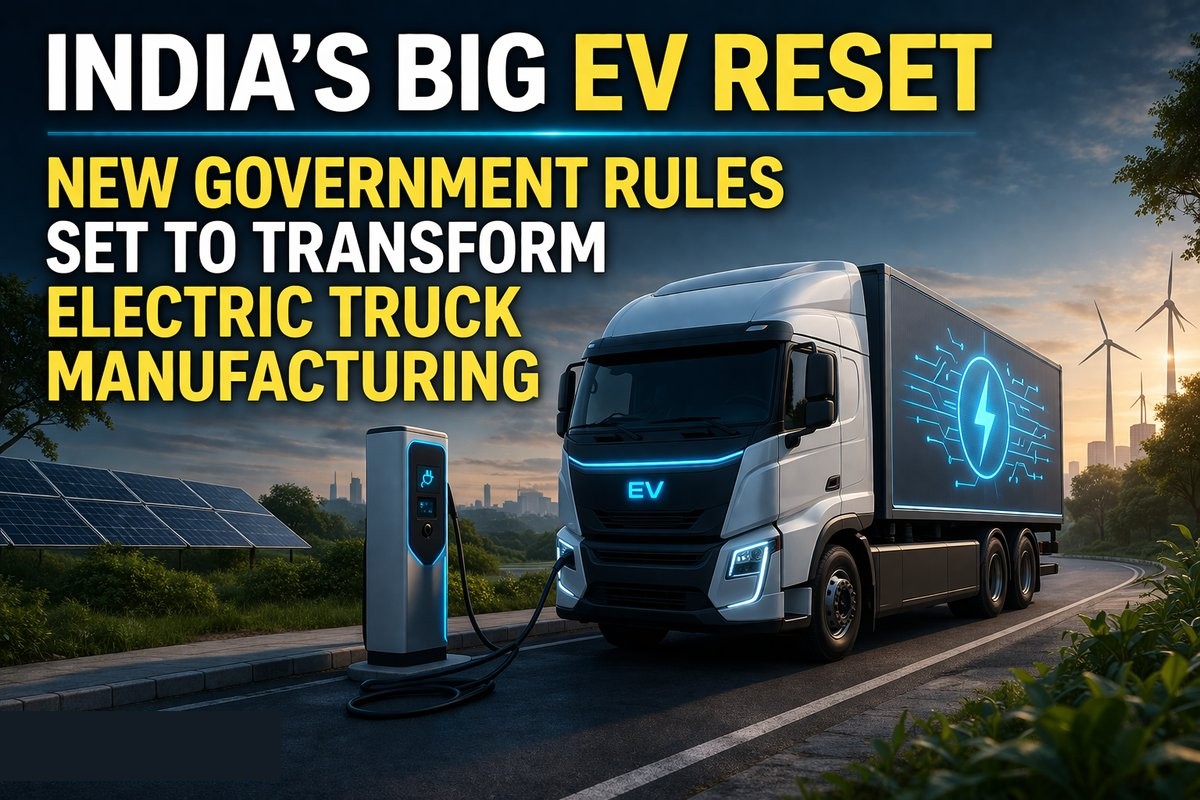
India’s electric vehicle (EV) industry is entering a new phase of transformation as the government prepares to introduce updated regulations for electric trucks. These new rules are expected to significantly change how electric commercial vehicles are designed, manufactured, and integrated in the country.
nn
The move is being seen as a “big EV reset,” especially for the electric truck segment, which has so far lagged behind passenger EVs in adoption. The updated policy framework aims to improve performance standards, ensure better component quality, and align India’s EV ecosystem with global benchmarks.
nn
What is the Big EV Reset?
nn
The term “big EV reset” refers to a major overhaul of technical and manufacturing standards for electric trucks in India. The government is focusing on standardising and improving key components that form the backbone of electric commercial vehicles.
nn
The new rules will primarily cover four critical areas:
nn
- n
- Traction motors
- Integrated motor and transmission systems
- Motor controllers
- Inverters
n
n
n
n
nn
These components play a crucial role in determining the efficiency, performance, and reliability of electric trucks. By setting stricter requirements, the government aims to ensure higher quality and consistency across manufacturers.
nn
Focus on Performance and Reliability
nn
One of the main objectives of the new rules is to improve the overall performance and reliability of electric trucks. In recent years, the EV market in India has grown rapidly, but concerns around durability and component quality—especially in commercial vehicles—have remained.
nn
Electric trucks operate under demanding conditions, often carrying heavy loads over long distances. Any failure in key components such as motors or controllers can lead to significant operational losses.
nn
By introducing stricter technical guidelines, the government aims to address these challenges and ensure that electric trucks meet higher standards of durability and efficiency.
nn
Impact on Manufacturers and Suppliers
nn
The new regulations are expected to have a major impact on automotive manufacturers and component suppliers, particularly Tier-1 companies that supply critical EV components.
nn
Manufacturers will need to:
nn
- n
- Upgrade their existing designs
- Invest in research and development (R&D)
- Align production processes with new standards
n
n
n
nn
While this may increase costs in the short term, it is expected to result in better products and improved competitiveness in the long run.
nn
For suppliers, the changes will require a shift toward more advanced technologies and higher-quality manufacturing processes. This could lead to consolidation in the supplier ecosystem, with only the most capable companies able to meet the new requirements.
nn
Challenges Ahead
nn
Despite the long-term benefits, the transition to the new rules may not be easy. Industry experts have highlighted several potential challenges, including:
nn
- n
- Increased R&D costs
- Disruption of existing supply chains
- Delays in product development and launches
n
n
n
nn
Many companies have already invested heavily in current technologies, and adapting to new standards could require significant additional investment.
nn
However, these challenges are seen as a necessary step toward building a more robust and globally competitive EV ecosystem.
nn
Boost for Innovation
nn
One of the key advantages of the new rules is that they are expected to drive innovation in the EV sector. By setting higher benchmarks, the government is encouraging companies to develop more advanced technologies and improve their products.
nn
This could lead to:
nn
- n
- More efficient electric drivetrains
- Better battery management systems
- Improved vehicle performance
n
n
n
nn
In the long run, this innovation could help Indian companies compete more effectively in global markets.
nn
Alignment with Global Standards
nn
Another important aspect of the new policy is its focus on aligning India’s EV standards with international benchmarks.
nn
Global markets are rapidly moving toward stricter regulations for electric vehicles, particularly in terms of safety, efficiency, and emissions. By adopting similar standards, India can:
nn
- n
- Improve export opportunities for domestic manufacturers
- Attract global investments
- Enhance technological collaboration
n
n
n
nn
This alignment is crucial for India’s ambition to become a global hub for EV manufacturing.
nn
Importance of Electric Trucks in India
nn
Electric trucks are a critical component of India’s transition to sustainable transportation. Although they represent a small percentage of the total vehicle fleet, they contribute significantly to fuel consumption and emissions.
nn
Heavy-duty trucks account for a large share of pollution and operating costs in the logistics sector. Electrifying this segment can:
nn
- n
- Reduce carbon emissions
- Lower fuel costs
- Improve air quality
n
n
n
nn
As India continues to urbanise and industrialise, the demand for efficient and sustainable logistics solutions is expected to grow.
nn
Government’s Broader EV Strategy
nn
The new rules for electric trucks are part of a broader strategy to promote electric mobility in India. The government has already introduced several initiatives, including:
nn
- n
- FAME and PM E-DRIVE schemes
- Incentives for EV buyers
- Support for charging infrastructure
n
n
n
nn
These initiatives aim to make EVs more accessible and affordable, while also supporting domestic manufacturing.
nn
Role of Local Manufacturing
nn
Local manufacturing is a key focus area under the new rules. The government wants to reduce dependence on imports and strengthen the domestic EV ecosystem.
nn
By encouraging local production of key components such as motors and controllers, India can:
nn
- n
- Create jobs
- Reduce costs over time
- Improve supply chain resilience
n
n
n
nn
This approach is aligned with the “Make in India” initiative and aims to position India as a global manufacturing hub.
nn
Future of Electric Trucks in India
nn
The electric truck segment in India is still in its early stages, but it is expected to grow rapidly in the coming years. Factors driving this growth include:
nn
- n
- Rising fuel prices
- Government incentives
- Improving technology
n
n
n
nn
With the introduction of new rules, the sector is likely to become more structured and competitive.
nn
Industry experts believe that the next few years will be crucial for the adoption of electric trucks, as companies invest in new technologies and infrastructure.
nn
Industry Response
nn
The response from the industry has been mixed. While many companies support the move toward higher standards, some have expressed concerns about the cost and complexity of implementation.
nn
However, there is a general consensus that the new rules will ultimately benefit the industry by improving product quality and building consumer trust.
nn
Environmental Impact
nn
The new regulations are also expected to have a positive impact on the environment. By improving the performance and reliability of electric trucks, the government aims to accelerate their adoption.
nn
This could lead to:
nn
- n
- Reduced greenhouse gas emissions
- Lower dependence on fossil fuels
- Cleaner air in urban areas
n
n
n
nn
As India works toward its climate goals, electrifying the transport sector will play a key role.
nnn
India’s “big EV reset” marks a significant step forward in the country’s journey toward electric mobility. By introducing stricter standards for electric truck components, the government is laying the foundation for a more robust and competitive EV ecosystem.
nn
While the transition may present challenges for manufacturers, the long-term benefits in terms of innovation, quality, and global competitiveness are substantial.
nn
The new rules are expected to reshape the electric truck segment, making it more efficient, reliable, and sustainable. As the industry adapts to these changes, India is well-positioned to become a leader in the global EV market.
nn
The coming years will be crucial as manufacturers, suppliers, and policymakers work together to drive the next phase of EV growth in the country.