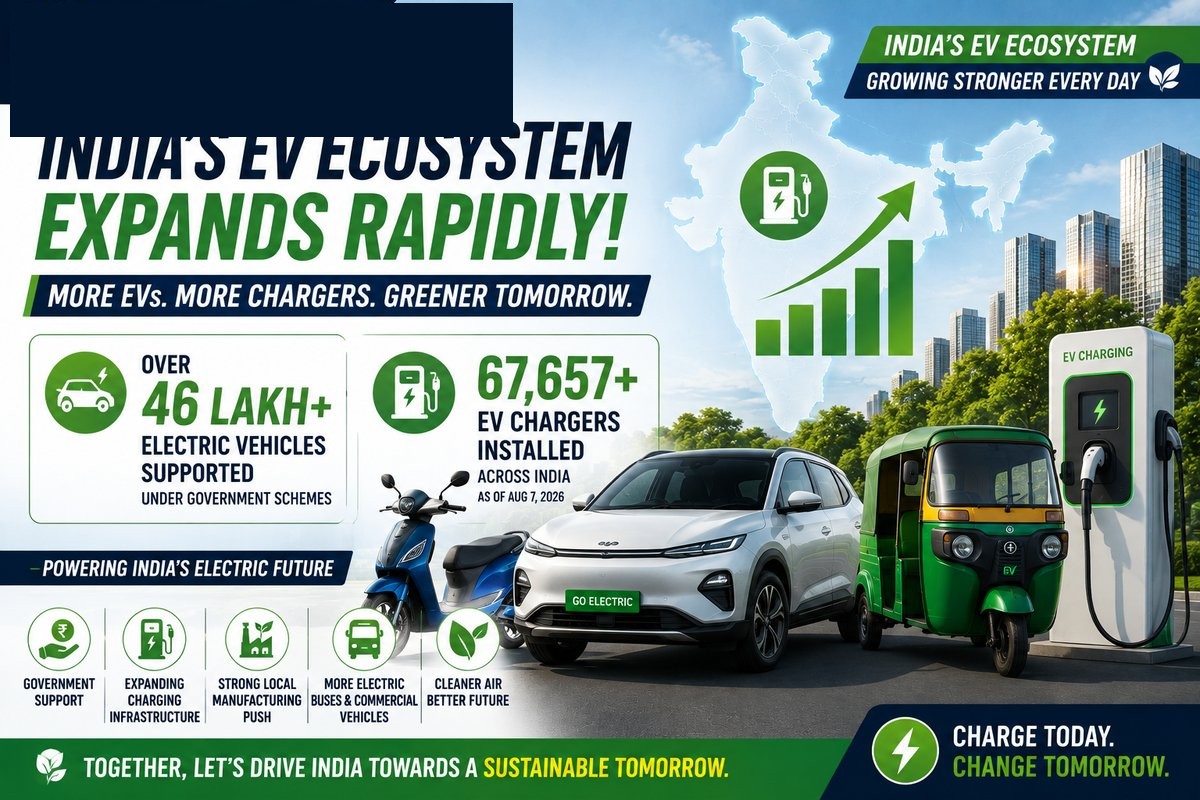
Summary: India’s electric mobility ecosystem is witnessing rapid expansion, with more than 46 lakh electric vehicles supported through various government initiatives. At the same time, the country’s EV charging network has grown to 67,657 chargers across States and Union Territories, strengthening the infrastructure required for large-scale EV adoption.
India Accelerates Its Electric Mobility Push
India is continuing to strengthen its electric vehicle ecosystem through a combination of consumer incentives, manufacturing programmes, charging infrastructure investments and public transport electrification.
According to the latest government update, more than 46 lakh EVs have been supported under different schemes of the Ministry of Heavy Industries. These initiatives cover electric two-wheelers, three-wheelers, passenger vehicles, buses, trucks and other electric mobility applications. :contentReference[oaicite:1]{index=1}
Charging Infrastructure Crosses 67,000
Charging infrastructure is becoming one of the most important pillars of India’s EV transition.
As of August 7, 2026, India had 67,657 EV chargers installed across States and Union Territories. The network also includes 1,139 chargers at battery-swapping stations. :contentReference[oaicite:2]{index=2}
The rapid expansion of charging infrastructure can help reduce range anxiety and make EV ownership more practical for consumers, commercial operators and public transport fleets.
PM E-DRIVE Continues to Support EV Adoption
The PM Electric Drive Revolution in Innovative Vehicle Enhancement, or PM E-DRIVE, is playing a major role in India’s current EV transition.
The scheme has an overall outlay of ₹10,900 crore and supports electric two-wheelers, three-wheelers, trucks, buses and ambulances. Funding has also been allocated for the expansion of public charging infrastructure and electric buses. :contentReference[oaicite:3]{index=3}
Government Support Extends Across the EV Value Chain
India’s EV strategy is not limited to vehicle purchases. The government is also focusing on developing domestic manufacturing capabilities for vehicles, batteries and critical components.
The Production Linked Incentive programme for automobiles and auto components has an outlay of ₹25,938 crore, while the Advanced Chemistry Cell battery manufacturing programme has an outlay of ₹18,100 crore. These initiatives aim to strengthen India’s domestic EV supply chain and reduce dependence on imported technology and components. :contentReference[oaicite:4]{index=4}
Electric Buses and Commercial Vehicles Gain Attention
Commercial and public transportation are becoming an increasingly important part of India’s electrification strategy.
The government is supporting electric bus deployment through programmes designed to improve the financial security of operators. As of July 10, 2026, more than 27,500 electric buses were covered under various central and state initiatives. :contentReference[oaicite:5]{index=5}
Electrifying buses and commercial vehicles could have a significant impact because these vehicles typically travel much greater distances than private cars.
Electric Two-Wheelers Remain a Key Growth Driver
Electric scooters and motorcycles continue to play a major role in India’s EV adoption story because of their relatively low operating costs and suitability for daily urban commuting.
The government has also extended PM E-DRIVE support for electric two-wheelers until March 31, 2028. Under the revised structure, eligible electric two-wheelers can receive an incentive of up to ₹5,000, subject to the applicable conditions. :contentReference[oaicite:6]{index=6}
What This Means for EV Buyers
The combination of increasing EV availability, expanding charging infrastructure and government support could make electric mobility more accessible to Indian consumers.
- More public charging locations
- Greater availability of electric two-wheelers and cars
- Growing electric bus and commercial vehicle deployment
- Increasing domestic battery manufacturing
- Stronger EV component and vehicle manufacturing ecosystem
Take
India’s EV transition is moving beyond vehicle sales and into ecosystem development. Supporting more than 46 lakh electric vehicles while expanding the charging network to more than 67,000 chargers represents significant progress.
The next major challenge will be ensuring that charging infrastructure keeps pace with EV sales, while battery manufacturing, financing and after-sales service continue to improve.
India’s electric future will ultimately depend on three things working together: better EVs, stronger infrastructure and a reliable domestic supply chain.