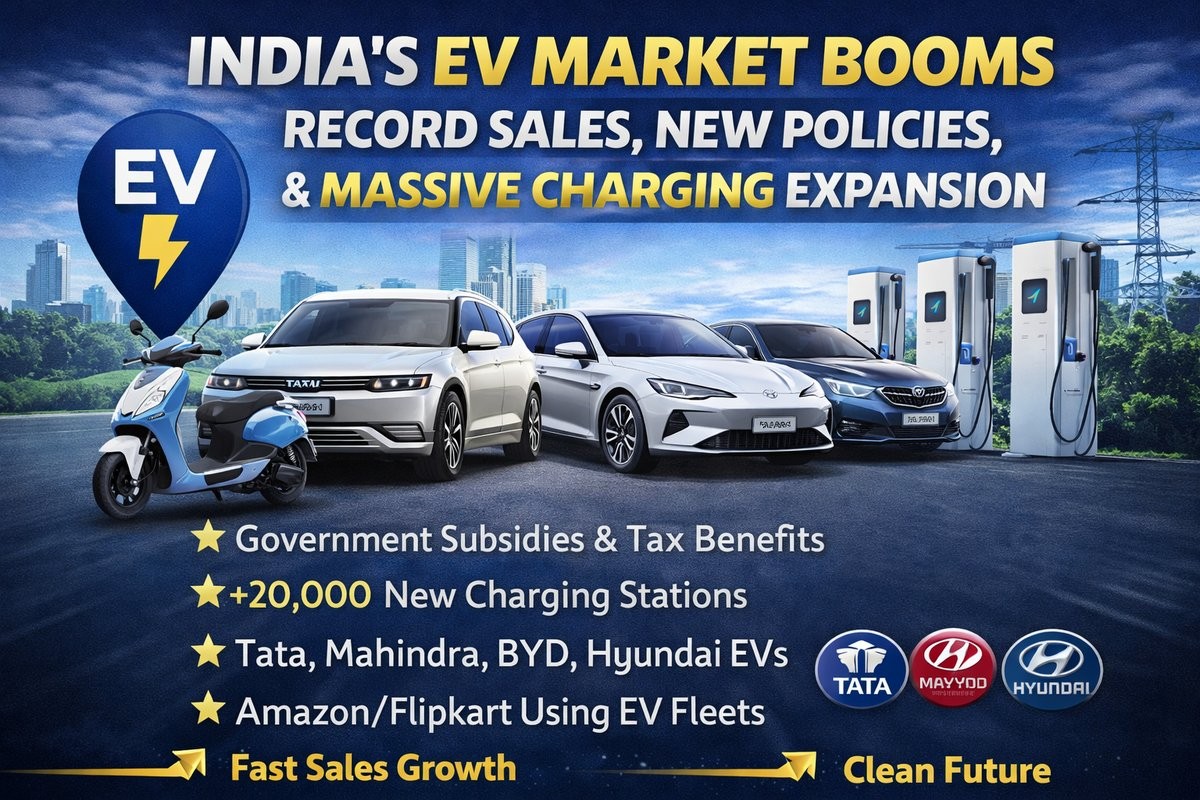
India’s electric vehicle (EV) industry is witnessing rapid growth as new government policies, rising investments, and increasing consumer demand continue to drive the transition toward clean mobility. Today’s developments reflect a strong push across multiple sectors, positioning India as one of the fastest-growing EV markets globally.
nn
Record Growth in EV Sales
nn
The EV market in India has recorded a significant rise in sales over the past few months. Electric two-wheelers, cars, and commercial vehicles are seeing increasing adoption as consumers look for cost-effective and environmentally friendly alternatives.
nn
Industry data shows that EV sales have grown sharply compared to last year, with electric scooters leading the market. The demand for electric cars is also increasing steadily, especially in urban areas.
nn
This growth is driven by multiple factors, including rising fuel prices, improved battery technology, and increased awareness about sustainability.
nn
Government Push Strengthens EV Ecosystem
nn
The Indian government continues to play a key role in promoting electric mobility. New initiatives announced today aim to make EVs more affordable and accessible across the country.
nn
These initiatives include:
nn
- n
- Enhanced subsidies for EV buyers
- Tax benefits for electric vehicle purchases
- Support for domestic battery manufacturing
- Incentives for setting up charging infrastructure
n
n
n
n
nn
The focus is not only on increasing adoption but also on building a strong domestic EV ecosystem.
nn
Massive Expansion of Charging Infrastructure
nn
One of the biggest developments today is the announcement of a large-scale expansion of EV charging infrastructure across India.
nn
The government and private companies are planning to install over 20,000 new charging stations in the next phase. These stations will be strategically located in cities, highways, and rural areas.
nn
Fast-charging technology is also being introduced to reduce charging time significantly, making EVs more convenient for long-distance travel.
nn
Battery swapping stations are gaining popularity, especially for electric scooters and commercial vehicles, offering quick and efficient energy solutions.
nn
Automakers Increase EV Launches
nn
Automobile companies are accelerating their EV strategies with new launches and product upgrades.
nn
Tata Motors continues to lead the Indian EV market with new variants and improved battery performance. The company is focusing on making EVs affordable for mass adoption.
nn
Mahindra Electric is expanding its EV lineup with premium models featuring advanced technology and higher range.
nn
Global players such as BYD, Hyundai, and Kia are also increasing their presence in India with new electric vehicles tailored to Indian consumers.
nn
The growing competition is expected to improve product quality and reduce prices over time.
nn
Electric Two-Wheelers Lead the Market
nn
Electric two-wheelers continue to dominate the EV market in India. Their low cost and ease of use make them a popular choice among daily commuters.
nn
Companies like Ola Electric, Ather Energy, and TVS Motor Company are seeing strong demand for their products. These scooters offer smart features, longer battery life, and low maintenance costs.
nn
The segment is expected to grow even faster in the coming years.
nn
Corporate Sector Accelerates EV Adoption
nn
The corporate sector is playing a major role in driving EV adoption. E-commerce and logistics companies are transitioning to electric fleets to reduce operational costs and meet sustainability targets.
nn
Companies like Amazon and Flipkart are expanding their electric delivery networks across India. This shift is expected to significantly reduce carbon emissions and fuel expenses.
nn
Ride-hailing services are also exploring electric vehicles as part of their long-term strategies.
nn
Advancements in Battery Technology
nn
Battery technology remains a key factor in EV growth. Today’s updates highlight ongoing advancements in battery efficiency, safety, and charging speed.
nn
Solid-state batteries are being developed to offer higher energy density and faster charging. Indian startups are also contributing to innovation by creating cost-effective solutions.
nn
These advancements are expected to make EVs more affordable and practical for a wider audience.
nn
Environmental Impact and Sustainability
nn
The transition to electric vehicles is essential for reducing pollution and achieving sustainability goals. EVs produce zero tailpipe emissions, helping improve air quality in urban areas.
nn
India aims to reduce its dependence on fossil fuels and lower greenhouse gas emissions through increased EV adoption.
nn
The shift toward clean energy is expected to have long-term benefits for both the environment and public health.
nn
Challenges Still Exist
nn
Despite the positive developments, several challenges remain:
nn
- n
- High initial cost of EVs
- Limited charging infrastructure in remote areas
- Dependence on imported battery materials
- Lack of awareness among rural consumers
n
n
n
n
nn
Addressing these challenges will be crucial for achieving widespread adoption.
nn
Future Outlook
nn
The future of India’s EV market looks highly promising. With strong policy support, technological advancements, and increasing investments, the sector is expected to grow rapidly.
nn
By 2030, electric vehicles are likely to account for a significant share of total vehicle sales in India.
nn
Continuous innovation and infrastructure development will play a key role in shaping the future of mobility.
nnn
Today’s developments highlight the rapid progress of India’s electric vehicle industry. With increasing sales, new policies, and expanding infrastructure, the country is moving toward a cleaner and more sustainable transportation system.
nn
The EV revolution in India is gaining strong momentum, and the coming years are expected to bring even greater advancements and opportunities in this space.