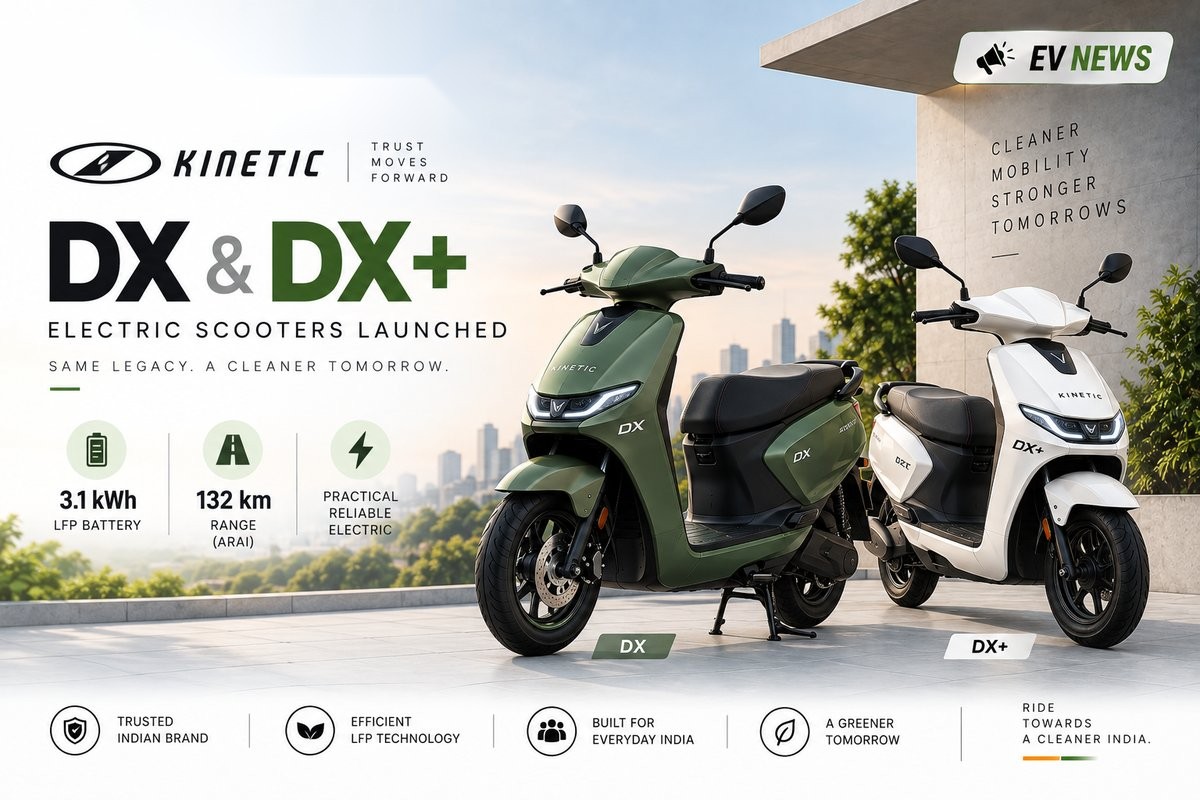
Kinetic has expanded its DX electric scooter lineup with a pair of larger-battery variants, and this update is worth paying attention to for a specific reason: it’s a direct response to one of the most consistent criticisms the DX family received when it first launched. The original DX and DX+ came with a 2.6kWh battery good for a real-world range of under 100km — perfectly workable for short city hops, but genuinely tight for anyone with a longer daily commute. Kinetic has now addressed that head-on with new 3kWh and 3.1kWh battery options, sold alongside the existing smaller-battery versions rather than replacing them outright.
Two New Variants, Two Different Prices
The base DX now gets a 3kWh battery option, priced at ₹1.19 lakh (ex-showroom) — a fairly modest ₹7,000 more than the existing 2.6kWh DX. The bigger news sits with the range-topping DX+, which now offers a larger 3.1kWh battery, priced at ₹1.28 lakh (ex-showroom), just ₹6,476 more than the existing DX+ 2.6kWh. In both cases, Kinetic has kept the price increase for the extra battery capacity genuinely small, which is a fairly buyer-friendly way to handle this kind of lineup expansion — you’re not being asked to pay a steep premium just to get meaningfully more range.
The Headline Number: 132km
The new DX+ 3.1kWh is the star of this update, claiming an IDC-certified range of up to 132km — a genuinely significant jump from the existing DX+’s 105km figure. Kinetic itself has been upfront about what that translates to in the real world, estimating actual usable range at around 105-110km, which is a fair and honest gap between the certified and real-world numbers rather than an unrealistically rosy claim.
The Trade-Off Nobody’s Headlining: Less Power, One Fewer Mode
Here’s the part of this story that’s easy to miss if you only skim the range figures, and it’s genuinely worth knowing before you decide which variant to buy. The new DX+ 3.1kWh actually has a less powerful motor than the outgoing 2.6kWh version — a 3.8kW peak-power hub-mounted BLDC motor, down from the previous 4.78kW unit. That’s not a small drop, and it comes with a related change: the new 3.1kWh version loses the Turbo riding mode entirely, retaining only Range and Power modes, where the older battery variant offered all three.
It’s a genuinely reasonable engineering trade-off — Kinetic has clearly prioritised range and everyday usability over outright punch for this variant — but it does mean the new bigger-battery DX+ isn’t a straightforward upgrade in every dimension. If you specifically valued the older DX+’s stronger motor output or its Turbo mode for quicker overtakes, that’s something you’d be giving up in exchange for the extra range. For most buyers whose main complaint was range anxiety rather than outright performance, that trade will likely feel like an easy one to make — but it’s worth going in with eyes open.
What Ajinkya Firodia Had to Say
— Ajinkya Firodia, Managing Director and Vice Chairman, Kinetic EV
That framing around the Kinetic name’s legacy isn’t just marketing flourish — it’s a genuinely meaningful part of this scooter’s identity. The Kinetic name carries real nostalgic weight in India, tied to generations of riders’ memories of the brand’s earlier petrol-powered scooters, and the DX’s design leans directly into that heritage rather than chasing a more futuristic EV aesthetic.
Design: Still the Iconic Metal Body
Both new variants retain the DX family’s signature all-metal body construction — a deliberate design choice that sets it apart from the plastic-bodied construction most rivals in this segment use, and one that ties directly back to the nostalgia Firodia’s comments lean on. It’s a build approach that trades some weight for a more solid, durable feel, and it’s clearly central to how Kinetic wants this scooter to be perceived against newer, more plastic-heavy competitors.
Battery Chemistry: A Genuine Upgrade Worth Understanding
Both new battery options use LFP (Lithium Iron Phosphate) chemistry, a detail that matters beyond just the bigger capacity number. LFP batteries are generally recognised for offering better thermal stability and a longer overall lifecycle compared to more conventional lithium-ion chemistries — meaning the new DX and DX+ variants aren’t just carrying more energy, they’re likely to hold up better over years of daily charging cycles too.
Features Carried Over
- K-Coast Tech: Kinetic’s proprietary regenerative braking system, recovering energy during deceleration to help extend real-world range across both Range and Power modes.
- Easy Charge system: A retractable charging cable built into the scooter, letting owners charge without carrying a separate cable around.
- Park Assist and Reverse: Genuinely useful conveniences for manoeuvring in tight parking spots.
- IP67 protection: Dust and water ingress protection for the electricals, a meaningful reassurance given how much of India’s riding happens through monsoon conditions.
- Telematics: Included as standard as part of the vehicle price, rather than being locked behind a separate subscription.
Full Spec Sheet: DX+ 3.1kWh
| Specification | Detail |
|---|---|
| Battery | 3.1 kWh LFP |
| Motor | 3.8 kW peak power, hub-mounted BLDC |
| Claimed IDC Range | 132 km |
| Estimated Real-World Range | 105-110 km |
| Riding Modes | Range, Power (no Turbo) |
| Front Brake | 220 mm disc |
| Rear Brake | 130 mm drum |
| Ground Clearance | 165 mm |
| Seat Height | 714 mm |
| Wheelbase | 1,315 mm |
| Tyres (Front/Rear) | 100/80 section, both ends |
| Ingress Protection | IP67 |
| Price (Ex-Showroom) | ₹1.28 lakh |
Festive Offers
Alongside the launch, Kinetic has rolled out a set of festive incentives across the DX range: ₹2,000 cash benefit on the DX 3kWh, ₹3,000 cash benefit on the Kinetic DX+, an ₹8,999 extended warranty offer on the DX+, and a ₹5,000 Amazon cashback. Worth checking with your local dealer on which of these are still active and how they stack, since festive offers like these typically run for a limited window.
What This Means for Buyers Choosing Between Variants
With four battery options now sitting across the DX and DX+ range — 2.6kWh, 3kWh, 3.1kWh, and the older DX+ 2.6kWh trim — the decision genuinely comes down to what you value more: outright performance and Turbo mode, or the extra breathing room in daily range. If your commute regularly pushes past 60-70km round trip, the new 3.1kWh DX+ is a meaningfully more relaxed proposition than the older 2.6kWh version. If your rides are shorter and you occasionally want the extra punch of Turbo mode for quick overtakes, sticking with the existing 2.6kWh variant, or simply the base 3kWh DX, may still make sense.
Bigger Picture: Kinetic’s Export Ambitions
This update also lands alongside a broader strategic push for Kinetic. The company is reportedly evaluating exporting the DX, manufactured in India, to as many as seven overseas markets. A stronger-range variant fits neatly into that ambition — a scooter with genuinely competitive range figures makes a considerably stronger case internationally than one still tied to a sub-100km real-world figure, and this update looks very much like Kinetic shoring up its domestic product before taking that step abroad.
Autocar India · BikeDekho · ZigWheels · RushLane · BikeAdvice · GaadiKey · AutoGuideIndia · ThrustZone