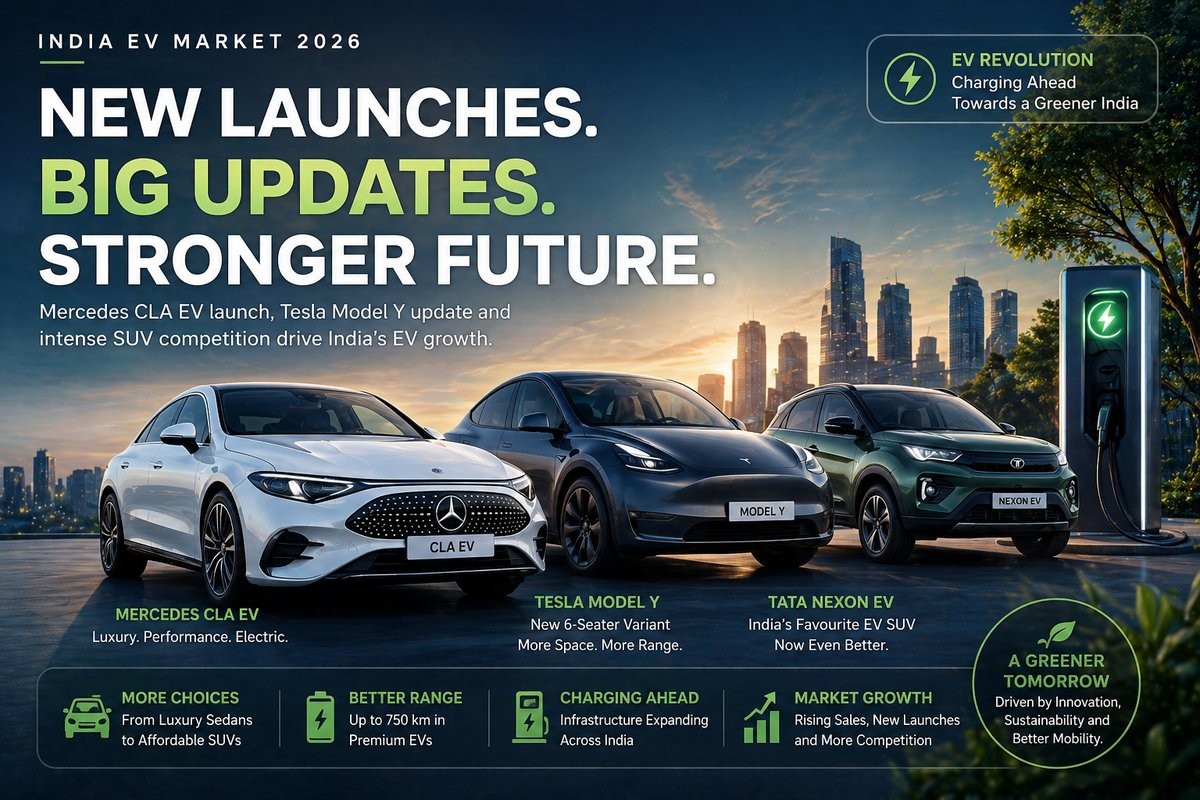
India’s electric vehicle (EV) market is witnessing one of its most dynamic phases in 2026, with major global and domestic automakers launching new models, updating existing lineups, and aggressively competing across price segments. From premium electric sedans to affordable compact SUVs, the latest developments show that the EV industry is moving rapidly toward mainstream adoption.
nn
Recent launches such as the Mercedes-Benz CLA Electric and updates like Tesla’s new Model Y variant highlight how manufacturers are targeting both luxury and family buyers. At the same time, competition in the mid-range SUV segment continues to intensify with models from Tata, Mahindra, Hyundai, and MG.
nn
Mercedes-Benz CLA Electric Officially Launched
nn
Mercedes-Benz has launched its most affordable electric car in India, the CLA EV, marking a major step in bringing premium EV technology to a wider audience. The model is available in multiple variants, offering both standard and long-range configurations.
nn
The CLA EV is positioned as an entry-level luxury electric sedan and features advanced design, premium interiors, and high-end technology. The launch has already generated strong interest among buyers, with early bookings showing positive demand.
nn
With this launch, Mercedes-Benz aims to strengthen its presence in India’s growing premium EV segment and compete with other global brands offering electric sedans.
nn
Tesla Expands Lineup with New Model Y Variant
nn
Tesla has also made headlines by introducing a new six-seater version of its Model Y in India. The updated version focuses on practicality and family usage, offering more seating capacity and improved range.
nn
The new Model Y variant delivers a range of around 680 km and is designed to appeal to premium SUV buyers looking for space, performance, and advanced technology.
nn
However, Tesla continues to face challenges in India due to high import duties, which significantly increase vehicle prices compared to other markets.
nn
Despite these challenges, Tesla’s presence is expected to push other automakers to improve their offerings in the premium EV space.
nn
Premium EV Comparison: CLA EV vs BYD Seal
nn
The launch of the CLA EV has intensified competition in the premium electric sedan segment. One of its key rivals is the BYD Seal, which offers strong performance and competitive pricing.
nn
| Feature | Mercedes CLA EV | BYD Seal |
|---|---|---|
| Price | ₹55–64 Lakh | ₹45–55 Lakh |
| Range | Up to ~750 km | ~570 km |
| Segment | Luxury Sedan | Premium Sedan |
| Features | Premium interiors, advanced tech | High performance, value pricing |
nn
This comparison highlights the growing competition between global luxury brands and emerging EV manufacturers. While Mercedes focuses on premium experience, BYD emphasizes value and performance.
nn
Mid-Range Electric SUV Segment Becomes Battlefield
nn
While premium EVs attract attention, the real competition in India lies in the mid-range SUV segment. This category is seeing rapid growth due to increasing demand from urban families and first-time EV buyers.
nn
Popular and upcoming models in this segment include Tata Nexon EV, Mahindra BE series, Hyundai Creta EV, and Maruti eVitara. These vehicles offer a balance of affordability, range, and features.
nn
Typical pricing in this segment ranges between ₹15 lakh and ₹30 lakh, making it accessible to a larger audience compared to luxury EVs.
nn
Electric SUV Comparison: Nexon EV vs Creta EV vs eVitara
nn
| Feature | Tata Nexon EV | Hyundai Creta EV | Maruti eVitara |
|---|---|---|---|
| Price | ₹13–18 Lakh | ₹20–25 Lakh | ₹22–28 Lakh |
| Range | ~465 km | ~400–450 km | Up to ~550 km |
| Segment | Compact SUV | Mid SUV | Mid SUV |
| Target Buyers | Budget EV buyers | Premium mid-range buyers | Tech-focused buyers |
nn
This comparison clearly shows how automakers are targeting different customer groups within the same segment. Tata focuses on affordability, Hyundai on premium features, and Maruti on efficiency and range.
nn
Upcoming EV Launches Add More Excitement
nn
The Indian EV market is not slowing down, with several new launches expected in the coming months. Upcoming models include the Toyota Urban Cruiser Electric, Tata Sierra EV, and Tata Safari EV.
nn
These vehicles are expected to offer improved battery technology, longer driving range, and enhanced features, further strengthening the EV ecosystem.
nn
New entrants are also preparing to launch electric MPVs and SUVs, increasing competition across segments.
nn
Technology Advancements Driving EV Growth
nn
One of the key factors behind the rapid growth of EVs is continuous technological advancement. Battery technology is improving, allowing vehicles to offer longer range and faster charging.
nn
Modern EVs now come equipped with advanced features such as connected car technology, digital dashboards, and driver assistance systems.
nn
Fast-charging capabilities are also improving, with many vehicles now capable of charging from 10% to 80% in under an hour.
nn
EV Market Growth and Sales Trends
nn
India’s EV market is growing steadily, with increasing adoption across both personal and commercial segments. Electric car sales have shown consistent growth, supported by new product launches and competitive pricing.
nn
Affordable models are helping expand the market by targeting budget-conscious buyers.
nn
At the same time, premium models from global brands are attracting high-end customers, creating a balanced market structure.
nn
Challenges in the EV Ecosystem
nn
Despite strong growth, the EV market faces several challenges. High upfront costs remain a major concern for many buyers, especially in the premium segment.
nn
Charging infrastructure is also still developing, particularly in smaller cities and rural areas. This creates concerns about convenience and long-distance travel.
nn
Automakers and government agencies are working together to address these challenges by expanding charging networks and introducing incentives.
nn
Changing Consumer Preferences
nn
Consumer preferences are evolving as more people become aware of the benefits of electric vehicles. Buyers are now considering factors such as running costs, environmental impact, and long-term savings.
nn
The availability of more models and improved technology is also making EVs a more attractive option.
nn
As a result, demand for electric vehicles is becoming more consistent throughout the year.
nn
Future Outlook for EV Market
nn
The future of India’s EV market looks promising, with strong growth expected in the coming years. More affordable models, better infrastructure, and continued innovation will drive adoption.
nn
Competition among automakers will continue to increase, leading to better products and more options for consumers.
nn
The combination of premium launches and mass-market vehicles will play a key role in shaping the future of electric mobility in India.