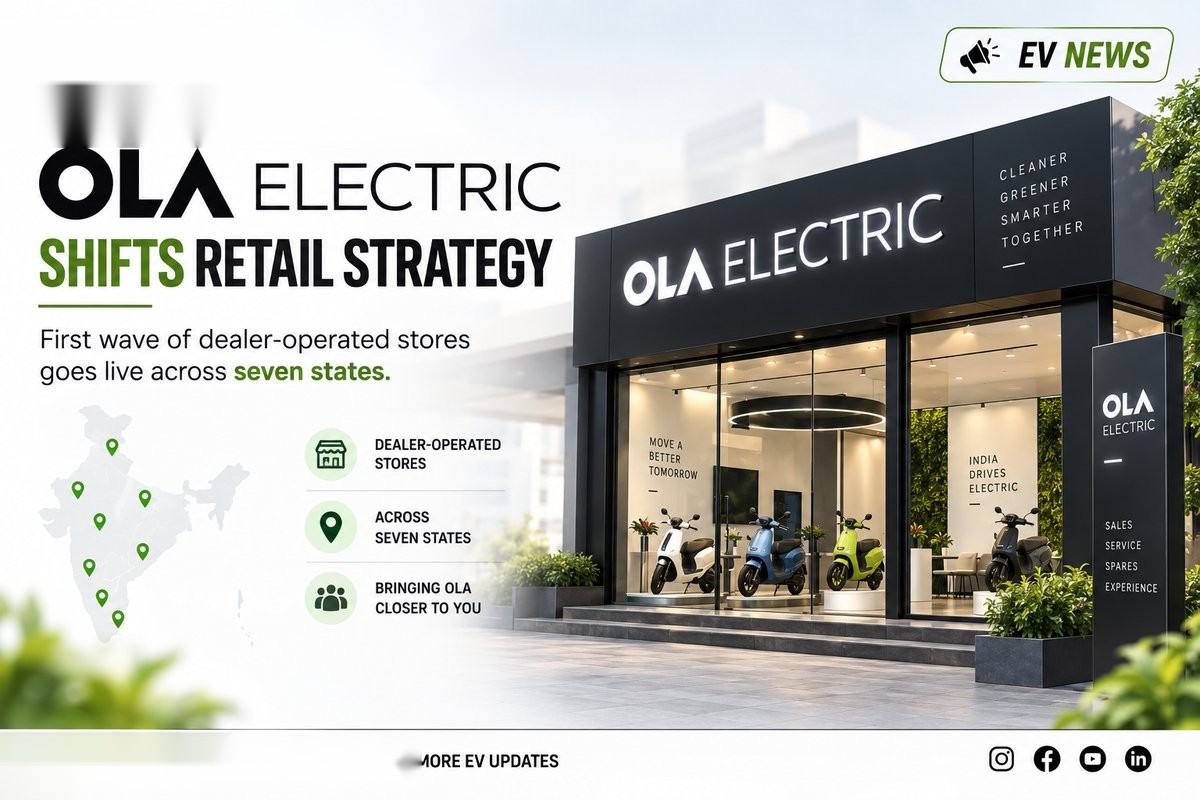
Ola Electric has opened its first cohort of dealer-operated stores, going live across seven states in a move the company is calling a structural shift in its retail strategy. What makes this particularly notable isn’t just the change itself — it’s the speed at which it’s happened. Ola only opened its sales and service network to dealer partners for the first time on August 6, 2026. Less than a month later, the first partner stores are already open and serving customers, a genuinely fast turnaround for a change of this scale.
Where the New Stores Are Opening
The first wave of dealer-operated outlets is now live in cities and towns across seven states: Rajasthan, Tamil Nadu, Maharashtra, Bihar, Telangana, Uttar Pradesh, and Madhya Pradesh. These aren’t concentrated in a single region either — the spread deliberately covers a genuinely wide geographic and demographic mix, from established EV markets in the south to less penetrated territory further north, suggesting this is meant to be a genuinely nationwide push rather than a limited regional pilot.
Why Ola Is Making This Change Now
For its first five years in business, Ola Electric built its retail presence almost entirely through company-owned stores — a strategy that made sense in the early days of establishing a brand new company in a category that barely existed in India before Ola helped popularise it. That strategy has clearly run its course, at least in Ola’s own telling.
— Manoj Murali, Chief Business Officer, Ola Electric
Under the new model, dealers take over local sales and service responsibilities, while Ola’s existing company-owned outlets will gradually transition into what the company is calling “product experience centres” — spaces focused on showcasing the brand and its vehicles rather than handling day-to-day transactions and servicing.
The Business Logic: Cost, Reach, and Something More Urgent
On the surface, the rationale here is fairly standard playbook stuff for a company scaling distribution — a partner-led model lets Ola expand into more cities and smaller towns without carrying the capital cost of setting up and running every single store itself. Dealers bring their own local market knowledge, existing customer relationships, and crucially, their own capital to the table, which should let Ola grow its physical footprint considerably faster than it could by continuing to fund and staff every outlet on its own books.
There’s already a number attached to this that’s worth taking seriously: Ola has stated its average service turnaround time has fallen substantially, from roughly nine days in October 2025 down to almost a single day by March 2026. If that improvement holds up and extends further under the new dealer-led model, it would directly address one of the most persistent criticisms levelled at the company by its own existing customers.
The Scale of the Ambition
This isn’t a small, cautious pilot program. Ola is targeting a network of more than 500 dealerships within the next two quarters — a genuinely aggressive expansion timeline for a retail model that’s been live for less than a month. Dealers interested in joining the network can apply directly through the company’s partner portal, which Ola has set up specifically for this rollout.
| Detail | Information |
|---|---|
| Dealer network opened to partners | August 6, 2026 |
| First partner stores went live | September 4, 2026 |
| States covered (first cohort) | Rajasthan, Tamil Nadu, Maharashtra, Bihar, Telangana, Uttar Pradesh, Madhya Pradesh |
| Target dealership count | 500+ within 2 quarters |
| Existing customer base cited | Over 10 lakh riders |
| Service turnaround improvement cited | ~9 days (Oct 2025) → ~1 day (Mar 2026) |
| Entry-level model cited | Ola S1Z, from ₹79,999 |
What Happens to Ola’s Existing Stores
Ola’s current network of company-owned outlets isn’t being shut down — it’s being repurposed. As the dealer-led network scales up and takes over the actual business of selling and servicing vehicles, existing company-owned locations are expected to shift toward functioning as brand and product experience centres instead: places built around showcasing Ola’s vehicles and building brand engagement, rather than handling the transactional side of the business. It’s a fairly common pattern for companies moving from a direct-to-consumer retail model toward a franchise or dealer-led one, letting the original stores keep doing what they arguably do best — building brand presence in key markets — while offloading the more capital- and labour-intensive parts of the business to partners.
Broader Financial Context
This retail overhaul isn’t happening in isolation from the rest of Ola Electric’s business. Around the same period as this announcement, the company also secured ₹95.8 crore under India’s PLI (Production Linked Incentive) scheme, part of the broader government push to boost domestic manufacturing of EV components. Taken together, the dealer network expansion and the PLI disbursement paint a picture of a company trying to strengthen its position on multiple fronts simultaneously — deepening its domestic manufacturing incentives on one side while fundamentally restructuring how it reaches and serves customers on the other.
Why This Matters for India’s EV Two-Wheeler Market
Ola Electric has been one of the most visible names in India’s electric two-wheeler story, and its retail model — fully company-owned from day one — was itself something of a distinguishing feature compared to rivals like TVS, Bajaj, and Hero, all of whom have long relied on established dealer networks built up over decades of selling petrol vehicles. Ola’s pivot toward a dealer-led model now brings it structurally closer to how its more traditional competitors already operate, which raises a genuinely interesting question: was the company-owned model always meant to be a temporary, brand-building phase, or is this shift a response to real operational strain that Ola’s own direct retail approach simply couldn’t keep up with as the company scaled? Based on the company’s own commentary around service turnaround times, it looks like at least part of the answer is the latter.
What Happens Next
With the first cohort of dealer stores now live and serving customers, the real test over the coming two quarters will be whether Ola can actually hit its 500-dealership target, and — more importantly for existing and prospective customers — whether the promised service improvements hold up as the network scales well beyond these initial seven states. A fast rollout is one thing; consistent execution across hundreds of independently run dealer locations is a considerably harder thing to sustain.
Business Standard · Inc42 · Daily Excelsior · StartupTalky · Electrical Mirror · EVSHIFT (ETAuto) · InvestyWise · Hello Entrepreneurs