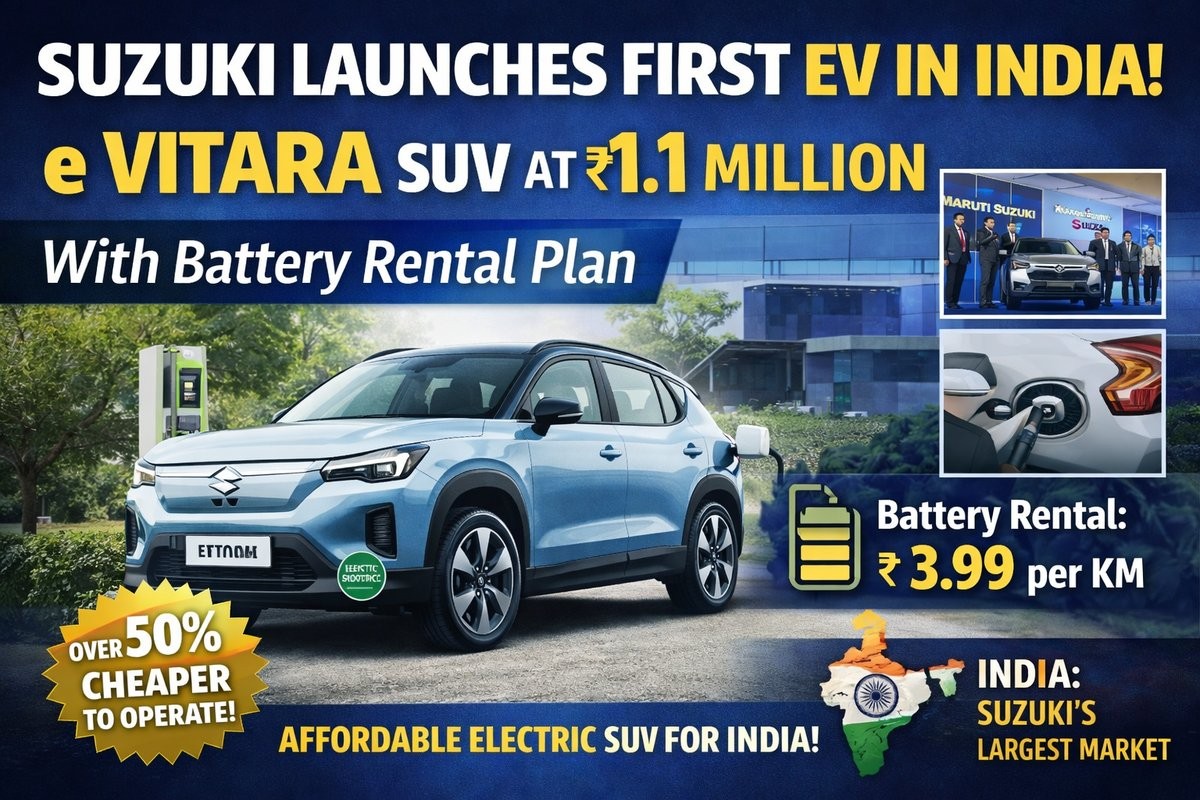
Suzuki Motor has officially entered India’s fast-growing electric vehicle market with the launch of its first EV, the e VITARA SUV. The model has been introduced by its Indian subsidiary Maruti Suzuki at an introductory base price of ₹1.1 million (approximately $12,100), making it one of the most competitively priced electric SUVs in the country.rnrnIndia is Suzuki’s largest global market and the world’s third-largest automobile market, making this launch strategically significant. The e VITARA has been developed in collaboration with Toyota Motor Corporation under a global model-sharing partnership. Production began in India in August last year, and in 2025 alone, about 13,000 units were exported to 28 countries.rnrnA key highlight of the launch is the introduction of a battery rental plan, designed to lower the upfront purchase cost for buyers. Under this model, customers will pay ₹3.99 per kilometre for battery usage. This “battery as a service” approach shifts the expensive battery component away from the purchase price, making the EV more accessible to cost-sensitive Indian consumers.rnrnAnalysts believe the pricing strategy could significantly disrupt the segment. Gaurav Vangaal of S&P Global Mobility noted that Maruti Suzuki has historically reshaped segments it enters and that the battery rental model could draw strong showroom traffic. According to estimates, the per-kilometre operating cost of the e VITARA could be roughly 50% lower than that of a comparable internal combustion engine SUV.rnrnThe launch comes more than a year after the vehicle was first unveiled, as the company worked to address customer concerns around charging infrastructure and high battery import costs. With infrastructure gradually improving and EV adoption gaining momentum, Suzuki appears confident about timing its entry now.rnrnBattery rental models are not entirely new in India. SAIC Motor’s Indian venture, JSW MG Motor India, introduced a similar scheme in 2023. However, Suzuki’s scale and dominance in the small car segment could bring the concept to a much wider audience.rnrnElectric vehicle sales in India are accelerating, supported by launches from Tata Motors, Hyundai Motor Company, Mahindra & Mahindra, and Tesla over the past year. EVs accounted for about 5% of India’s total car sales in 2025, nearly doubling from the previous year. The Indian government has set an ambitious target for EVs to represent 30% of all car sales by 2030.rnrnFollowing the pricing announcement, Maruti Suzuki’s shares rose as much as 1.1% before closing 0.6% higher, reflecting investor optimism about the company’s electric transition strategy.rnrnThe launch of the e VITARA marks a critical milestone for Suzuki as it transitions from its traditional strength in affordable combustion-engine vehicles to the rapidly expanding electric mobility segment.