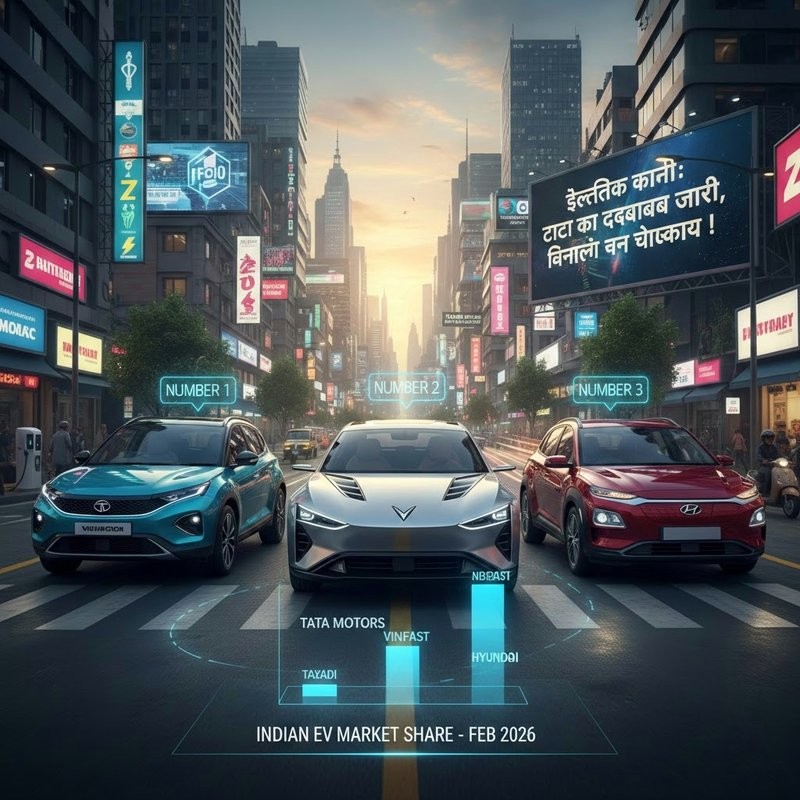
The Indian electric vehicle (EV) market is witnessing one of its most competitive phases yet in mid-February 2026. Latest retail registration data shows a fierce battle for market share, with established players defending their turf while new entrants rapidly gain ground. While Tata Motors continues to lead the segment, Vietnamese automaker VinFast has emerged as the biggest disruptor — overtaking Hyundai Motor India for the second consecutive month to secure the second position.rnrnTata Motors Strengthens Its Grip:rnrnTata Motors has retained its leadership position in India’s EV market, supported by a diversified product portfolio spanning hatchbacks, compact SUVs, and fleet-oriented offerings. Its strong brand recall, widespread dealership network, and expanding charging partnerships have helped the company maintain consistent retail momentum.rnrnIndustry analysts note that Tata’s early mover advantage in the mass-market EV category continues to pay dividends. Competitive pricing, localisation of battery packs, and after-sales service reach have reinforced consumer confidence, particularly among first-time EV buyers.rnrnVinFast’s Rapid Rise:rnrnThe real headline, however, belongs to VinFast. The Vietnamese EV manufacturer has quickly carved out a substantial presence in India within months of its official launch. Surpassing Hyundai for the second month in a row signals not just a temporary spike but a potentially sustained upward trajectory.rnrnVinFast’s rapid growth is attributed to aggressive pricing strategies, feature-loaded models, and an ambitious rollout of charging infrastructure in partnership with private operators. The company has focused heavily on urban centres and high-growth Tier-1 cities, targeting tech-savvy consumers seeking premium design and advanced connectivity features.rnrnMarket observers also highlight VinFast’s ability to localise assembly operations quickly, which has allowed it to keep costs competitive while responding rapidly to demand fluctuations.rnrnHyundai Faces Growing Pressure:rnrnHyundai, long considered one of India’s most reliable automotive brands, has now slipped to third position in the EV rankings. While its EV models continue to enjoy strong brand value and technological credibility, intensifying competition and aggressive pricing from rivals have put pressure on its market share.rnrnHyundai is expected to respond with refreshed product launches, expanded localisation, and possible price recalibrations in the coming quarters. Industry insiders suggest that 2026 could see Hyundai accelerating its EV roadmap to regain lost ground.rnrnMarket Expansion Fuels Competition:rnrnThe broader Indian EV market continues to expand at a robust pace. Rising fuel prices, enhanced charging infrastructure, and increasing consumer awareness about sustainability are driving demand across passenger vehicles, two-wheelers, and commercial segments.rnrnGovernment incentives under national and state EV policies, tax benefits, and support for domestic manufacturing are further accelerating adoption. Financial institutions are also offering attractive EV financing schemes, making electric mobility more accessible to middle-income buyers.rnrnFleet electrification — particularly in ride-hailing, last-mile delivery, and corporate mobility programs — is adding significant volumes to overall sales. This steady demand is creating room for new entrants while intensifying rivalry among established brands.rnrnInnovation and Pricing at the Core:rnrnWhat makes 2026 particularly exciting is the combination of innovation and affordability. Automakers are competing not only on price but also on:rnrn* Battery range and efficiencyrn* Advanced driver-assistance systems (ADAS)rn* Connected vehicle technologyrn* Faster charging capabilitiesrn* Extended warranty packagesrnrnThis competitive pressure is benefiting consumers through better features, improved quality, and more aggressive pricing.rnrnA Transformative Year Ahead:rnrnThe mid-February 2026 snapshot signals that the Indian EV market is entering a transformative phase. Tata Motors continues to hold the crown, but VinFast’s meteoric rise indicates that the competitive landscape is far from settled. Hyundai’s repositioning efforts and potential new launches could further intensify the battle in the coming months.rnrnWith global players expanding their footprint and domestic manufacturers doubling down on innovation, 2026 is shaping up to be a defining year for India’s electric mobility journey. The race is no longer just about sales numbers — it is about technological leadership, cost efficiency, infrastructure expansion, and long-term brand dominance in one of the world’s fastest-growing EV markets.