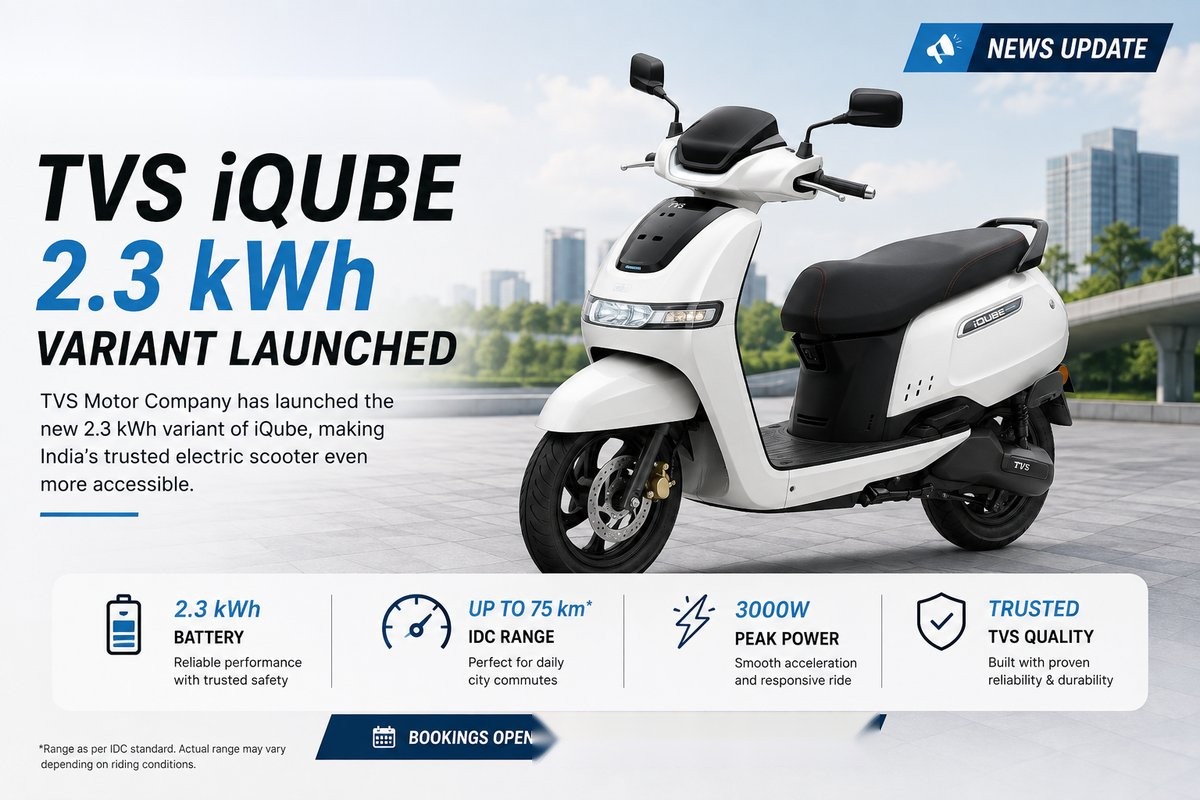
TVS has updated the base variant of its iQube electric scooter, and while it’s not the kind of launch that comes with a big press event, it’s a genuinely useful update for anyone who’s been eyeing the entry-level iQube. The scooter’s smallest battery pack has grown from 2.2kWh to 2.3kWh, replacing the older base variant outright, and with it comes a small but noticeable set of changes — some good, one arguably not so much.
Price: A Modest Bump
The new iQube 2.3kWh is priced at ₹1,16,310 (ex-showroom, Delhi), which works out to just ₹988 more than the outgoing 2.2kWh variant. That’s a genuinely small increase for what buyers are getting in return, and it keeps the scooter firmly positioned as the most affordable entry point into TVS’s electric two-wheeler lineup, ahead of the 3.1kWh, 3.5kWh, iQube S, and range-topping iQube ST variants above it.
What’s Actually New
The headline change is the battery. The pack has grown from 2.2kWh to 2.3kWh, and TVS is claiming a maximum IDC (Indian Driving Conditions) range of 114km — about 20km more than what the outgoing variant offered. For a scooter aimed squarely at daily city commuters, that’s a meaningful real-world improvement, especially for buyers who were previously cutting it close on a single charge.
There’s also a shift on the instrument cluster front, and this one’s a bit of a mixed bag depending on what you valued in the outgoing model. The old TFT screen has been swapped out for a 5-inch LCD console instead. It’s not necessarily a downgrade in function — the new console still supports Bluetooth connectivity, turn-by-turn navigation, and call and SMS alerts — but TFT displays are generally seen as the more premium option, so buyers coming from the older variant, or cross-shopping against rivals with TFT screens, may notice the difference.
Charging time has stretched out slightly too. The new 2.3kWh variant takes 2 hours 50 minutes to charge from 0-80% using the standard 950W charger, about 5 minutes longer than before. It’s a small enough difference that it’s unlikely to change anyone’s daily routine, but worth knowing if you’re comparing charge times closely against rivals.
Full Spec Sheet: 2.3kWh Variant
| Specification | Detail |
|---|---|
| Battery | 2.3kWh Li-ion (up from 2.2kWh) |
| Motor | BLDC hub-mounted, 3.68kW peak power |
| Claimed IDC Range | 114 km (up ~20km from outgoing variant) |
| Top Speed | 68 kmph (down from 75 kmph) |
| Charging Time (0-80%) | 2 hours 50 minutes (via 950W standard charger) |
| Instrument Cluster | 5-inch LCD (replaces previous TFT unit) |
| Connectivity | Bluetooth, turn-by-turn navigation, call/SMS alerts, OTA updates |
| Price (ex-showroom, Delhi) | ₹1,16,310 |
Where It Sits in the iQube Family
TVS currently sells the iQube across six variants, and the lineup has actually grown busier this year. Alongside the refreshed 2.3kWh entry model, TVS also recently rolled out a MillionR Special Edition — priced at around ₹1.40 lakh — to mark the brand crossing one million iQube customers, featuring an exclusive Aurora Green dual-tone paint job and MillionR badging, while retaining the mid-range 3.5kWh battery pack and its claimed 145km range.
| Variant | Battery | Approx. Price (Ex-Showroom) |
|---|---|---|
| iQube 2.3 kWh | 2.3 kWh | ₹1,16,310 – ₹1,19,250 |
| iQube 3.1 kWh | 3.1 kWh | ₹1,38,495 |
| iQube MillionR Special Edition | 3.5 kWh | ₹1,40,138 |
| iQube 3.5 kWh | 3.5 kWh | ₹1,45,653 |
| iQube S | 4.7 kWh | ₹1,65,353 |
| iQube ST | 5.3 kWh | ₹1,75,599 |
Note that these are average ex-showroom figures and will vary slightly by state and city depending on local subsidies, so it’s worth checking exact on-road pricing with your nearest TVS dealership before booking.
The Bigger Picture: TVS’s EV Momentum
This update lands at a moment when TVS’s electric scooter business is genuinely firing on all cylinders. The company has sold over 3.07 lakh electric scooters between January and July 2026 alone, already on pace to surpass its entire 2025 sales figure in under eight months. With that kind of volume, even a modest refresh to the entry-level variant carries real weight — the 2.3kWh model isn’t a niche trim, it’s the version that likely accounts for a meaningful chunk of first-time EV buyers walking into TVS showrooms.
Should You Wait or Buy Now?
For most city commuters, the extra 20km of range for under a thousand rupees more is an easy call in the 2.3kWh variant’s favour — it directly addresses the range anxiety that tends to be the biggest hesitation for first-time electric scooter buyers. The reduced top speed is the only real consideration worth pausing on, and honestly, it’s unlikely to matter much if your riding is mostly stop-start city traffic rather than open highway stretches. If you specifically want a TFT display over the new LCD unit, or you were drawn to the outgoing variant’s slightly higher top speed, it may be worth checking dealer stock to see if any of the older 2.2kWh units are still available — though TVS has confirmed this new variant replaces it outright, so that window is likely closing fast.
BikeDekho · BikeWale · TVS Motor Company (official product pages) · ZigWheels