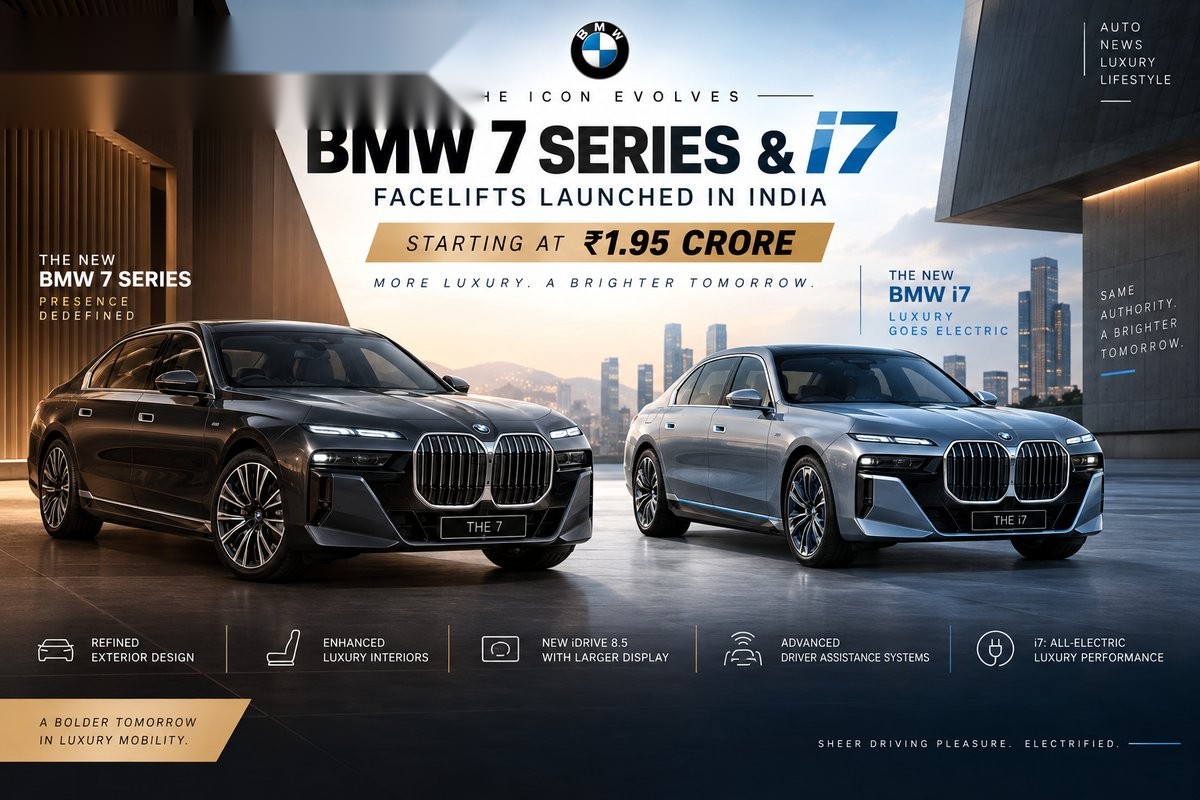
BMW India has officially launched the facelifted 7 Series and i7 range, with prices starting at ₹1.95 crore, ex-showroom. It’s a mid-life update to the G70-generation flagship sedan, arriving nearly four years after this generation first went on sale in India, and it brings a genuinely comprehensive set of changes across styling, technology, and powertrains — enough that this feels like considerably more than the usual light cosmetic refresh most facelifts amount to.
The Full Price List
BMW is offering three distinct variants at launch, and the pricing tells its own story about where the brand sees this generation heading. The petrol-powered 740 M Sport and the electric i7 eDrive50 xDrive M Sport are priced identically at ₹1.95 crore each, while the new, genuinely flagship-grade i7 M70 xDrive sits considerably higher at ₹2.65 crore. Bookings are open now, with deliveries scheduled to begin in October 2026.
| Variant | Powertrain | Price (Ex-Showroom) |
|---|---|---|
| 740 M Sport | Petrol, mild-hybrid | ₹1.95 crore |
| i7 eDrive50 xDrive M Sport | Electric | ₹1.95 crore |
| i7 M70 xDrive | Electric, dual-motor | ₹2.65 crore |
A Notable Omission: No More Diesel
Local Assembly: A Genuinely Notable Milestone for the i7
Both the 740 and the i7 eDrive50 will be locally assembled at BMW’s Chennai plant, and this matters more than it might first appear. According to reporting on the launch, this makes India only the second country outside Germany where the i7 electric sedan is being locally assembled — a genuinely significant vote of confidence in India’s manufacturing capability for a car at this price and technology tier. The range-topping i7 M70 xDrive, however, doesn’t get the same treatment: it continues to arrive in India via the CBU (Completely Built Unit) route, fully imported rather than locally assembled, which is very likely a meaningful part of why it carries a ₹70 lakh premium over the other two variants.
Design: A Thorough Visual Refresh
The exterior updates are considerably more than a token facelift’s worth of tweaks. The car picks up BMW’s Iconic Glow kidney grille, BMW Individual crystal headlights featuring genuine Swarovski elements, redesigned front and rear bumpers, flush-fitting door handles, and new tail-light graphics. M Sport variants go further still, adding sportier bumper designs, 20-inch wheels, and M Sport brakes as standard.
The i7 M70 xDrive: BMW’s Own Words, “The Most Powerful 7 Series Yet”
Battery and Range: The i7 eDrive50’s Real Upgrade
The i7 eDrive50 xDrive gets a genuinely substantial battery upgrade with this facelift, moving to a new 112.5kWh pack that pushes claimed WLTP range up to 728km — an increase of 125km over the outgoing model, and notably, that’s actually a longer claimed range than the more powerful M70 variant manages, since the eDrive50 isn’t carrying the extra weight and power draw of a second motor. Output on the eDrive50 sits at 455hp and, depending on the source, either 660Nm or 600Nm of torque (reporting varies slightly on this figure), enough for a 0-100km/h sprint in 5.5 seconds and a top speed of 210km/h.
Both electric variants support DC fast charging at up to 250kW, allowing a claimed 10-80 percent top-up in around 28 minutes. BMW is also including a complimentary 22kW wallbox charger and its installation for i7 and i7 M70 customers — a genuinely useful inclusion that removes one more logistical step from EV ownership at this level.
The Petrol 740: More Power, No Diesel Alternative
The 740 M Sport carries forward its 3.0-litre, inline-six, turbo-petrol engine paired with a 48-volt mild-hybrid system, but internal upgrades have pushed output to 400hp and 540Nm — an increase of 19hp and 20Nm over the outgoing car. Power reaches the rear wheels through an 8-speed torque-converter automatic, and BMW claims a 0-100km/h time of 5.4 seconds with an electronically limited top speed of 250km/h.
Interior: A Genuine Technology Overhaul
This is where the facelift arguably goes furthest beyond what a typical mid-life update usually covers. The cabin picks up technology clearly inspired by BMW’s newer Neue Klasse models, including a pillar-to-pillar BMW Panoramic Vision display, BMW’s Operating System X, and what BMW describes as the brand’s first-ever dedicated passenger screen — meaning front passengers now get their own display separate from the driver’s and central units, a genuinely new addition to BMW’s cabin technology across its lineup, not just this facelift.
Beyond the headline tech, the updated 7 Series and i7 come loaded with a genuinely comprehensive feature list: a 35-speaker Bowers & Wilkins surround sound system, customisable ambient lighting, powered doors, wireless Apple CarPlay and Android Auto, over-the-air software updates, a fixed panoramic glass roof, a “Boss mode” for rear-seat passengers to control the front passenger seat position, powered leg rests, Level 2 ADAS, a substantial 31.3-inch 8K rear entertainment screen, four-zone climate control, and front seats that are powered, heated, ventilated, and offer massage functionality.
How It Stacks Up Against the S-Class
The most natural comparison for the 7 Series in India remains the Mercedes-Benz S-Class, which itself received a facelift a few months before BMW’s update arrived. On pure pricing, BMW holds a meaningful edge here: the S-Class is currently priced in the ₹2.20 crore to ₹2.38 crore range in India, meaning the 2026 7 Series undercuts it by up to ₹43 lakh at the entry point — a genuinely significant gap in a segment where buyers are typically choosing based on brand loyalty and specific feature preferences as much as outright price.
Full Spec Comparison: The Three Variants
| Specification | 740 M Sport | i7 eDrive50 xDrive | i7 M70 xDrive |
|---|---|---|---|
| Powertrain | 3.0L I6 turbo-petrol, mild hybrid | Single motor, electric | Dual motor, electric |
| Power | 400 hp | 455 hp | 680 hp |
| Torque | 540 Nm | ~600-660 Nm | Up to 1,100 Nm |
| 0-100 km/h | 5.4 sec | 5.5 sec | 3.8 sec |
| Top Speed | 250 km/h | 210 km/h | 250 km/h |
| Battery | — | 112.5 kWh | 112.5 kWh |
| WLTP Range | — | 728 km | 686 km |
| Assembly | Local (Chennai) | Local (Chennai) | Imported (CBU) |
| Price (Ex-Showroom) | ₹1.95 crore | ₹1.95 crore | ₹2.65 crore |
What Happens Next
With bookings now open, the near-term milestone to watch for is deliveries, which BMW has confirmed will begin in October 2026. Given the strength of this update — particularly the i7 M70’s genuinely dramatic performance figures and the eDrive50’s substantial range increase — the more interesting longer-term question is how Mercedes-Benz responds with its own S-Class electric counterpart, the EQS, and whether BMW’s local-assembly advantage on pricing proves durable as that rivalry continues to play out in India’s still-small but closely watched ultra-luxury sedan segment.
Autocar India · CarWale · RushLane · DriveSpark · WionDrive · Auto India Daily